
Commercial vs. Household Toilet Paper: 10 Key Differences You Need to Know
Toilet paper is a necessity that is present in households, commercial offices, hotels, restaurants, shopping centers and hospitals. Although commercial toilet paper and household toilet paper serve the same basic purpose, they are designed to meet different usage requirements. Factors such as user volume, roll capacity, softness, durability, cost, storage and dispenser compatibility influence which type of toilet paper is most suitable for a particular environment.
Understanding the differences between commercial and household toilet paper can aid businesses, facility managers, and consumers in making more effective purchases. Whether supplying a busy public restroom or choosing everyday bathroom essentials for a family, making the right choice will positively impact hygiene and user satisfaction while potentially decreasing overall costs.

Understanding the Basics of Commercial Toilet Paper
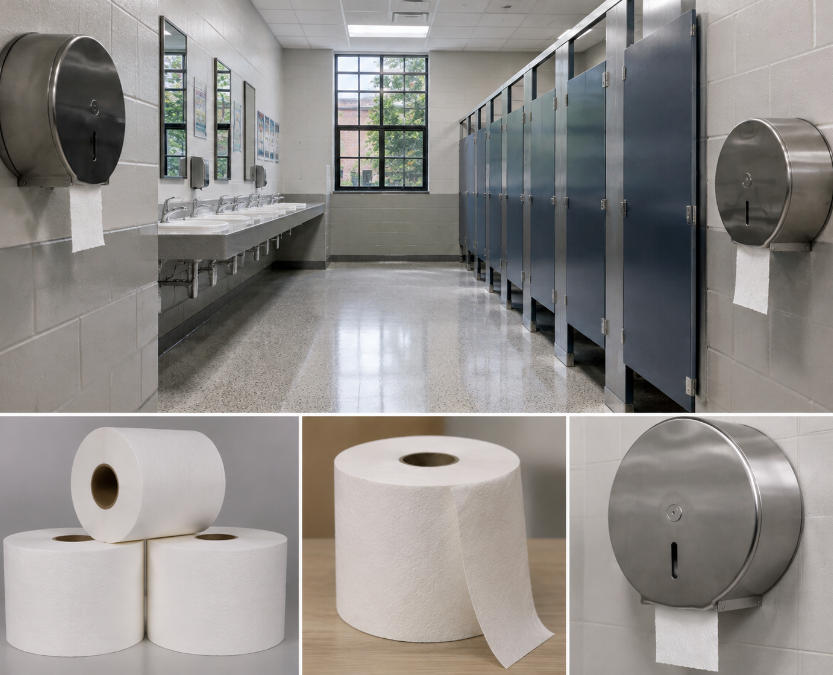
Commercial toilet paper is designed for high-use restrooms and busy locations. This toilet paper can be seen in the workplace and hospitality and educational facilities like schools, hospitals and hotels.
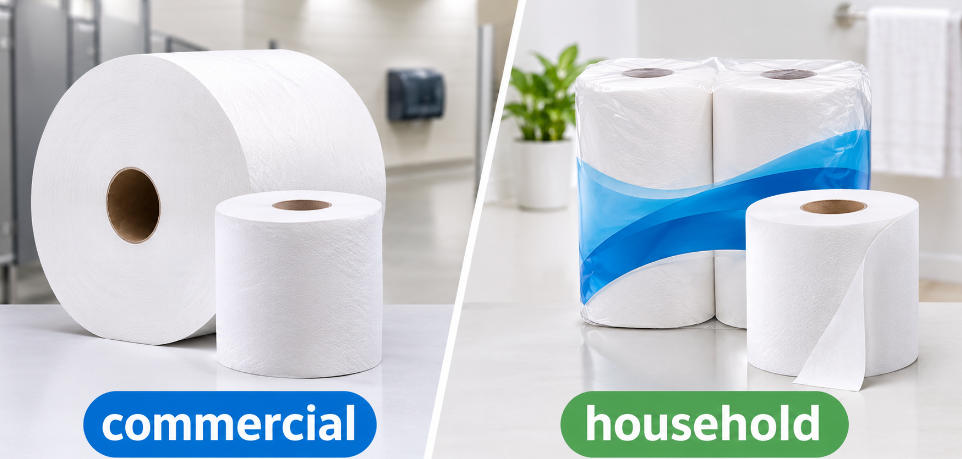
Commercial toilet paper rolls are typically much larger than household products and are often dispensed using proprietary technology. Commercial tissue papers come in an assortment of configurations of plies, roll sizes and materials, and dispensing methods. Some options are more appropriate for certain commercial uses and spaces. Standard Jumbo rolls and mini jumbo toilet rolls, coreless rolls and even folded tissue options are available to businesses for selection.
Understanding the Basics of Household Toilet Paper
Household toilet paper is usually found in retail stores and online and is available in small rolls and larger pack options.
When shopping for household toilet paper, you’ll find there is an even larger variety of products to choose from, such as lotion infused or scented options and multi-ply tissues. In fact, many brands of household toilet paper emphasize softness, comfort, thickness, and convenient packaging.
You’ll also find that household toilet paper works with most regular household toilet paper holders, and the rolls and sheet counts balance daily needs with convenience and cost.

Key Differences Between Commercial and Household Toilet Paper
1. Intended Applications
The biggest difference between commercial and household toilet paper is where it is intended for use.
One of the key applications of commercial toilet paper is high-traffic restrooms. These spaces require tissue paper to be readily available and conveniently dispensed, while balancing this need with efficient management of tissue paper consumption.
Household toilet paper is designed for bathrooms and focuses on features such as softness, comfort, and convenience.
Different circumstances require different specifications, packaging, roll size, and purchasing arrangements.
2. Roll Sizes and Capacities
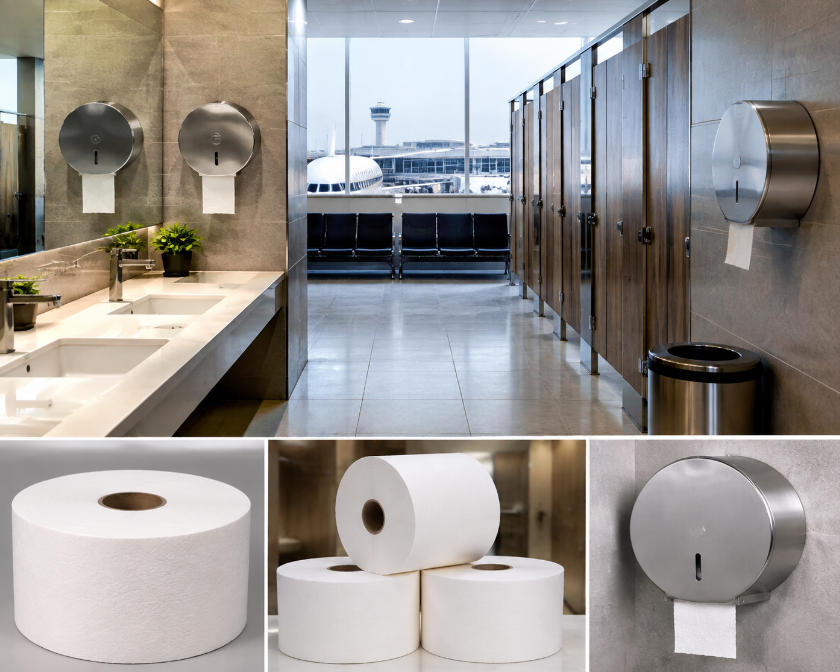
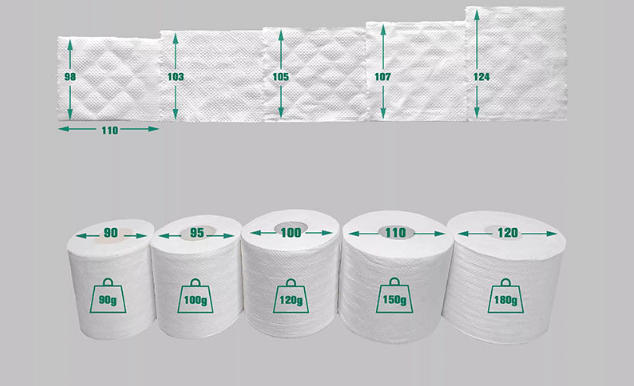
Commercial and household toilet paper can be distinguished by roll size and capacity.
Large capacity jumbo, mini jumbo, and other commercial size rolls help reduce roll replacements for a business.
Household rolls are standard-sized, easy to handle and store, and are best replaced in high-usage areas.
The following table highlights their differences:
| Comparison Factor | Commercial Toilet Paper | Household Toilet Paper |
| Roll Size | Standard, jumbo, and mini jumbo formats | Primarily standard-sized rolls |
| Paper Length | Often longer per roll | Usually shorter per roll |
| Sheet Quantity | Generally higher for high-capacity formats | Generally lower per roll |
| Replacement Frequency | Lower in busy restrooms when using larger rolls | More frequent replacement |
| Storage Requirements | Requires bulk storage space | Suitable for household cabinets |
| Main Benefit | Reduces maintenance frequency | Convenient for everyday handling |
3. Softness and Comfort Levels
There are varying degrees of softness and comfort in household and commercial toilet paper.
Household toilet paper focuses on softness, because it is used daily by an individual or the entire family. Soft toilet paper is made from high-quality pulp with sophisticated embossing and paper technology and multiple layers.
The focus for commercial toilet paper is on practicality and cost, especially in places that have high-volume use of the paper.
The comfort and softness levels of commercial toilet paper are not always lower. Some premium quality commercial toilet papers are high in softness and have high levels of absorbency and tensile strength, making them ideal for customers in higher-end locations.

4. Ply Structures and Thickness
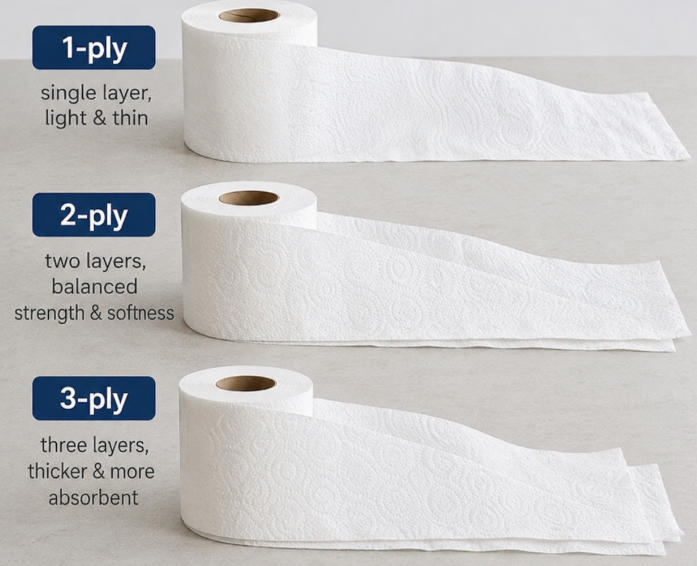
The term “ply” refers to how many layers are used to construct the paper, and this also dictates thickness and how soft, strong, and absorbent the paper will be.
Toilet paper manufactured for the commercial market is typically available in one-ply and two-ply options. The former are a good budget solution for restrooms in very high-traffic areas, while the latter provide a balance between the latter two considerations and the former.
The household paper market provides options of one, two, and three-ply toilet paper, and the highest-quality ones often feature surfaces that are quilted or embossed to further improve thickness and softness.
| Comparison Factor | Commercial Toilet Paper | Household Toilet Paper |
| Common Ply Options | 1-ply and 2-ply | 1-ply, 2-ply, and 3-ply |
| Thickness | Often thinner in economy products | Frequently thicker in premium products |
| Softness | Focuses on practical performance | Often emphasizes comfort |
| Strength | Designed for regular shared use | Designed for personal hygiene needs |
| Absorbency | Varies by product specifications | Varies by product specifications |
| Typical Selection Priority | Cost and consumption efficiency | Comfort and performance |
It is important to note that ply count alone does not determine overall quality. Fiber composition, paper weight, embossing, and manufacturing technology also influence the finished product.
5. Raw Materials
The quality, softness, and strength of toilet paper depend on the materials used to manufacture it. Additionally, there are environmental impacts that come along with the raw materials.
Toilet paper in both markets is manufactured from either virgin wood pulp, recycled pulp, or a mix of both.
Commercial toilet paper manufacturers often select raw materials based on the required balance between cost, strength, absorbency, and softness. Recycled fibers may be used in economical commercial products, particularly when sustainability and purchasing costs are important considerations.
Household toilet paper often uses virgin pulp in products positioned around softness and comfort. Premium products may use carefully processed fibers to create a smoother texture and improved absorbency.
| Raw Material | Main Characteristics | Common Applications |
| Virgin Wood Pulp | Soft texture, good strength, and absorbency | Household and premium commercial toilet paper |
| Recycled Paper Fibers | Supports resource reuse and can reduce reliance on virgin pulp | Commercial and economy toilet paper |
| Mixed Fibers | Balances selected performance and cost requirements | Commercial and household products |
| Bamboo Pulp | Plant-based fiber alternative with varying softness and strength | Household and selected commercial products |
The actual performance of each product depends on fiber quality, processing methods, and manufacturing standards.

6. Packaging and Purchasing Methods
There are more obvious differences in packaging between commercial and household toilet paper.
In commercial toilet paper, there is bulk packaging. Each box contains several rolls. With tissue paper manufacturers offering differing packaging quantities for hotels, hospitals, office buildings, restaurants and other businesses, ordering in the quantities needed is possible.
Household toilet paper can be found in smaller packs through various channels, such as grocery stores and online retailers. Retail packaging is typically designed for carrying, storing and displaying for purchase.
| Comparison Factor | Commercial Toilet Paper | Household Toilet Paper |
| Packaging Format | Bulk cartons and large cases | Consumer multi-packs |
| Purchasing Quantity | Large-volume orders | Small or medium quantities |
| Sales Channels | Manufacturers, wholesalers, and distributors | Supermarkets and online retailers |
| Target Buyers | Businesses and institutions | Individual consumers and families |
| Storage | Commercial storage areas | Household storage spaces |
| Purchasing Frequency | Based on facility consumption | Based on family consumption |
For commercial buyers, bulk purchasing can simplify inventory management and help reduce the cost per sheet.

7. Dispenser Compatibility
The toilet paper types used in the home and commercially differ greatly and have a major impact on dispensing systems.
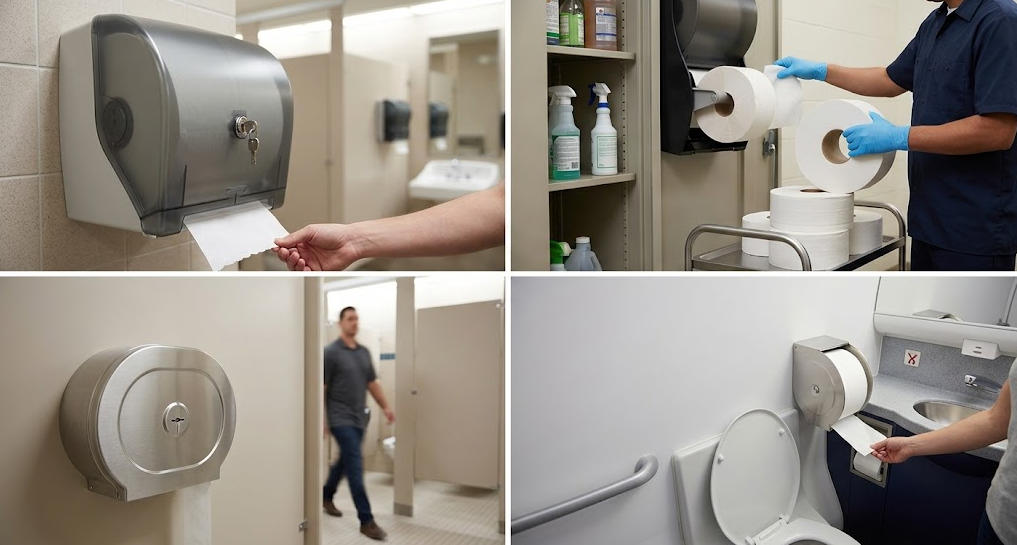
In many commercial washrooms, specialized dispensers are utilized for jumbo rolls, mini jumbo rolls, coreless rolls or folded toilet paper. These systems help with tissue dispensing and contamination control, and help reduce the burden of maintenance.
Household toilet paper is typically made to fit residential toilet paper holders. In most cases, these toilet paper rolls are very easy to replace with no extra tools or professional help.
It is recommended for facilities managers to look into the dimensions of a commercial toilet paper roll and roll dispenser, including the width, core, and diameter, before purchasing.
8. Cost Structures
Cost is one of the most important considerations for both household consumers and commercial buyers.
The costs for household toilet paper tend to vary based on the manufacturer’s brand, ply, softness, packaging and the quality of the paper. There are also smaller sizes that consumers can buy.
Commercial toilet paper tends to be bought in larger quantities. While it is true that buying wholesale tends to require a higher initial cost for commercial toilet paper, in the long run it will decrease the price per unit and provide a solution to easier inventory management.
Consumers ought to look into the cost per sheet or the price per meter and shouldn’t only look into the cost per roll.
| Cost Factor | Commercial Toilet Paper | Household Toilet Paper |
| Purchasing Method | Wholesale and bulk orders | Retail and online purchases |
| Initial Investment | Usually higher for bulk orders | Usually lower per purchase |
| Cost per Sheet | Often lower in bulk purchasing | Varies by brand and product |
| Consumption Management | Important for operating budgets | Mainly based on family needs |
| Long-Term Purchasing | Regular supply contracts or bulk orders | Repeated retail purchases |
| Main Cost Consideration | Total consumption and maintenance costs | Price, quality, and convenience |
9. Performance Requirements
Expectations for the performance of commercial and household toilet paper differ.
In a commercial environment, toilet paper should withstand a lot of usage and perform consistently. Factors such as strength, how much moisture it absorbs, how easily the toilet paper is dispensed, and whether or not it breaks down the way it’s supposed to should all be taken into account. Additionally, products should work well with the plumbing and sewer systems at a given facility.
The comfort and ease of use of toilet paper is the primary goal for the household market. Most customers consider a toilet paper’s softness, thickness, durability, and whether or not it is easy to tear.
Both markets should develop their products to meet applicable safety and quality standards, and be sure to create products that will properly flush. It should never be assumed that one type of toilet paper is better than another in terms of being septic safe, as all brands have specific details that should be checked.
10. Applications across Industries
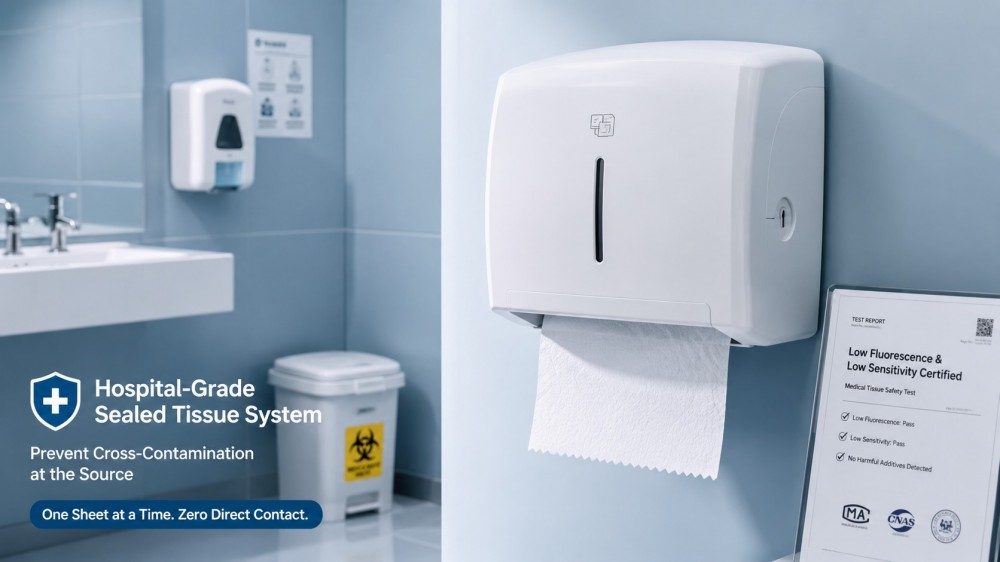
Commercial toilet paper is widely used across industries and public facilities, while household toilet paper is primarily intended for residential applications.
| Application | Recommended Toilet Paper | Main Requirements |
| Family Bathrooms | Household | Softness, comfort, and convenience |
| Hotels | Commercial | Quality, capacity, and consistent supply |
| Restaurants | Commercial | Reliable performance and easy maintenance |
| Hospitals | Commercial | Hygiene, reliable supply, and operational efficiency |
| Office Buildings | Commercial | Cost efficiency and high-capacity rolls |
| Schools | Commercial | Practical performance and frequent-use suitability |
| Shopping Malls | Commercial | Large roll capacity and dispenser compatibility |
| Airports | Commercial | High-volume usage and reduced replacement frequency |
| Guest Bathrooms | Household | Convenience and comfortable use |
| Residential Apartments | Household | Everyday comfort and affordability |

Summary Comparison Table of Commercial and Household Toilet Paper
| Comparison Factors | Commercial Toilet Paper | Household Toilet Paper |
| Main Purpose | Designed for public and commercial restrooms | Designed for personal and family use |
| Target Users | Businesses, institutions, and public facilities | Individuals and households |
| Main Applications | Hotels, restaurants, hospitals, offices, schools, and shopping malls | Residential bathrooms and guest bathrooms |
| Roll Size | Often available in jumbo, mini jumbo, and standard sizes | Primarily standard-sized rolls |
| Roll Capacity | Generally higher capacity to reduce replacement frequency | Usually lower capacity for convenient handling |
| Ply Options | Commonly 1-ply and 2-ply | Commonly 1-ply, 2-ply, and 3-ply |
| Thickness | Often thinner in economy products | Often thicker in premium products |
| Softness | Focuses on practical performance and cost efficiency | Often prioritizes softness and comfort |
| Raw Materials | Virgin pulp, recycled fibers, or mixed fibers | Commonly virgin pulp, recycled fibers, or bamboo pulp |
| Strength | Designed for frequent use in shared facilities | Designed for everyday personal hygiene |
| Absorbency | Depends on fiber quality and product specifications | Often emphasizes comfortable and effective absorption |
| Packaging | Bulk cartons and large cases | Small and medium-sized multipacks |
| Dispenser Compatibility | Often designed for specialized commercial dispensers | Usually compatible with standard household holders |
| Purchasing Method | Wholesale and bulk purchasing | Retail stores and online shopping |
| Cost Structure | Often lower cost per sheet when purchased in bulk | Varies by brand, quality, and package size |
| Replacement Frequency | Generally less frequent with high-capacity rolls | Generally more frequent |
| Storage Requirements | Requires dedicated bulk storage space | Easy to store in household cabinets |
| Key Purchasing Factors | Roll capacity, cost efficiency, quality, and dispenser compatibility | Softness, thickness, absorbency, and affordability |
| Primary Advantage | Efficient for high-volume restroom operations | Comfortable and convenient for everyday use |
How to Choose Between Commercial and Household Toilet Paper
Choosing between commercial and household toilet paper depends on the intended environment, consumption level, budget, and product expectations.
For residential users, household toilet paper is generally the most convenient option. Buyers should consider ply count, softness, absorbency, sheet quantity, and compatibility with their plumbing systems.
For businesses and public facilities, commercial toilet paper is usually more suitable. Facility managers should evaluate the following factors:
- Daily Usage: The number of restroom users multiplied by the amount of toilet paper used per person.
- Roll Capacity: Larger roll sizes result in fewer roll changes.
- Ply Structure: Choose one- or two-ply paper based on comfort and cost.
- Dispenser Compatibility: Paper roll sizes must match the toilet paper dispenser in use.
- Product Quality: Examine softness, strength, absorbency and rate the speed of paper disintegration.
- Purchasing Cost: Compare the cost per roll, but do not forget to check the cost per sheet and the total length of the roll.
- Supply Reliability: Maintain a relationship with toilet paper manufacturers hat ensure consistent quality and timely deliveries.
Better choices result in improved restroom service as well as decreased costs for purchases and service.
Summary
Commercial and household toilet papers differ in many significant ways. These include: roll capacity, ply structure, raw materials, softness, packaging, dispenser compatibility, purchasing methods, and performance requirements.
- Commercial toilet paper generally emphasizes high roll capacity, bulk purchasing, dispenser compatibility, and cost efficiency, making it suitable for public and commercial facilities.
- Household toilet paper focuses more on residential comfort, softness, and convenient packaging.
- For businesses, selecting suitable commercial toilet paper can help improve restroom management and reduce long-term operating expenses.
- For households, choosing the right toilet paper ensures a comfortable and reliable daily hygiene experience.
To be an informed consumer, it is necessary to understand these differences whether buying for a public facility or a residential bathroom.