
How Softness and Strength are Engineered in Toilet Paper
Toilet paper is a daily essential item that has to juggle two qualities that look kinda opposite. Like, it has to be soft, for comfort, but also strength for dependable use. People want it to feel gentle on the skin but still be tough enough for everyday wiping, without ripping up too fast. Getting that mix right of softness and strength in toilet paper takes careful engineering all the way through, from choosing raw materials to tweaking fiber structures, then adding certain treatments and using newer production technologies, too.
Understanding the Balance Between Softness and Strength
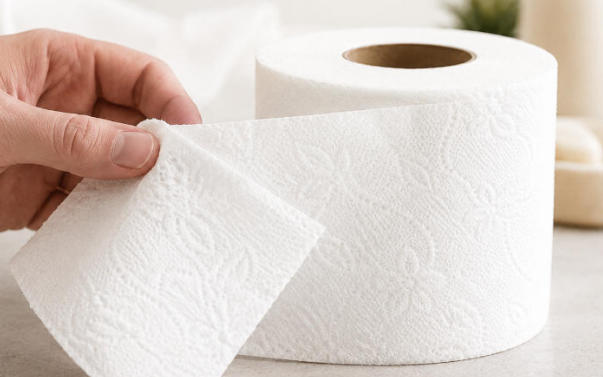
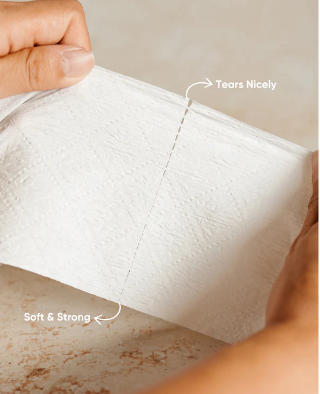
Softness and strength are probably the most critical performance markers of toilet paper. But when you try to boost one, it can mess with the other, kind of. Softness is mostly about the surface texture, how flexible the sheet feels, and whether it gives a nice tactile sensation. Strength depends more on how well the fibers bond, the sheet’s overall structure, and how well it resists tearing whether it is wet or dry.
In older paper making, the main focus was pushing strength by building strong fiber bonds. Yet those tightly bonded fibers often lead to paper that feels stiff, and a bit abrasive too, which is not great. Nowadays toilet paper engineering aims for a regulated fiber web instead, something that keeps durability, while still letting the paper stay cushioned and flexible enough to feel soft.
Tissue paper manufacturers reach this balance using selective material choices, fiber processing steps, embossing methods,and even multi-layer sheet layouts which help spread forces in a more orderly way.
Key Process of Engineering the Softness and Strength in Toilet Paper
The engineering of softness and strength is essentially the process of controlling the relationship between fiber structure and paper performance. Manufacturers must create a tissue sheet that is flexible and gentle while maintaining sufficient internal bonding and mechanical stability.
1. Selecting and Preparing High-Quality Fiber Materials
The first step in engineering toilet paper performance is choosing suitable raw materials. The type, length, and quality of fibers directly influence the final softness and strength.
| Fiber Material | Source / Characteristics | Contribution to Toilet Paper Performance |
| Virgin Softwood Pulp | Made from long fibers obtained from trees such as pine and spruce. It has excellent fiber length and strong bonding ability. | Improves tensile strength, tear resistance, and overall durability of toilet paper. |
| Virgin Hardwood Pulp | Produced from shorter and finer fibers from trees such as eucalyptus and birch. | Enhances softness, smoothness, and surface comfort while improving tissue texture. |
| Softwood–Hardwood Fiber Blend | A carefully balanced combination of long softwood fibers and short hardwood fibers. | Provides an ideal balance between strength, softness, flexibility, and absorbency. |
| Eucalyptus Pulp | A fast-growing hardwood fiber known for its smooth texture and uniform fiber structure. | Creates a soft surface feel and improves tissue brightness and comfort. |
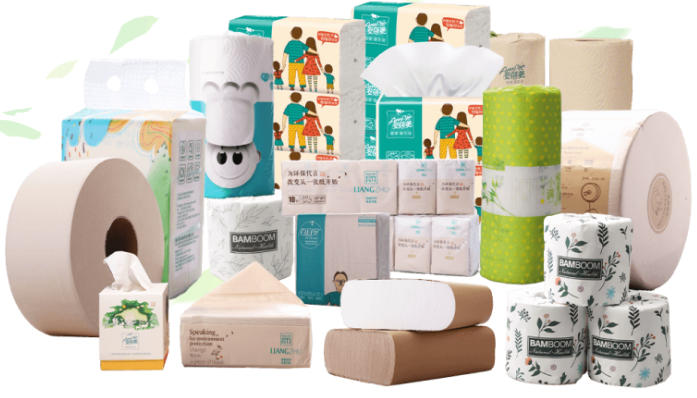
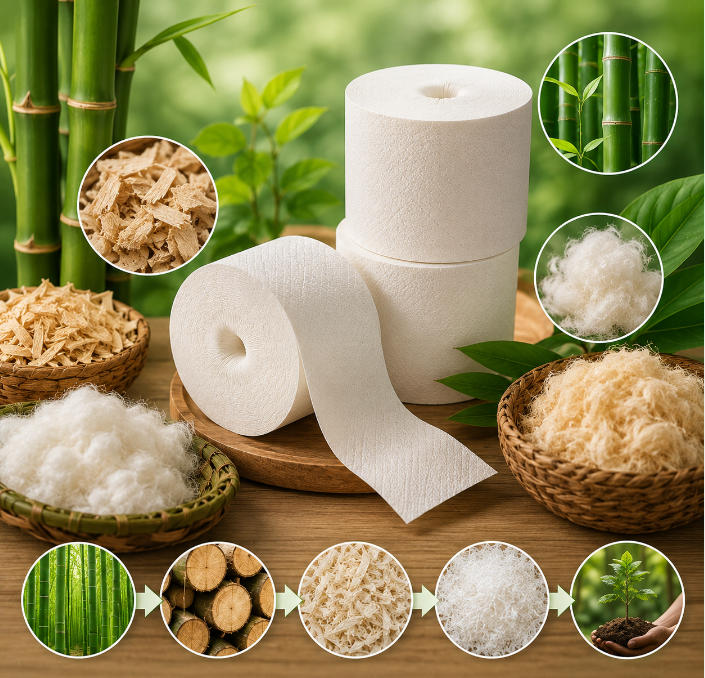
| Bamboo Fiber Pulp | Renewable plant-based fiber with good strength and natural softness. | Bamboo toilet paper provides sustainable toilet paper production while offering softness and adequate durability. |
| Recycled Fiber Pulp | Recovered paper fibers processed and reused in tissue production. | Improves environmental sustainability and reduces dependence on virgin resources, though additional processing may be needed to maintain strength. |
| High-Purity Bleached Pulp | Carefully processed pulp with impurities removed and brightness improved. | Produces clean, smooth, and high-quality toilet paper suitable for sensitive skin. |
| Fluff Pulp | Highly absorbent cellulose fiber with a loose structure. | Enhances bulk, softness, and liquid absorption capacity. |
| Specialty Modified Fibers | Engineered fibers with improved flexibility, bonding, or surface properties. | Helps manufacturers customize softness, strength, and performance for premium tissue products. |
| Sustainably Sourced Certified Pulp | Fiber materials are obtained from responsibly managed forests or renewable sources. | Supports eco-friendly production while maintaining required softness and strength standards. |
After selection, pulp preparation begins. Fibers are mixed with water to form a pulp suspension, which is then cleaned and processed to remove impurities. Proper pulp preparation ensures consistent fiber distribution during later manufacturing stages.
2. Optimizing Fiber Refining and Bonding
Fiber refining is one of the key procedures that affects how softness and strength end up working together. During refining, some mechanical action changes the surface behavior of the fibers, and this really helps their bonding capacity.
If the fibers are refined in a proper way, more connection spots appear between each individual fiber. As a result, paper strength usually rises, and tearing resistance gets better too. Still, if refining is pushed too far, fibers can collapse and form a denser sheet, and then the material tends to feel less pliable, less soft.
Today many tissue producers rely on refined process control, so the fiber structure lands near the target. Refining energy, fiber flexibility and pulp consistency are adjusted with care, so the final tissue shows the intended balance of durability and softness.
3. Controlling Sheet Formation and Fiber Arrangement
After pulp preparation, the fiber suspension is spread across a moving forming wire to end up with a wet tissue web. During this particular stage, the way the fibers settle really affects what you get in the end, so yes, it matters a lot.
If the fibers are distributed in a uniform manner, the sheet tends to show steadier strength from one area to another. At the same time, the goal is to keep sufficient open space between the fibers, because that openness supports softness and absorbency in use.
Modern forming approaches let manufacturers steer fiber alignment and influence the sheet structure. When the fiber network is planned well, it supports higher tensile strength while keeping a light, flexible hand feel that is not stiff or heavy.
4. Managing Drying Technology to Preserve Softness
Drying is a critical step, since it shapes both the physical structure and the surface texture of toilet paper. Conventional drying techniques often enhance fiber bonding, which can yield a more robust sheet, but they can also make the paper feel less soft.
Modern tissue production often relies on more advanced drying technologies to keep bulk, feel, and flexibility mostly intact. Through air drying (TAD) , for example, makes use of heated air to pull out moisture while still keeping the tissue’s three-dimensional form.
When producers maintain more open fiber spaces, newer drying methods help boost softness, thickness, and absorbency a bit more. Then the final tissue ends up feeling more pleasant to the touch, yet it still delivers dependable strength.
5. Applying Multi-Ply Layer Engineering
Multi-ply construction in toilet paper is another major process to improve softness. Instead of forming one single thick sheet, manufacturers combine multiple thin layers so the total outcome is improved.
Those layers can be tuned to handle specific tasks. The outer layers usually prioritize softness, and surface comfort, while the inner layers focus on supporting the structure and adding extra strength.
During the lamination process, manufacturers carefully manage how the layers bond together. They need solid connections so the sheets do not end up separating, yet too much adhesion can make the material less flexible, so there is a balance to find. When layer integration is done properly, the result is a product that remains soft, strong, and durable.
6. Using Embossing Technology to Enhance Texture and Strength
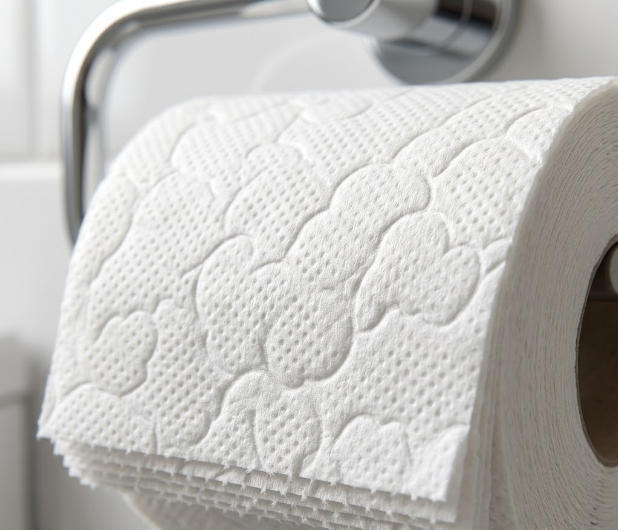
Embossing in toilet paper is frequently used to raise the tactile experience and practical performance. Here, patterned rollers press an arrangement into the tissue surface, so raised features appear along with tiny air pockets.
That extra texture increases the sheet thickness, which tends to make it feel softer and more cushiony. The extra volume also supports liquid absorption because the spaces can hold moisture for longer.
Embossing patterns are engineered on purpose, because the design affects both the look and the function. Bigger patterns can add comfort and bulk, while smaller ones tend to support surface strength and overall sheet stability.

7. Applying Controlled Chemical Treatments
Chemical additives can be employed to push certain properties of toilet paper a bit further, you know, to make it better where it matters. The selection is done with intention, not random, so performance improves while safety plus environmental requirements stay intact.
Wet strength agents are used so the sheet keeps its integrity when it meets moisture. They form firmer bonds between fibers, so the chance of tearing during ordinary use goes down.
Softening agents work by reducing friction among the fibers, which helps the surface feel smoother and more comfortable. Even so, makers have to keep additive levels exact, since too much chemistry may interfere with absorbency, or with biodegradability.
In the end, mechanical processing paired with chemical treatment lets manufacturers tune tissue traits for different kinds of use, more or less each time.
8. Optimizing Moisture Control and Conditioning
Moisture content plays an important role in tissue softness and strength. Too much moisture can weaken the sheet, while insufficient moisture can make it brittle and rough.
During production, manufacturers continuously monitor moisture levels to ensure consistent quality. After manufacturing, toilet paper may undergo conditioning processes that stabilize its moisture balance before packaging.
Proper moisture control improves flexibility, reduces breakage, and helps maintain a consistent user experience.
9. Conducting Advanced Quality Testing
Engineering softness and strength requires continuous testing throughout the production process. Manufacturers use advanced measurement methods to evaluate whether the tissue meets performance requirements.
| Quality Testing Method | Purpose | Impact on Softness and Strength Engineering |
| Tensile Strength Testing | Measures the maximum force toilet paper can withstand before breaking under tension. | Ensures the tissue has sufficient durability while allowing manufacturers to optimize fiber bonding without making the paper too stiff. |
| Tear Resistance Testing | Evaluates the paper’s ability to resist tearing when pulled or stressed. | Helps determine whether fiber selection, refining, and sheet structure provide reliable strength during use. |
| Burst Strength Testing | Measures the paper’s resistance to pressure applied perpendicular to the sheet surface. | Ensures the tissue maintains structural integrity while balancing softness and flexibility. |
| Wet Strength Testing | Tests the ability of toilet paper to maintain performance after absorbing moisture. | Helps optimize wet-strength additives and fiber bonding to prevent excessive tearing when wet. |
| Softness Measurement Testing | Uses specialized instruments to evaluate surface smoothness, flexibility, and compressibility. | Allows manufacturers to improve the tactile feel and create a softer user experience. |
| Surface Roughness Testing | Measures microscopic surface irregularities of the tissue sheet. | Helps control fiber arrangement and embossing patterns to achieve a smoother, more comfortable surface. |
| Bulk and Thickness Testing | Determines the volume, thickness, and three-dimensional structure of toilet paper. | Supports the development of softer and more cushion-like tissue while maintaining strength. |
| Absorbency Testing | Measures how quickly and how much liquid the tissue can absorb. | Helps optimize fiber structure, sheet formation, and embossing designs for better moisture handling. |
| Ply Bond Strength Testing | Evaluates how firmly multiple tissue layers are connected. | Ensures multi-ply toilet paper maintains layer stability while preserving softness and flexibility. |
| Fiber Analysis Testing | Examines fiber length, distribution, composition, and quality. | Helps manufacturers adjust softwood and hardwood fiber ratios to achieve the desired softness-strength balance. |
| Moisture Content Testing | Determines the amount of moisture contained in the finished tissue. | Maintains flexibility and prevents the paper from becoming too brittle or too weak. |
| Caliper Testing | Measures the thickness of individual sheets or multi-ply structures. | Helps optimize bulk, softness, and consumer perception of product quality. |
| Embossing Quality Inspection | Evaluates embossing depth, pattern consistency, and surface structure. | Ensures embossing improves softness, absorbency, and appearance without reducing sheet strength. |
10. Integrating Smart Manufacturing Technologies
Nowadays, tissue paper production leans more and more on automation and digital tools. With sensors, artificial intelligence, and real-time tracking systems, producers can keep the product quality consistent, without guessing.
Smart manufacturing setups can evaluate things like fiber distribution, moisture levels , sheet thickness, and how the machine is performing. When irregularities show up quickly, manufacturers can fine tune the settings, which boosts efficiency and cuts down on waste.
In addition, these approaches back sustainability too, because they help use raw materials more precisely and reduce energy requirements.

Sustainability Considerations in Toilet Paper Engineering
Sustainability has been getting more attention in toilet paper development, and honestly it matters more each year. Manufacturers are trying to craft products that still feel soft and sturdy while at the same time cutting down the environmental footprint.
By using eco-friendly fibers that are responsibly sourced, recycled material where it makes sense, and leaning on energy-efficient production systems, the whole process can reduce resource use. In addition, some companies are working on tissue sheets that use less overall substance, through better fiber efficiency and a more thoughtful paper layout, which is a little different than the standard sheet design.
The real problem is keeping softness and strength in toilet paper manufacturing, while also shrinking the amount of raw material. Advanced fiber engineering and tighter manufacturing optimization are supporting that balancing act, because it is not just one change, it is several small improvements placed together.
Final Thoughts
Engineering the softness and strength of toilet paper is a tricky process because it pulls together material science, mechanical engineering, and modern production methods. It starts with choosing the right fiber blend then moves through refining, drying, embossing, and finally quality checks, each step adding something to how the finished roll will behave in real life.