
How to Compare Tissue Paper Supplier Quotes: A Buyer’s Cost Breakdown
Choosing a tissue paper supplier based on the lowest quoted price can be misleading. Different suppliers may offer similar-looking products but vary in GSM, ply, sheet dimensions, packaging, shipping terms, and delivery quantities. These differences can significantly affect the actual purchasing cost.
For importers, wholesalers, distributors, and private-label brands, a reliable tissue paper supplier quotation should be evaluated against consistent product specifications and total landed cost—not just the initial unit price.
This guide explains how to compare tissue paper wholesale prices, standardize supplier quotations, calculate the cost of accepted products, and select a manufacturer based on both commercial value and delivery reliability.

Standardize Product Specifications Before Comparing Quotes
Before comparing a tissue paper supplier quotation with competing offers, confirm that each supplier is quoting the same product specification. A lower price may reflect fewer sheets per pack, a shorter roll, a different GSM, or a less comprehensive packaging configuration.
Use the following checklist to establish a consistent comparison basis.
| Specification | What Buyers Should Confirm |
| Product type | Toilet paper, facial tissue, kitchen paper, or hand towel |
| Material | Bamboo pulp, wood pulp, or other specified material |
| GSM and ply | Basis weight and number of tissue layers |
| Sheet dimensions | Length and width of each sheet |
| Roll specifications | Roll length, diameter, and core dimensions |
| Quantity | Sheets per pack, rolls per pack, and packs per carton |
| Packaging | Individual wrapping, retail packaging, and outer cartons |
For example, when comparing bamboo facial tissue, verify the GSM, ply, sheet dimensions, and sheet count before treating two offers as equivalent.
For customized products, confirm that each tissue paper manufacturer has quoted against the same approved sample, packaging design, and labeling requirements. A fair price comparison starts with equivalent products, not similar product names.
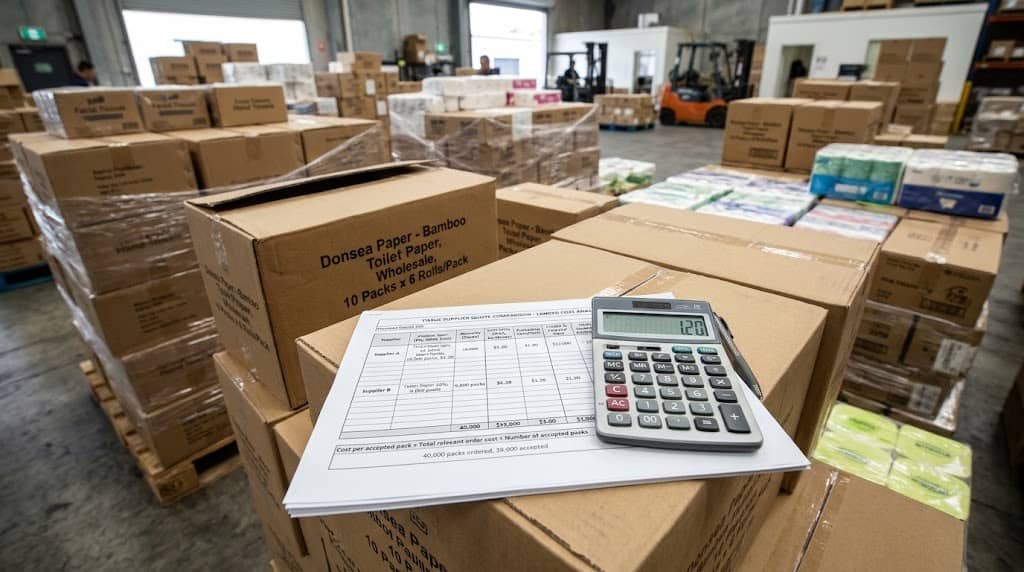
Compare Tissue Paper Wholesale Prices by Unit
A tissue paper wholesale price may be quoted per ton, roll, pack, or carton. Each unit is useful for a different purchasing situation, but prices cannot be compared directly without checking the underlying specifications.
- Price per ton: Useful for bulk purchasing when the weight basis and included materials are clearly defined.
- Price per roll: Suitable for toilet paper and kitchen towels when roll length, ply, and core specifications match.
- Price per pack: Appropriate for facial tissues and soft-pack products when sheet count and dimensions are equivalent.
- Price per carton: Useful for wholesale and export orders when the number of packs or rolls per carton is consistent.
Calculate the unit price using:
Unit price = Total quoted product cost ÷ Quoted product quantity
For example, Supplier A quotes $12,000 for 10,000 packs, while Supplier B quotes $11,500 for 9,000 packs.
- Supplier A: $1.20 per pack.
- Supplier B: approximately $1.28 per pack.
Supplier B has the lower total order value, but Supplier A offers the lower price per pack. This comparison is valid only if both products meet equivalent specifications and quality requirements.
When comparing a tissue paper wholesale price per ton, clarify whether the quoted weight refers to tissue paper alone, finished products, or goods including packaging.
Check Packaging Costs and Actual Saleable Quantity
Packaging can affect the quoted price, shipment volume, and quantity of finished products available for sale.
Ask each tissue paper supplier whether the quotation includes:
- Individual wrappers, retail boxes, and outer cartons.
- Printed packaging, labels, and required artwork preparation.
- Cores, embossing, or other specified product features.
- Applicable printing setup, sampling, or customization charges.
For a bulk tissue paper order, also verify the relationship between cartons, packs, rolls, and individual sheets. Suppose an order contains 1,000 cartons with 40 packs per carton. The nominal quantity is 40,000 packs. If inspection identifies 400 packs that fail the agreed acceptance criteria, only 39,600 packs qualify as conforming products.
Use the following calculation:
Cost per accepted pack = Total relevant order cost ÷ Number of accepted packs
This approach helps buyers compare quotations using the quantity that meets their requirements rather than relying solely on the quantity originally ordered. Contractual responsibility for defective or short-delivered goods should be confirmed separately.
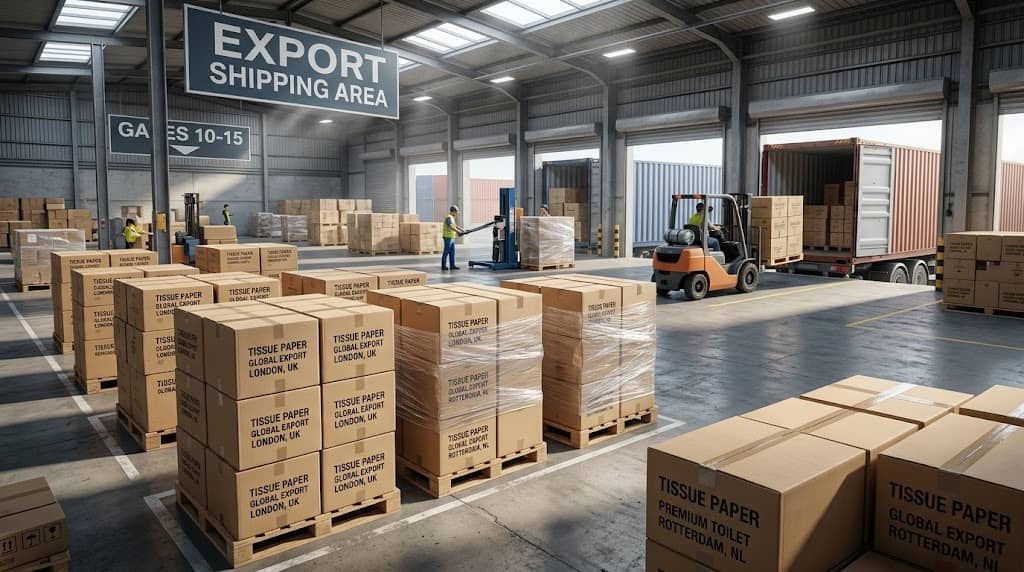
Calculate Freight, Import Charges, and Total Landed Cost
A factory quotation does not necessarily represent the full cost of receiving tissue paper at the buyer’s warehouse. Depending on the agreed trade terms and destination, additional expenses may include freight, insurance, customs duties, port handling, customs clearance, and inland transportation.
Before comparing quotations, confirm:
- Whether the offer uses EXW, FOB, CIF, DAP, or another agreed Incoterm.
- The named port or delivery location.
- Which party arranges transportation and insurance.
- Which import duties, taxes, and destination charges are excluded.
- Whether freight costs cover the same shipment size and route.
The International Chamber of Commerce’s Incoterms® 2020 guidance explains how trade terms allocate delivery obligations, costs, and risks between buyers and sellers.
Calculate the total landed cost as follows:
Total landed cost = Product cost + Applicable freight and insurance + Import duties and taxes + Other applicable charges
The exact cost components depend on the transaction and applicable trade terms. For example, CIF does not automatically cover every destination charge. To compare two tissue paper manufacturers fairly, calculate the landed cost per accepted pack, roll, or carton using the same delivery destination and cost assumptions.
Evaluate Quality Consistency and Delivery Reliability
The lowest tissue paper supplier quotation is not necessarily the best commercial offer. Buyers should also evaluate whether the manufacturer can consistently deliver products that meet the agreed specifications.
Confirm the following before placing a bulk order:
- Sample approval: Does the quoted product match the approved reference sample?
- Quality requirements: Are GSM, dimensions, sheet count, packaging, and acceptance criteria documented?
- Production capacity: Can the manufacturer accommodate the required quantity and delivery schedule?
- Traceability: Are production batches and inspection records available where required?
- Commercial terms: Are lead time, payment conditions, and procedures for nonconforming products clearly stated?
These factors help buyers assess the reliability of a tissue paper manufacturer without confusing supplier evaluation with price comparison.
For more information about Donsea’s manufacturing background and production capabilities, visit the Donsea Paper company profile. Any certification or product claim referenced in a quotation should be relevant to the product being purchased and supported by current documentation.

Build a Standardized Tissue Paper Supplier Quotation Comparison Table
A structured comparison table helps procurement teams identify pricing differences and missing information before making a purchasing decision.
| Category | Information to Compare |
| Product | Type, material, GSM, ply, and dimensions |
| Quantity | Sheets, rolls, packs, and cartons |
| Packaging | Configuration and included charges |
| Price | Currency, unit price, order value, and validity |
| Logistics | Incoterm, destination, freight, and insurance |
| Import costs | Applicable duties, taxes, and destination charges |
| Quality | Approved sample and acceptance criteria |
| Delivery | Production lead time and shipment schedule |
| Commercial terms | Payment conditions and claims handling |
Follow five steps when evaluating a tissue paper supplier quotation:
- Standardize specifications: Resolve missing or inconsistent product information.
- Normalize the unit price: Convert quotations into a common unit.
- Calculate landed cost: Include applicable expenses not covered by the quoted price.
- Review quality and delivery: Check the agreed specifications, lead time, and acceptance requirements.
- Compare the complete offer: Record differences before selecting a supplier.
Do not assume that a quotation with more included services is automatically better. Identify what each offer covers, calculate the cost of making them comparable, and evaluate any remaining differences. This method provides a more dependable basis for comparing tissue paper wholesale prices than relying on headline figures alone.
Questions to Ask a Tissue Paper Manufacturer Before Requesting a Quote
Q1: What should a tissue paper supplier quotation include?
It should identify the product specifications, quantity, packaging, unit price, currency, delivery terms, lead time, and quotation validity.
Q2: How can I compare tissue paper wholesale prices from different suppliers?
Standardize product specifications, convert prices to the same unit, and include applicable packaging, freight, import charges, and quality-related adjustments.
Q3: Why do tissue paper manufacturers quote different prices for similar products?
Differences may reflect material, GSM, ply, dimensions, packaging, order quantity, delivery terms, or quality requirements.
Q4: What information is needed for a private-label tissue paper quotation?
Provide the product specification, target quantity, packaging design, labeling requirements, destination market, and preferred delivery schedule.
Q5: Should freight be included in the quoted unit price?
Either approach can work. Confirm which charges are included and compare suppliers using the same delivery destination and cost assumptions.
Conclusion: Compare the Complete Offer, Not Just the Price
A competitive tissue paper wholesale price is only one part of a sound purchasing decision. Buyers should compare equivalent specifications, transparent packaging costs, accepted quantities, total landed cost, and delivery reliability.
For importers, distributors, and private-label brands, a standardized quotation process also makes supplier negotiations more productive by identifying exactly where offers differ. Donsea Paper manufactures bamboo toilet paper, bamboo facial tissue, kitchen paper towels, and other tissue products, with OEM and private-label options. If you are sourcing tissue products for wholesale or a private-label program, prepare your target specifications, packaging requirements, and order quantity before requesting a quotation.
Explore Donsea Paper’s product range or contact the team through the website to discuss your sourcing requirements.