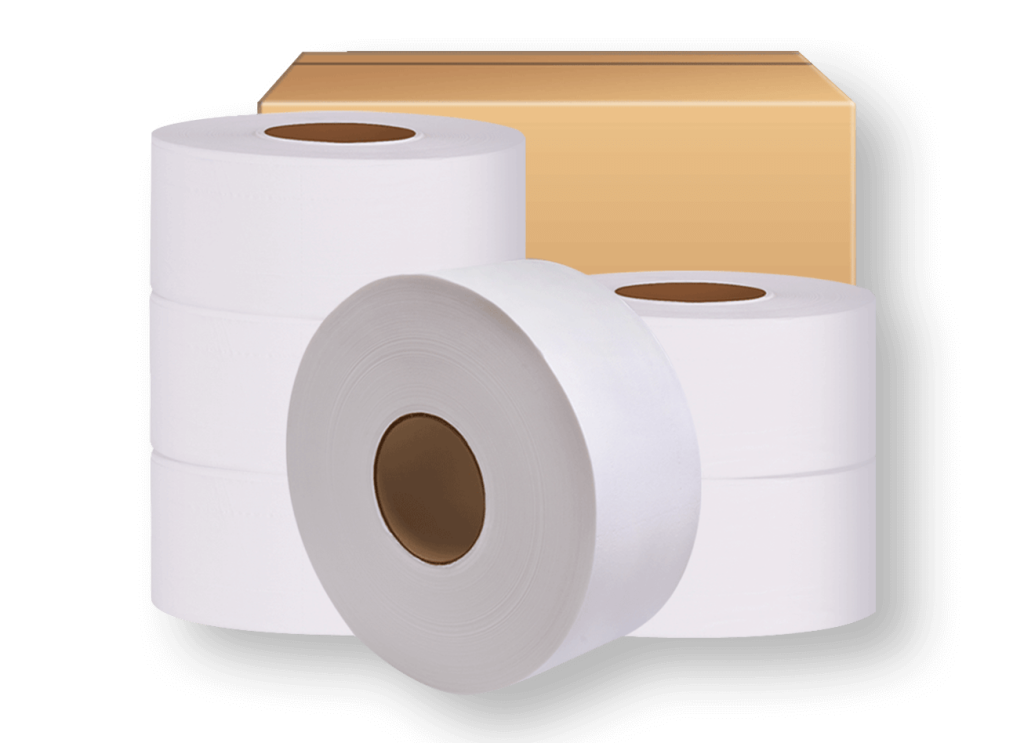
Commercial Toilet Paper Cost: How to Calculate Cost per Roll and Cost per Use
The lowest commercial toilet paper price per roll does not always mean the lowest overall cost for commercial facilities. The purchase of an inexpensive toilet paper roll leads to decreased sheet availability and shorter replacement intervals, which result in elevated paper usage during each restroom visit.
The best approach for commercial toilet paper cost assessment involves calculating roll expenses together with sheet expenses and usage expenses, as well as monthly consumption and yearly acquisition expenditures. The established metrics enable hotels, restaurants, offices, facility managers, distributors, and other bulk buyers to assess various toilet paper products through identical evaluation standards.
This guide explains the formulas and shows how to turn a supplier quotation into a practical toilet paper cost per use and annual consumption estimate.

What Makes Up the Cost of Commercial Toilet Paper?
The quoted commercial toilet paper price is only one part of the total purchasing cost. To make a meaningful comparison, buyers should first identify how much usable paper they receive for the quoted price.
The main variables include:
- Price per case
- Rolls per case
- Sheets per roll or roll length
- Sheet dimensions
- Ply
- Average sheets used per visit
- Daily restroom traffic
- Operating days
- Roll replacement frequency
- Packaging and delivery requirements
For example, Supplier A may offer a lower price per case than Supplier B. However, if Supplier A’s rolls contain significantly fewer sheets, the apparent saving may disappear once actual consumption is considered. This is why commercial buyers should distinguish between purchase cost and consumption cost.
Purchase Cost vs. Consumption Cost
- Purchase cost answers: How much do I pay when I place an order?
- Consumption cost answers: How much does it cost to provide toilet paper for each actual use?
Purchase cost is useful for budgeting and quotation comparisons. Consumption cost is more useful when evaluating long-term operating expenses.
For high-traffic commercial toilet paper applications, even a small difference in cost per use can become significant when multiplied by thousands of visits each month.
How to Calculate Commercial Toilet Paper Cost per Roll
Cost per roll is the simplest metric for comparing a commercial toilet paper quotation.
Cost per Roll Formula
Cost per Roll = Case Price ÷ Number of Rolls per Case
For example:
- Case price: $48
- Rolls per case: 24
Therefore: $48 ÷ 24 = $2.00 per roll
This calculation works well when suppliers offer products with comparable specifications and packaging. However, cost per roll should not be the only purchasing metric.
Why Price per Roll Can Be Misleading
Consider two products:
| Specification | Product A | Product B |
| Case price | $48 | $54 |
| Rolls per case | 24 | 24 |
| Cost per roll | $2.00 | $2.25 |
| Sheets per roll | 500 | 800 |
Product A has the lower commercial toilet paper price per roll. However, Product B contains substantially more sheets per roll. If the products are consumed at a similar rate per visit, Product B may deliver a lower cost per sheet and potentially a lower cost per use.
This is why buyers should move from unit price to consumption-based calculations when comparing bulk toilet paper suppliers.
How to Calculate Cost per Sheet and Cost per Use
Cost per sheet provides a more consistent basis for comparing rolls with different sheet counts.
Cost per Sheet Formula
Cost per Sheet = Cost per Roll ÷ Sheets per Roll
- For Product A: $2.00 ÷ 500 = $0.0040 per sheet
- For Product B: $2.25 ÷ 800 = $0.0028 per sheet
Although Product B costs more per roll, each sheet costs less.
Cost per Use Formula
The next step is to estimate how many sheets are used during an average restroom visit.
Cost per Use = Cost per Sheet × Average Sheets Used per Visit
If the cost per sheet is $0.0028 and average consumption is eight sheets per visit: $0.0028 × 8 = approximately $0.022 per use
The actual number of sheets used per visit varies by facility. User behavior, sheet dimensions, product performance, and dispensing conditions can all influence consumption. For this reason, measured facility data is preferable to a universal assumed usage rate.
Why Cost per Use Is a Better Commercial Metric
A commercial facility does not ultimately consume “rolls.” It consumes sheets through individual restroom visits. Therefore, the more useful purchasing question is: How much does it cost to serve one restroom visit?
This makes toilet paper cost per use particularly useful when comparing products with different roll prices, sheet counts, or configurations.
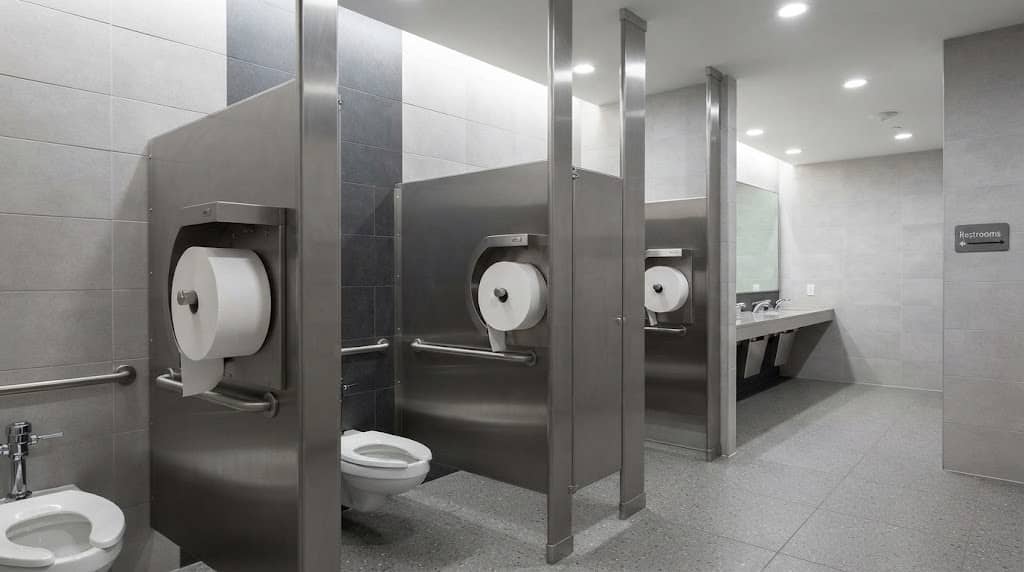
How to Estimate Monthly Toilet Paper Consumption
After calculating cost per use, buyers can estimate the amount of toilet paper required over a month.
A practical formula is: Monthly Sheets = Daily Users × Average Uses per User × Sheets per Use × Operating Days
Then: Monthly Rolls = Monthly Sheets ÷ Sheets per Roll
Commercial Toilet Paper Consumption Example
Assume a facility has:
- 500 users per day
- 1.5 restroom visits per user per day
- 8 sheets per visit
- 30 operating days per month
- 800 sheets per roll
Estimated monthly sheet consumption: 500 × 1.5 × 8 × 30 = 180,000 sheets
Estimated monthly roll consumption: 180,000 ÷ 800 = 225 rolls
If the cost is $2.25 per roll: 225 × $2.25 = $506.25 per month
This gives the purchasing team a practical estimate of its monthly commercial toilet paper cost.
What Can Change Actual Consumption?
Theoretical calculations should be treated as planning estimates rather than exact forecasts. Actual toilet paper consumption can change because of:
- Daily visitor volume
- Restroom usage patterns
- Facility occupancy
- Operating hours
- User behavior
- Dispenser configuration
- Maintenance practices
- Paper waste
- Emergency replenishment
- Seasonal changes
Facilities with historical purchasing records should use actual monthly consumption to refine their calculations.
How to Compare Commercial Toilet Paper Products by Real Cost
A proper comparison should use the same cost metrics for every supplier. For example:
| Cost Metric | Product A | Product B |
| Case price | $48 | $54 |
| Rolls per case | 24 | 24 |
| Cost per roll | $2.00 | $2.25 |
| Sheets per roll | 500 | 800 |
| Cost per sheet | $0.0040 | $0.0028 |
| Sheets per use* | 8 | 8 |
| Approx. cost per use* | $0.0320 | $0.0220 |
Illustrative calculation. Actual consumption should be measured under the intended operating conditions. The example shows an important purchasing principle: A higher cost per roll does not necessarily mean a higher operating cost.
Product B costs more per roll but has a lower calculated cost per sheet and cost per use under the same usage assumption.
Compare Equivalent Product Specifications
Cost comparisons are only meaningful when the products being compared are reasonably equivalent. When requesting quotations, buyers should record:
- Fiber or material composition
- Ply
- Sheet dimensions
- Sheets per roll
- Roll length where applicable
- Rolls per case
- Case price
- Packaging configuration
The purpose is not to choose a product based on the toilet paper specification. It is to ensure that suppliers are quoting products that can be evaluated on a consistent basis.
What to Request from a Toilet Paper Supplier
Instead of asking only for: “What is your price per roll?”
Commercial buyers can request: Case price + rolls per case + sheets per roll + sheet size + product specifications
This makes it easier to calculate bulk toilet paper cost and compare quotations from different manufacturers.

Which Specifications Affect the Real Cost of Toilet Paper?
Product specifications can affect the actual cost of supplying a commercial restroom, but their impact should be evaluated through consumption rather than isolated specifications.
Sheets per Roll or Roll Length
For high-traffic facilities, higher-capacity commercial toilet rolls can reduce replacement frequency and simplify restroom maintenance. However, a larger roll is not automatically more economical. Buyers should consider its price, capacity, dispenser compatibility, and actual consumption together.
Sheet Dimensions
Sheet dimensions can influence how many sheets users take during each visit. Consequently, sheets per roll alone do not provide a complete cost picture.
A better comparison considers: Sheet Size + Sheets per Roll + Cost per Roll + Actual Sheets per Use
Ply
Toilet paper ply can affect product performance and consumption, but a higher ply does not automatically result in a higher or lower total cost.
The relevant commercial question is whether the product provides the required user experience and performance without unnecessary consumption.
Product Configuration
Roll configuration and packaging can also influence operational efficiency. For facilities that prioritize controlled dispensing and reduced paper waste, central pull toilet paper can be another configuration to evaluate. A product that requires frequent replacement may increase the workload for cleaning personnel. A higher-capacity configuration may reduce replacement frequency and improve inventory handling.
For high-traffic facilities, these operational considerations should be evaluated alongside the quoted paper price.
How to Calculate the Total Annual Commercial Toilet Paper Cost
Monthly consumption is useful for inventory planning, but annual cost is often more useful for procurement decisions.
The basic formula is: Annual Toilet Paper Cost = Monthly Rolls × Cost per Roll × 12
Using the previous example:
- Monthly consumption: 225 rolls
- Cost per roll: $2.25
Monthly cost: 225 × $2.25 = $506.25
Estimated annual cost: $506.25 × 12 = $6,075
The same calculation can be used to compare different products or suppliers.
Annual Cost for Multiple Facilities
For businesses operating multiple locations, calculate each facility separately before consolidating the results.
For example: Annual Rolls per Facility × Number of Facilities × Cost per Roll
This approach can help hotel groups, restaurant chains, office operators, cleaning companies, and distributors estimate their total annual commercial toilet paper purchasing cost.
It can also highlight facilities with unusually high consumption and provide a starting point for investigating the cause.
Purchase Price vs. Total Consumption Cost
The most useful comparison is not necessarily:
- Supplier A = $2.00/roll
- Supplier B = $2.25/roll
It is:
- Supplier A = estimated annual cost X
- Supplier B = estimated annual cost Y
When annual consumption is high, the difference between these two numbers may be much more meaningful than the difference in the initial quotation.

Commercial Toilet Paper Cost Calculation Checklist
Before comparing commercial toilet paper suppliers, buyers should collect the following information:
| Metric | What to Check |
| Case price | Supplier quotation |
| Rolls per case | Packaging configuration |
| Cost per roll | Case price ÷ rolls per case |
| Sheets per roll | Product specification |
| Cost per sheet | Cost per roll ÷ sheets |
| Average sheets per use | Measured or estimated consumption |
| Cost per use | Cost per sheet × sheets per use |
| Daily users | Facility traffic |
| Monthly rolls | Estimated consumption |
| Monthly cost | Monthly rolls × cost per roll |
| Annual cost | Monthly cost × 12 |
| Replacement frequency | Maintenance records |
For more accurate purchasing decisions, record actual monthly usage after introducing a product and compare it with the original estimate.
A practical procurement cycle is:
Supplier quotation → Product trial → Actual consumption → Cost per use → Annual cost → Purchasing decision
This approach gives buyers a stronger basis for evaluating bulk toilet paper suppliers than simply selecting the lowest quoted roll price.
How to Find the Lowest Real Cost for Commercial Toilet Paper
The most economical commercial toilet paper is not necessarily the product with the lowest price per roll.
A more reliable evaluation follows five steps:
- Calculate cost per roll from the supplier’s case quotation.
- Calculate cost per sheet using the number of sheets or roll length.
- Estimate cost per use based on actual or trial consumption.
- Project monthly and annual consumption based on facility traffic.
- Compare total cost using equivalent specifications.
The key formulas are:
- Cost per Roll = Case Price ÷ Rolls per Case
- Cost per Sheet = Cost per Roll ÷ Sheets per Roll
- Cost per Use = Cost per Sheet × Sheets Used per Visit
- Monthly Rolls = Daily Users × Uses per User × Sheets per Use × Operating Days ÷ Sheets per Roll
- Annual Cost = Monthly Rolls × Cost per Roll × 12
For hotels, restaurants, offices, public facilities, distributors, and other high-volume users, this method turns a simple supplier quotation into a more realistic commercial toilet paper cost model. The best-value product is the one that delivers the required performance with a predictable and efficient cost per use, rather than simply the lowest price per roll.
For bulk or private-label toilet paper requirements, Donsea Paper can work with buyers on product specifications, roll configuration, packaging, and supply requirements to develop a solution suited to their market.