
Toilet Paper Jumbo Rolls vs. Finished Toilet Rolls: What are the Key Differences
Toilet paper is used for hygiene in homes, offices, hotels, restaurants, hospitals, and public places. Even so, toilet paper is not made and sold in only one way. In the tissue paper market, two items come up often. These are toilet paper jumbo rolls and finished toilet rolls. They serve the same basic purpose, they differ significantly in production processes, sizes, applications, packaging, and purchasing requirements.
Knowing how toilet paper jumbo rolls differ from finished toilet rolls can help distributors, wholesalers, commercial buyers and tissue paper manufacturers make better purchasing decisions. Whether you need large quantities of raw tissue rolls for further processing or ready-to-use toilet paper for everyday consumption, the choice matters. It can affect cost and how smoothly operations run.
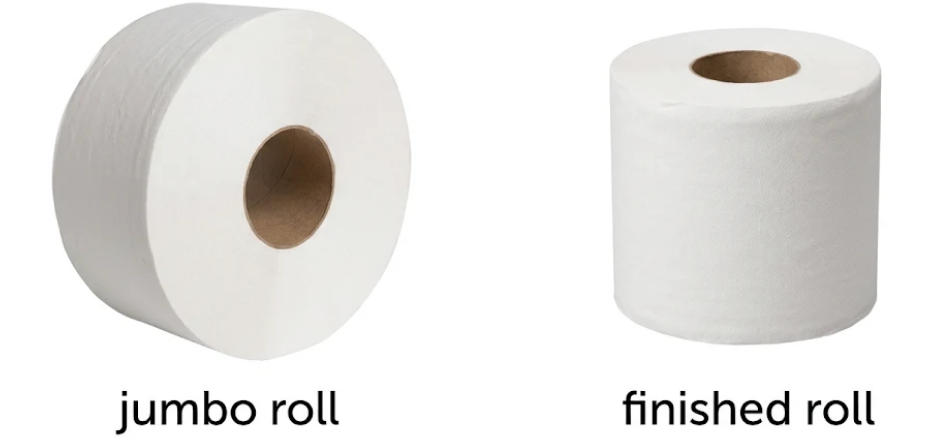
An Overview of Toilet Paper Jumbo Rolls
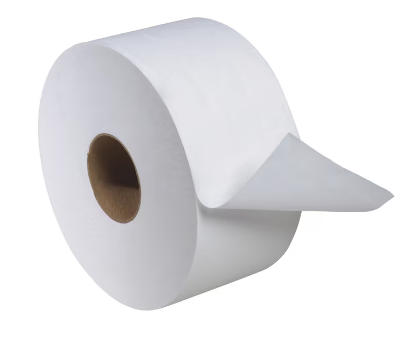
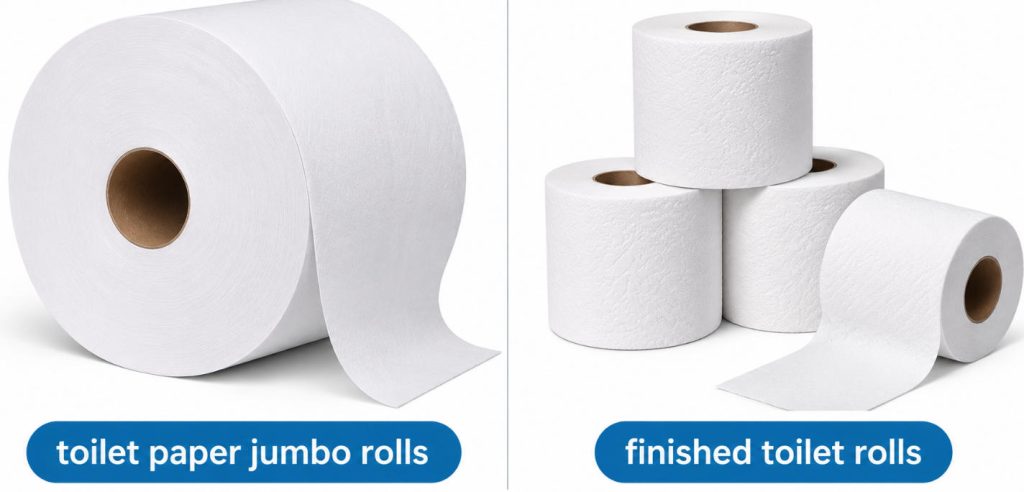
Toilet paper jumbo rolls, also known as parent rolls or mother rolls, are large rolls of tissue paper produced directly by paper mills. They act as the main starting material for making finished toilet paper.
They are shipped in large diameters and wide widths. The exact size depends on the mill equipment and what a customer asks for. Unlike what shoppers buy at home, jumbo rolls do not go through full converting yet. That means they are not finished with steps like rewinding, perforating, cutting, or individual bagging.
Most jumbo rolls are bought by converters and manufacturers. Wholesalers also buy them when they have the right equipment. These buyers then break down the big rolls into smaller products that fit market needs.
A major benefit is flexibility in production. Converters can change jumbo rolls into many finished formats. This can include different roll lengths, sheet counts, sizes, and pack styles based on what customers want..
An Overview of Finished Toilet Rolls
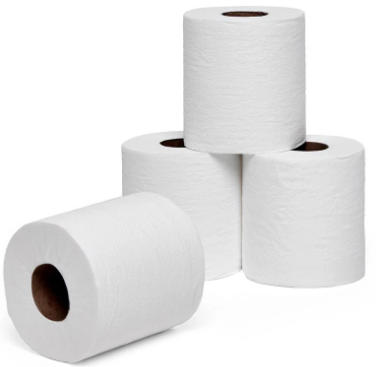
Finished toilet rolls are made for direct use. They are created by converting jumbo tissue rolls into smaller rolls. These finished rolls fit both homes and commercial sites.
During converting, the large parent roll is unwound. Then it goes through specialized equipment. The tissue is rewound into smaller rolls. It is also perforated into individual sheets, cut to the needed width, and packed for sale.
Finished toilet rolls come in many specs. Buyers may see different ply counts, sheet dimensions, roll diameters, embossing styles, and pack quantities.
You can find finished toilet rolls in supermarkets and convenience stores. They are also sold by wholesalers, online shops, and commercial hygiene suppliers. Unlike jumbo rolls, finished toilet rolls do not need more converting before they are used.
Key Differences Between Toilet Paper Jumbo Rolls and Finished Toilet Rolls
1. Size and Specifications
Size is one of the clearest differences between these two products.
Jumbo rolls are made for high volume manufacturing. The exact size depends on the paper machine, the conversion line, and what the buyer asks for. Key figures are the parent roll diameter, the paper width, the core diameter, and the roll mass.
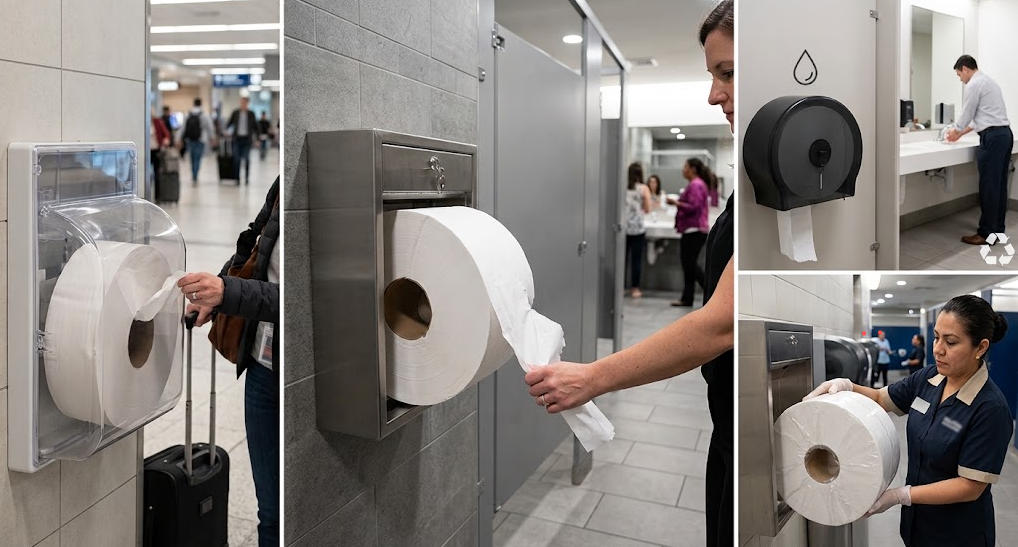
After converting, toilet rolls are much smaller. They are built to work in common dispenser types, or in units made for special needs.
Finished toilet roll specs usually list the roll diameter, roll width, total sheet count, sheet length, ply number, and core size.
For instance, a tissue converter can buy jumbo rolls and cut them into many smaller finished rolls. This is based on the jumbo parent roll size and on how the final product is planned.
Because the sizes differ, the needs for shipping, storage, handling, and day to day production also change.
2. Manufacturing Processes
Another important distinction is manufacturing process of the two kinds of toilet paper rolls.
Toilet Paper Jumbo Rolls
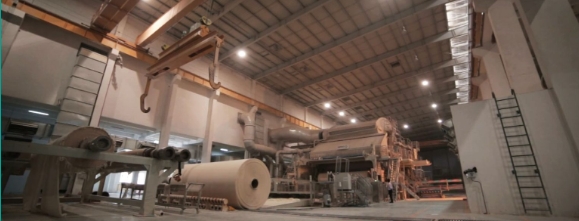
Jumbo rolls come from the main papermaking steps. First, feedstock like virgin wood pulp or recycled paper fibers is processed into pulp.
Next, the pulp is cleaned and refined, then mixed with water. The slurry then moves onto a paper machine. Water is taken out during drainage and drying, so the fibers form one long tissue web.
After that, the sheet is creped to boost softness, thickness, and flexibility. Then the web is wound onto large cores to form jumbo rolls.
Once the winding step is done, the jumbo rolls are ready to ship to tissue converters.
Finished Toilet Rolls
Finished toilet rolls are made in a converting workflow that uses jumbo rolls as the main input.
The converter sets up unwinding equipment and feeds the parent roll into a chain of conversion steps.
During conversion, the producer may join multiple plies, add embossing, and make perforation lines. Afterward, the paper is rewound into smaller log shapes.
Those logs are then cut into individual rolls sized for the target specifications. Last, the rolls go through a check for quality, then they are counted and packed.
In short, converting takes big industrial tissue rolls and turns them into products that fit retail and business shelves.
3. Customization Options
Jumbo rolls and finished toilet rolls also offer different customization opportunities.
Jumbo toilet roll customization mainly focuses on raw material properties and production compatibility, while finished toilet roll customization focuses on product appearance, usability, and packaging.
| Customization Factor | Jumbo Roll Customization | Finished Toilet Roll Customization |
| Paper Weight | Customized GSM | Customized GSM per ply |
| Paper Width | Adjusted to converting machinery | Adjusted to dispenser or market requirements |
| Roll Diameter | Customized parent roll diameter | Customized finished roll diameter |
| Core Size | Designed for unwinding equipment | Designed for dispenser compatibility |
| Ply Structure | Parent tissue configuration | Single-ply, two-ply, or three-ply products |
| Embossing | May be applied during subsequent converting | Customized surface patterns |
| Perforation | Usually completed during converting | Customized sheet length and perforation |
| Pulp Material | Virgin pulp, recycled fibers, or blends | Selected according to desired product quality |
| Packaging | Bulk industrial packaging | Individual wrapping, multipacks, and private-label packaging |
These options allow manufacturers to serve different market segments and develop products that meet specific customer requirements.

4. Applications
The applications of jumbo rolls and finished toilet rolls are closely related to their positions in the tissue paper supply chain.
Jumbo rolls are mainly used by manufacturers as production materials, whereas finished toilet rolls are used directly by consumers and commercial facilities.
| Application | Toilet Paper Jumbo Rolls | Finished Toilet Rolls |
| Tissue Converting Factories | Main raw material for manufacturing toilet paper | Final output of converting operations |
| Supermarkets | Used by private-label tissue product suppliers | Sold directly to consumers |
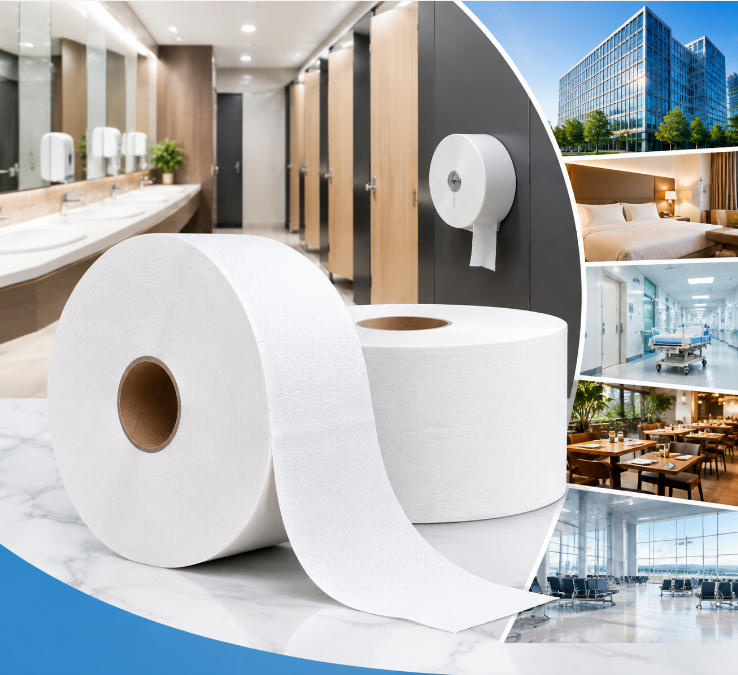
| Hotels | Supplied to tissue product manufacturers and distributors | Used in guest bathrooms and public restrooms |
| Restaurants | Used by commercial tissue suppliers | Provided in customer and employee restrooms |
| Hospitals | Used by institutional tissue product manufacturers | Used for daily hygiene requirements |
| Offices | Purchased by tissue converters and commercial suppliers | Used in workplace restrooms |
| Wholesale Markets | Sold in bulk to tissue manufacturers | Distributed to retailers and institutional buyers |
| Private-Label Brands | Used as the foundation for customized products | Packaged and sold under specific brand names |
5. Purchasing Costs and Business Economics
Cost is another important factor when selecting between jumbo rolls and finished toilet rolls.
Jumbo rolls often cost less per unit of tissue, since they are sold in larger quantities and skip extra converting and packaging steps.
Still, buying jumbo rolls means you must fund converting gear, staff, power use, upkeep, wrapping and packing supplies, and production space.
Finished toilet rolls usually cost more per unit. Their price includes extra work like cutting, rewinding, and packaging, on top of the base tissue making.
Buyers usually do not have to spend money on conversion tools or run the production line themselves.
Tissue paper manufacturers with steady output needs often find jumbo rolls cost better over time. Retailers, hotels, restaurants, and similar end users usually prefer finished toilet rolls. They are simpler to use and often cheaper when you count day to day work.
So it makes more sense to look at total ownership and operating costs. Relying only on the upfront price can mislead decisions.
6. Storage and Transportation
Storage and transportation requirements also vary significantly between these two products.
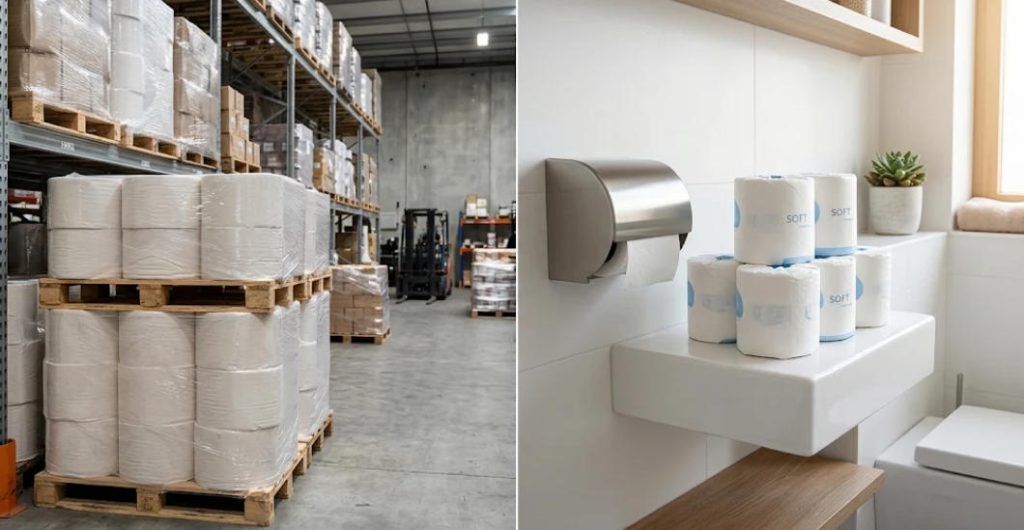
Jumbo rolls are big and heavy. They are often delivered in bulk. Because of that, you need enough warehouse space, solid packaging cover, and proper handling gear. Forklifts or roll handling setups are often required.
Storage also matters. Good conditions help stop moisture uptake. They also reduce the risk of dirt, shape changes, and dents or tears.
Finished toilet rolls take up less space and are easier to move. They are typically packed in individual bags, multipacks, or bulk cartons. That setup fits retail shelves and makes commercial delivery smoother.
The packaging also acts as a barrier. It helps limit dust and moisture exposure. It can also reduce outside contamination during shipping and storage.
If a business has tight warehouse limits, finished toilet rolls may be the easier choice. Still, large tissue converters with the right space and tools may gain more by buying jumbo rolls in bulk.
Summary Comparison Table of Toilet Paper Jumbo Rolls and Finished Toilet Rolls
| Comparison Factor | Toilet Paper Jumbo Rolls | Finished Toilet Rolls |
| Product Form | Large parent rolls of tissue paper | Small, ready-to-use toilet paper rolls |
| Manufacturing Stage | Produced during the papermaking process before converting | Produced after rewinding, perforating, cutting, and packaging |
| Main Purpose | Used as raw material for further processing | Used directly for personal hygiene and sanitation |
| Roll Size | Large diameter and width | Smaller diameter and standard or customized width |
| Paper Specifications | Customized GSM, width, diameter, and core size | Customized ply count, sheet size, sheet length, and roll diameter |
| Processing Requirements | Requires additional converting processes | Ready for direct use or resale |
| Production Equipment | Requires rewinding, perforating, cutting, and packaging machines | Does not require additional converting equipment |
| Customization Options | Paper weight, pulp composition, width, diameter, and moisture content | Ply structure, embossing, perforation, sheet count, and packaging |
| Packaging | Usually supplied in bulk industrial packaging | Usually individually wrapped or packed in multipacks |
| Main Buyers | Tissue paper manufacturers and converters | Wholesalers, retailers, hotels, restaurants, and consumers |
| Applications | Toilet paper manufacturing and private-label production | Homes, offices, hotels, hospitals, and public restrooms |
| Storage Requirements | Requires larger storage areas and specialized handling | Easier to store, handle, and distribute |
| Transportation | Commonly transported in large bulk quantities | Usually transported in cartons, bundles, or multipacks |
| Purchasing Cost | Generally lower per unit of tissue paper before converting costs | Generally higher due to additional processing and packaging |
| Production Flexibility | Offers greater flexibility for manufacturing different finished products | Limited to the specifications of the completed product |
| Quality Inspection | Focuses on GSM, moisture, roll tightness, paper uniformity, and dimensions | Focuses on softness, absorbency, strength, perforation, and packaging |
| Best Suited For | Large-scale tissue paper manufacturers and converting factories | Retail businesses, commercial facilities, and end users |
How to Choose Between Toilet Paper Jumbo Rolls and Finished Toilet Rolls for Your Business
Choosing between toilet paper jumbo rolls and finished toilet rolls depends on your business model, production capacity, and target customers.
If you run a tissue paper converting plant, jumbo rolls are often the better fit. You get raw supply that can be shaped during converting. You also have more control over product specs and the final pack format.
If you sell to end customers, like a retailer, supermarket, hotel, restaurant, or hygiene supplier, finished toilet rolls usually work better. You can offer them as is. You do not need extra production equipment.
For wholesalers and distributors, the deciding factor is who buys from you. Some suppliers focus on jumbo rolls if their clients are tissue paper manufacturers. Others lean toward finished toilet rolls if their clients are retail stores and institutions.
Quality Considerations for Toilet Paper Jumbo Rolls and Finished Toilet Rolls
Regardless of which product you purchase, quality control is essential.
For jumbo rolls, buyers should closely watch paper uniformity. Basis weight matters too, along with moisture levels. Also check how tight the roll is, the quality at the edges, and the parent roll size. When jumbo rolls vary in quality, problems can follow. These can include production delays, web breaks, uneven rewinding, and more waste.
Quality control for finished toilet rolls should cover softness, how well the rolls absorb, tensile strength, how tightly the plies bond, how accurate the perforations are, sheet uniformity, and how well the packs stay intact.
Each product type should also be looked at by its raw material makeup and by what it is meant to do in real use.
A business that works with a skilled toilet paper manufacturer can keep specs steady, raise output efficiency, and reduce the risk of uneven product quality.
Summary
Toilet paper jumbo rolls and finished toilet rolls are not the same, even though both matter in the tissue sector. Toilet paper jumbo rolls are big parent rolls. They are made so they can be cut and converted later. Finished toilet rolls are the smaller items that have already gone through the full manufacturing and packing steps.
The major differences involve product size, manufacturing stages, customization options, applications, purchasing costs, and storage requirements.
For converters and manufacturers who process tissue, jumbo rolls act as a flexible base input for high-volume output. For retailers, wholesalers, and other business buyers, finished rolls are easier to handle. They can be used right away.
When you compare these points, it is easier to choose better purchases, plan the supply path more smoothly, and pick toilet rolls that fit how you operate and what your market wants.