
How Tissue Paper Converting Affects Strength and Softness
Tissue paper quality is not only a function of the raw materials and the papermaking process but also of what occurs after the paper sheet is formed. Rewinding and ply bonding, embossing, folding, slitting, and packaging can all influence the structure, appearance, and performance of the final product.
Softness and bulk can be preserved through tissue paper converting, but sheet integrity may be compromised: one of the tissue paper manufacturer’s critical tasks is to ensure the product can be reproduced consistently. But just because a paper sheet is well-suited for converting does not mean the converting process does it any favours; poor converting can mean that a sheet is over-compressed, has malformed wind profiles, damaged sheet edges, or is dispensable.
At Donsea Paper, we understand that different tissue products require different converting considerations. Facial tissue requires a soft and gentle surface, while kitchen paper and commercial hand towels require enough strength to withstand normal handling. In this article, we will discuss critical tissue paper converting processes that have an impact on the final product performance and some considerations for manufacturers in making a uniform tissue product.
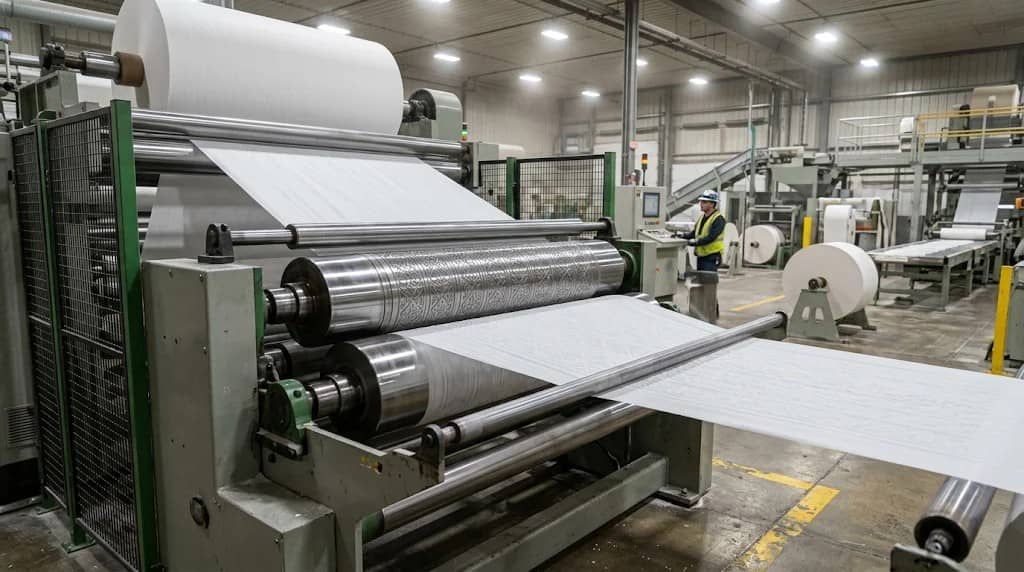
The Influence of Embossing on Tissue Paper
Embossing is a process of making raised patterns on the surface of the tissue by means of mechanical pressure. It is common in facial tissues, toilet paper, kitchen paper, and commercial hand towels. But embossing is not just for decoration. It changes the local structure of the paper and may influence the thickness, bulk, surface texture, and bonding properties of the paper.
The following should be considered:
- Emboss depth: Excessive pressure can crush fibres and result in breakage of the sheet.
- Pattern design: Paper surfaces respond to pressures submitted by different patterns.
- Even pressure: Uneven pressure can lead to inconsistent texture or appearance.
- Material properties: Different pulp compositions and weights of paper can be affected by embossing in different ways.
The manufacturers want a consistent pattern; they do not want to impair the paper. For example, bamboo tissue from Donsea Paper Bamboo Facial Tissue can offer customisation of packaging and other product specifications. In some markets, the embossing design can be considered in product development.
Sheet Integrity and the Effect of Ply Bonding
Multi-ply tissue products are made of two or more paper layers for optimal thickness, handling, and user experience. However, more layers do not always equal better. Bonding and consistency of layers are also important.
Manufacturers should ensure:
- Uniformity of the bond: A non-uniform bond can cause separation of the layers in use.
- Application of glue: If glueing, the amount of glue and its application location need to be closely controlled.
- Laying-up: Misaligned sheets defeat the purpose of the appearance and the converting operation.
- Ply bonding/sheet compression: Over compression of the sheets may affect multi-ply tissues’ inherent cushioning.
- Ply bonding: Essential for facial tissue and toilet paper to keep the sheets together during handling and dispensing.
Donsea Paper can provide customised 2-ply to 4-ply for its bamboo toilet paper and bamboo facial tissue based on the product requirement. This is to ensure good layer bonding for the finished tissue without sacrificing the softness and bulk.
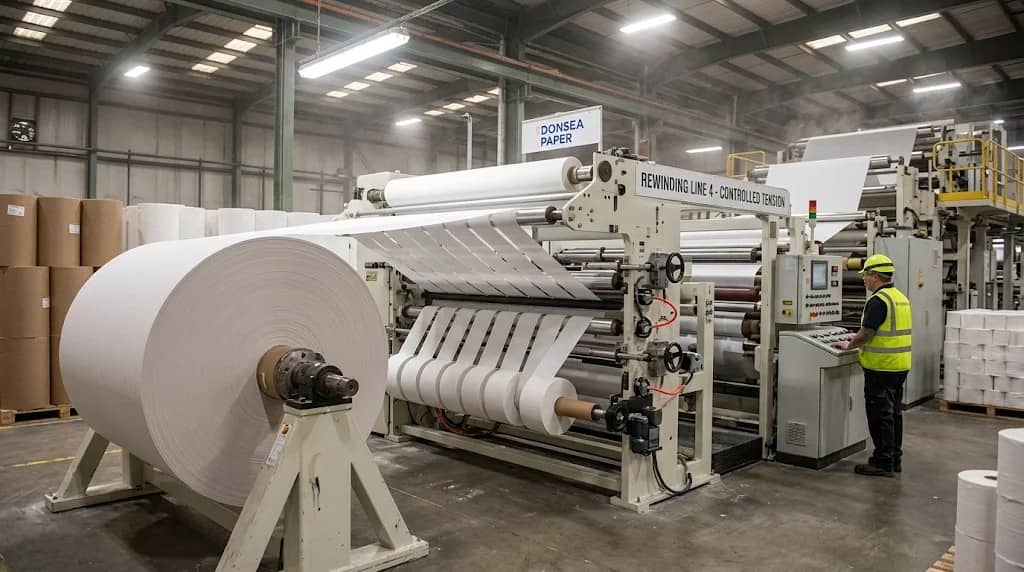
Why Rewinding Tension Matters for Tissue Paper Rolls
Rewinding is a key process in the processing of toilet paper, kitchen paper and commercial paper. During this process, the paper sheet is wound onto the paper core to form the final finished roll of paper. If the tension is not properly controlled, it may affect the density, shape, extraction performance and integrity of the paper.
Common issues include:
- Rolls that are too tight, resulting in excessive compression.
- Loose winding, which may cause unstable roll structures.
- Uneven tension across the paper width, creating irregular roll edges.
- Excessive web tension, increasing the risk of paper breaks.
Consistent rewinding tension helps manufacturers maintain stable roll dimensions and reliable dispensing performance. For example, Donsea’s Bamboo TAD Kitchen Paper is available in customized sheet sizes and roll configurations. Rewinding conditions should be selected according to the paper structure, roll dimensions, and intended application.
For commercial products, roll stability is especially important because the paper must work reliably with compatible dispensers.
How Slitting and Folding Affect Tissue Paper Usability
Cutting and folding determine the final size and extraction form of many household paper products. Although these processes may seem simple, if the processing is not precise enough, it may cause a series of problems, which in turn affect the appearance and daily use of the product.
Slitting and Edge Quality
Slitting equipment cuts large paper webs into narrower rolls or sheets.
Manufacturers should pay attention to:
- Blade condition and cutting accuracy.
- Consistency of finished roll width.
- Edge damage and paper dust.
- Alignment between cutting and winding operations.
Poor cutting conditions may cause rough edges, uneven rolls, or unnecessary material waste.
Folding and Sheet Alignment
Folded tissue products require accurate sheet positioning to ensure convenient dispensing. For commercial hand towels, inconsistent folding may cause sheets to overlap incorrectly or become difficult to pull from dispensers.
Donsea provides different commercial paper formats, including N-Fold Hand Towels and Hand Paper Towels. Consistent folding dimensions and alignment help improve dispensing reliability and reduce problems during commercial use.

How Packaging Protects Tissue Paper Performance
Packaging is the final converting stage, but its influence extends beyond product appearance. Tissue paper is sensitive to moisture, contamination, and physical compression. Inadequate packaging may affect the condition of the product during storage and transportation.
Manufacturers should evaluate several factors:
- Moisture protection: Packaging should provide suitable protection against environmental humidity.
- Compression control: Excessive pressure can deform tissue rolls and reduce product bulk.
- Package dimensions: Packaging should fit the finished product without unnecessary compression.
- Transportation durability: Outer cartons should protect products during stacking and shipping.
- Brand presentation: Printing, packaging materials, and labeling should meet the buyer’s requirements.
For private-brand tissue products, packaging specifications should be confirmed before mass production. At Donsea Paper, customers can utilize our OEM and ODM services to discuss customized product specifications and packaging solutions based on different market demands.
Different Tissue Products Require Different Converting Priorities
There is no one size fits all processing configuration for all household paper products. Manufacturers need to consider their intended use before selecting processing conditions.
| Tissue Product | Main Converting Considerations | Performance Priority |
| Facial Tissue | Ply bonding, folding, surface protection | Softness and dispensing |
| Toilet Paper | Embossing, rewinding, roll formation | Roll stability and sheet integrity |
| Kitchen Paper | Embossing, ply bonding, rewinding | Practical strength and absorbency |
| Commercial Hand Towels | Folding, slitting, sheet alignment | Dispensing and handling reliability |
For example, facial tissue needs careful handling to preserve its surface feel, while commercial hand towels require accurate folding and dimensions for compatible dispensing systems.
During the embossing and rewinding process of kitchen paper, special attention should be paid to its structure, as the product may come into contact with moisture during use. Donsea Paper has developed a variety of tissue product specifications based on different application needs, including bamboo toilet paper, bamboo facial tissue paper, bamboo kitchen paper, and commercial hand towels.
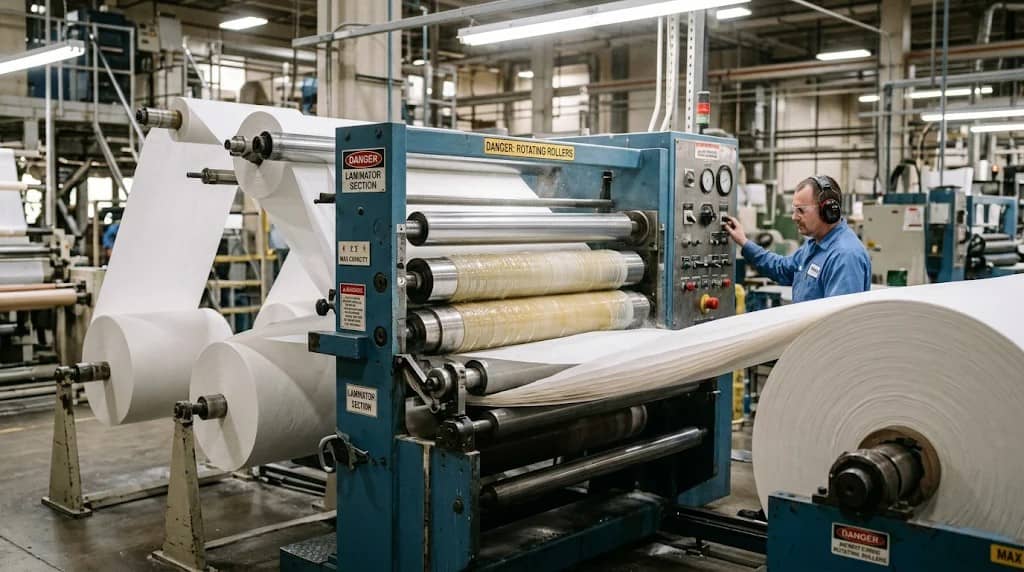
How Donsea Paper Approaches Consistent Tissue Product Manufacturing
To ensure product quality, effective collaboration must be achieved between various stages such as material selection, production conditions, processing procedures, and finished product inspection. Donsea Paper was founded in 2001 and is a manufacturer of household and commercial toilet paper products, providing OEM and ODM customization services.
In the process of production and product development, we focus on the following aspects:
1. Product specifications
Determine the paper weight, number of layers, single sheet size, roll paper specifications, and packaging requirements based on the expected use of the product.
2. Processing consistency
The process conditions for embossing, bonding, rewinding, slitting, and folding should be matched with the characteristics of various products.
3. Finished product inspection
Before product shipment, it is necessary to conduct strict inspections on the appearance, alignment, packaging status, and key performance indicators of the roll paper.
4. OEM customization
Customers can communicate their own brand (private label) packaging, product size, layer selection, and other specification requirements to develop paper products that meet their target market needs.
For additional information about inspection procedures throughout production, see our article on Quality Control in Tissue Paper Manufacturing. By considering the entire converting process rather than focusing on a single production parameter, manufacturers can better maintain product consistency and meet different customer requirements.
Conclusion
But the processes of cutting and wrapping household paper go far beyond that. For example, the final product structure and properties are affected by the embossing, interlayer lamination, rewinding, slitting, folding, and packaging.
The key for household paper manufacturers is linking the different processes to the raw material properties and the further use of the product.
Donsea Paper can tailor solutions to specifications and OEM requirements for a broad range of household paper products for home and commercial toilet paper customers. If you are in need of bamboo pulp facial tissues, bamboo pulp toilet paper, kitchen paper, or commercial hand towels, welcome to contact Donsea Paper together about product specifications and OEM needs.
Frequently Asked Questions
Q1: Does embossing damage household paper?
Embossing can affect the local fibre structure and paper strength. It is important not to select a pattern carelessly and/or apply too much pressure, as this can damage parts of the paper sheet; manufacturers also need to find a suitable compromise between the use of different pattern designs and process conditions.
Q2: What is the importance of rewinding tension for toilet paper?
Rewinding tension influences the tightness, shape, and stability of the paper roll. Tension prevents the paper roll from being too loose or too tight and tearing in use.
Q3: What is the interlayer bonding of quality household paper?
Interlayer bonding is to bond paper layers. Good bonding will help to reduce the chances of layer separation, thus maintaining the design of the product.
Q4: Do paper makers adapt their processing requirements to household paper?
Yes. When OEM, the buyer can negotiate with the manufacturer and customise according to its production capacity, such as embossed patterns, the number of layers, the single sheet size, paper roll specifications, folding methods, and packaging.