
What Determines the Quality of Bamboo Tissue Paper
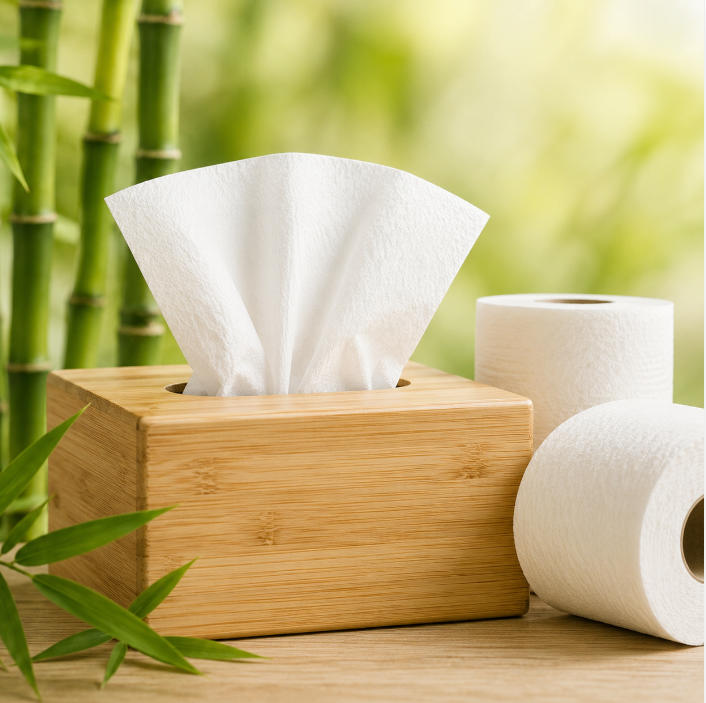
Bamboo tissue paper has been getting a lot of attention lately, as a more sustainable swap for the traditional wood-pulp tissue paper. Still, not every bamboo tissue is really the same. The quality depends on what happens first with raw material selection, then the whole manufacturing process, and how the fibers are treated. After that, there’s also the final product engineering, kind of like how it’s finished and how it’s put together. If you understand all of those moving parts, you can see why some bamboo tissue paper feels pleasantly soft and hold up, while others end up feeling a bit rough or they tear a little too easily.
What Defines Bamboo Tissue Paper Quality
The quality of bamboo tissue paper is typically assessed through several core performance indicators.
| Dimension | Definition Aspect | What It Means in Bamboo Tissue Paper Quality |
| Material Quality | Bamboo fiber purity | Degree to which the tissue is made from natural bamboo pulp (vs. mixed fibers) |
| Fiber Structure | Fiber integrity | Strength and length of bamboo fibers after pulping and processing |
| Softness | Skin comfort level | How smooth and non-irritating the tissue feels during use |
| Strength | Structural durability | Ability to resist tearing in both dry and wet conditions |
| Absorbency | Liquid uptake efficiency | Speed and capacity of absorbing moisture without breaking |
| Cleanliness | Hygiene standard | Absence of impurities, dust, and harmful chemical residues |
| Chemical Safety | Additive control | Minimal use of fluorescent agents, fragrances, or formaldehyde |
| Consistency | Product uniformity | Even thickness, stable texture, and reliable batch-to-batch quality |
| Environmental Quality | Sustainability level | Eco-friendly sourcing, low pollution processing, and biodegradability |
Key Factors to Consider for Manufacturing High-quality Bamboo Tissue Paper
1. Raw Material Purity and Bamboo Source
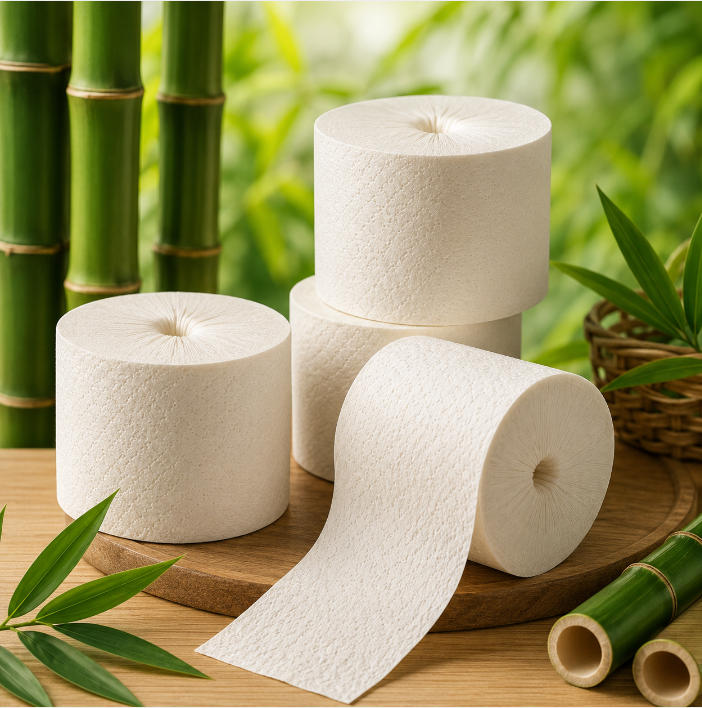
The base of bamboo tissue paper quality is basically in the bamboo itself, like, yes, the whole thing starts there. Better products mostly rely on mature bamboo that gets harvested at the right growth moment, when the fiber framework is strong and pretty stable. Also, the selection of species counts, since various bamboo types differ in fiber length, density, and the amount of cellulose.
Just as crucial is the purity of the starting material. Top bamboo tissue is often produced from 100% virgin bamboo pulp, while lower-tier lines might mix bamboo with recycled paper or even wood pulp. This sort of mixing can lower the price, but it can also mess with the softness, the brightness, and the uniformity a bit.
2. Pulping Process and Fiber Treatment
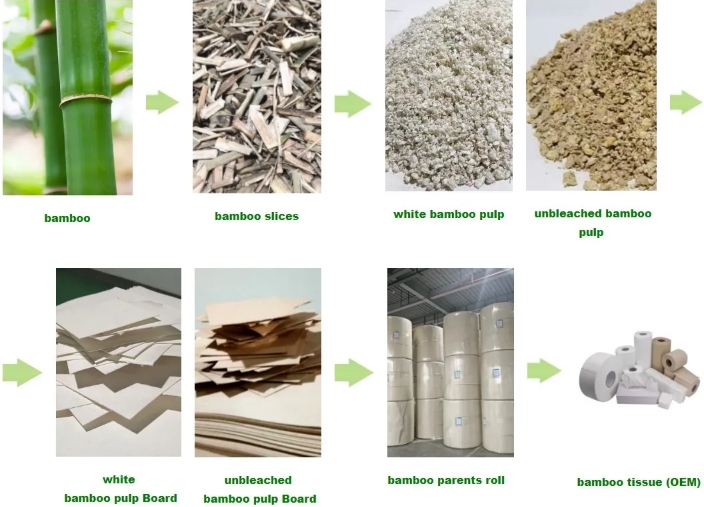
The way bamboo is converted into pulp significantly impacts final quality. The bamboo pulping process and fiber treatment stages are critical in determining bamboo tissue paper quality, directly influencing softness, strength, absorbency, and safety.
| Stage | Process Description | Impact on Tissue Quality |
| Pulping Process | Bamboo is processed using chemical or semi-chemical methods to separate cellulose fibers from lignin and hemicellulose. | Determines basic softness, strength, and fiber quality |
| Fiber Purification | Impurities and residual chemicals are removed through washing and controlled treatment. | Improves safety, whiteness, and cleanliness |
| Fiber Refining | Mechanical refining adjusts fiber length, flexibility, and bonding ability. | Balances softness and durability |
| Bleaching | Eco-friendly or chlorine-free bleaching improves brightness and hygiene. | Enhances appearance and skin safety |
| Fiber Modification | Fibers may be softened or treated to improve absorbency and texture. | Enhances comfort and liquid absorption |
| Pulp Slurry Formation | Refined fibers are mixed with water to form a uniform pulp slurry for sheet forming. | Ensures even distribution and consistent tissue structure |
3. Softness, Strength, and Thickness Balance
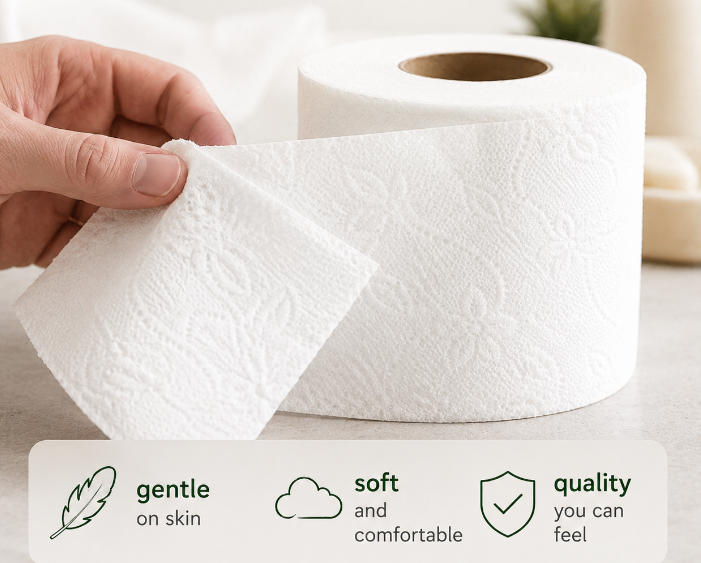
One of the main quality signs of bamboo tissue paper is that odd balance between softness and durability. People usually want something that feels gentle on their skin, but at the same time it should not just tear too easy when it gets used.
That balance is mostly about how the fibers are refined and how the sheets are built up, layer by layer. A multi-ply setup, meaning several thin sheets stacked and bonded together, tends to raise strength while still keeping the surface kind of pleasant. Still, if the softening process is too strong or too aggressive it can actually weaken the fibers, and then durability drops.
4. Absorbency and Porosity Control
Good bamboo tissue paper should take in moisture quickly, and pretty efficiently too. This is influenced by fiber arrangement, plus the whole porosity pattern inside the paper. In manufacturing, controlled pressing and drying help form tiny micro gaps between fibers. Those gaps act like little channels, so liquid absorption improves while the structure stays steadier. If processing is poorly controlled the tissue can end up overly dense, so absorbency becomes worse, or overly loose, so strength becomes worse.
5. Whiteness, Additions, and Safety Standards
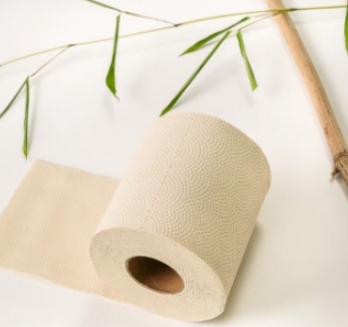
How white bamboo tissue looks is also a clue about quality. Higher whiteness is often reached using oxygen-based, or chlorine-free bleaching approaches, and these are generally considered safer and more eco-friendly.
But lower quality items may rely on too many optical brighteners or harsher chemicals, just to make the color seem brighter. That creates worries about skin safety, especially for facial tissues. So certification requirements and chemical residue checking really matter, because they show product reliability.
6. Manufacturing Precision and Quality Control
Consistency is another hallmark of high-quality bamboo tissue paper. Advanced tissue paper production lines ensure uniform thickness, even fiber distribution, and stable moisture content across batches.
Quality control systems monitor key parameters such as tensile strength, dust level, and layering adhesion.
| Quality Control Area | What Is Checked | Methods Used | Purpose |
| Basis Weight Control | Paper weight per unit area | Online sensors, automatic feedback systems | Maintains uniform thickness and strength |
| Moisture Control | Water content in tissue sheets | Infrared sensors, drying system adjustment | Prevents brittleness or softness imbalance |
| Thickness Uniformity | Evenness of sheet layers | Mechanical gauges, laser measurement systems | Ensures consistent hand feel and performance |
| Strength Testing | Tear resistance (dry & wet strength) | Tensile testers, burst strength tests | Ensures durability during use |
| Softness Evaluation | Surface smoothness and feel | Hand-feel panels, friction measurement tools | Guarantees comfort for skin contact |
| Absorbency Testing | Liquid uptake speed and capacity | Standard absorbency tests (capillary rate) | Ensures effective cleaning performance |
| Cleanliness Control | Dust, particles, microbial safety | Air filtration systems, particle counters | Maintains hygiene and safety standards |
| Defect Detection | Holes, stains, uneven areas | Automated vision inspection systems | Removes defective products before packaging |
| Final Packaging Check | Sealing, labeling, product protection | Manual + automated inspection | Preserves quality during storage and transport |

7. Packaging, Storage, and Final Performance
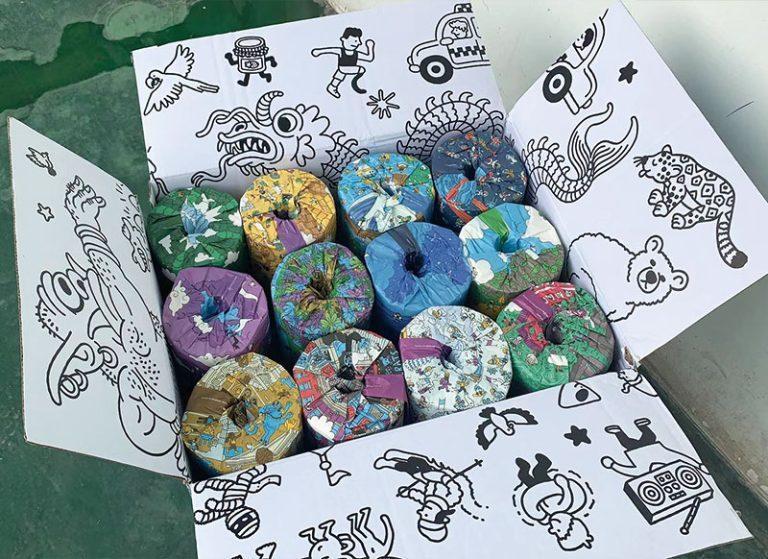
Even after production, quality can sort of be influenced by packaging and storage conditions, you know. Proper sealing protects bamboo tissue from moisture, dust, and contamination, which in turn keeps its softness as well as hygiene, more or less.
On the other hand, poor packaging or long-term exposure to humidity can weaken the fibers and cause the performance to drop. This is why quality bamboo tissue paper products often highlight airtight packaging and carefully controlled logistics, like everything is being watched.
Key Indicators of Premium Bamboo Tissue Paper
Premium bamboo tissue paper usually shows a mix of traits like these:
| Category | Key Indicator | What It Means in Premium Quality |
| Softness | Smooth touch | Feels gentle, non-irritating even for sensitive skin |
| Low roughness | No scratchy or coarse fiber sensation | |
| Strength | Wet strength | Does not easily break when damp or wet |
| Dry strength | Resists tearing during normal use | |
| Absorbency | Fast absorption | Quickly absorbs liquid without delay |
| Even distribution | Moisture spreads evenly across the sheet | |
| Structure | Uniform thickness | Consistent sheet quality without thin spots |
| Good fiber bonding | Fibers hold together firmly without falling apart | |
| Safety | No fluorescent agents | Free from whitening chemicals (optical brighteners) |
| Low chemical residue | Minimal harmful additives or irritants | |
| Low odor | No strong chemical or artificial fragrance smell | |
| Appearance | Clean color tone | Natural, even bamboo-derived color |
| Manufacturing | Clean embossing | Clear texture pattern that enhances softness and grip |
| Sustainability | Eco-friendly processing | Responsible pulp treatment and low environmental impact |
Final Thoughts
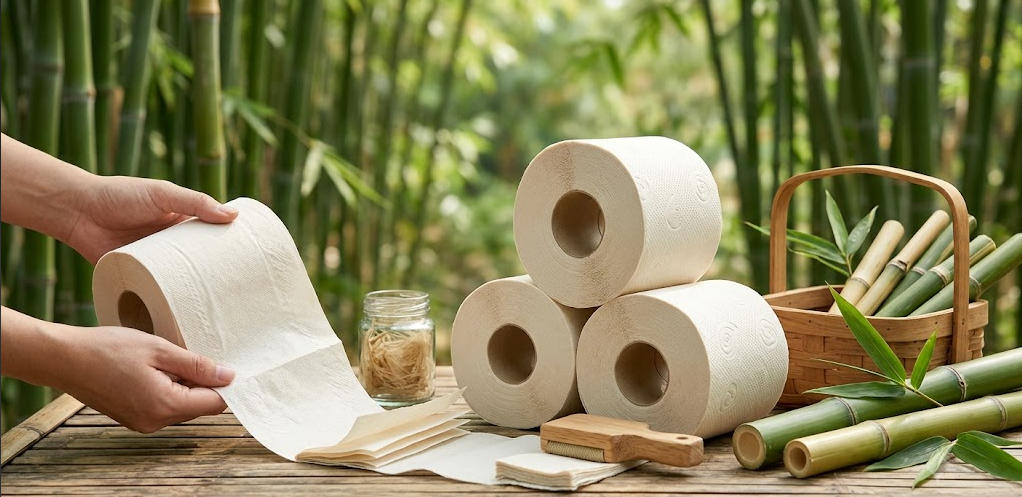
The quality of bamboo tissue paper is not decided by just one factor but by a chain of connected steps, starting from bamboo sourcing and pulping technology, then moving into manufacturing precision and packaging protection. When each stage is handled with care and control, the outcome becomes a tissue that feels soft, stays strong, absorbs well, and is safe too, so it becomes a genuinely competitive, eco-friendly alternative in the modern paper industry.