How Is Toilet Paper Quality Tested? A Buyer’s Guide
Toilet paper quality is typically evaluated through a combination of specification checks, physical tests, functional performance tests, appearance inspection, and packaging verification. For B2B buyers, quality should not be judged by softness or appearance alone. The delivered product should match the approved specifications and perform consistently from batch to batch.
This guide explains how buyers, importers, distributors, and commercial tissue purchasers can verify toilet paper quality before sample approval and during bulk shipment inspection.
What Does Toilet Paper Quality Mean?
For a buyer, toilet paper quality means more than how the product feels when used. A qualified product should meet the agreed specification and maintain consistent performance.
Key quality areas include:
- Specification compliance: GSM, ply, sheet dimensions, sheet count, roll length, core size, and roll diameter.
- Physical performance: tensile strength, thickness, and structural consistency.
- Functional performance: absorbency, softness, and appropriate wet performance.
- Water-related performance: disintegration under specified conditions where relevant.
- Manufacturing consistency: stable quality across samples, production batches, and shipments.
- Finished-product condition: clean surfaces, accurate perforation, properly wound rolls, and intact packaging.
For B2B purchasing, the most useful approach is to establish measurable acceptance criteria before production rather than relying on subjective product descriptions.
What Should Buyers Check Before Testing?
Testing starts with a clear product specification. Before evaluating samples or arranging a pre-shipment inspection, buyers should confirm exactly what has been agreed with the supplier.
| Specification | What Buyers Should Confirm | Why It Matters |
| Material | Agreed fiber or pulp type | Product consistency and positioning |
| Ply | 2-ply, 3-ply, etc. | Product structure |
| GSM | Target value or tolerance | Material consistency |
| Sheet size | Length × width | Actual usable sheet size |
| Sheet count | Sheets per roll | Quantity comparison |
| Roll length | Actual length or tolerance | Value per roll |
| Core diameter | Required core size | Dispenser compatibility |
| Roll diameter | Maximum/minimum range | Dispenser capacity |
| Packaging | Rolls, packs, cartons | Quantity and logistics |
| Labeling | Required product information | Shipment compliance |
The approved specification should become the reference point for sample testing and final inspection.
What Physical Tests Are Used for Toilet Paper?
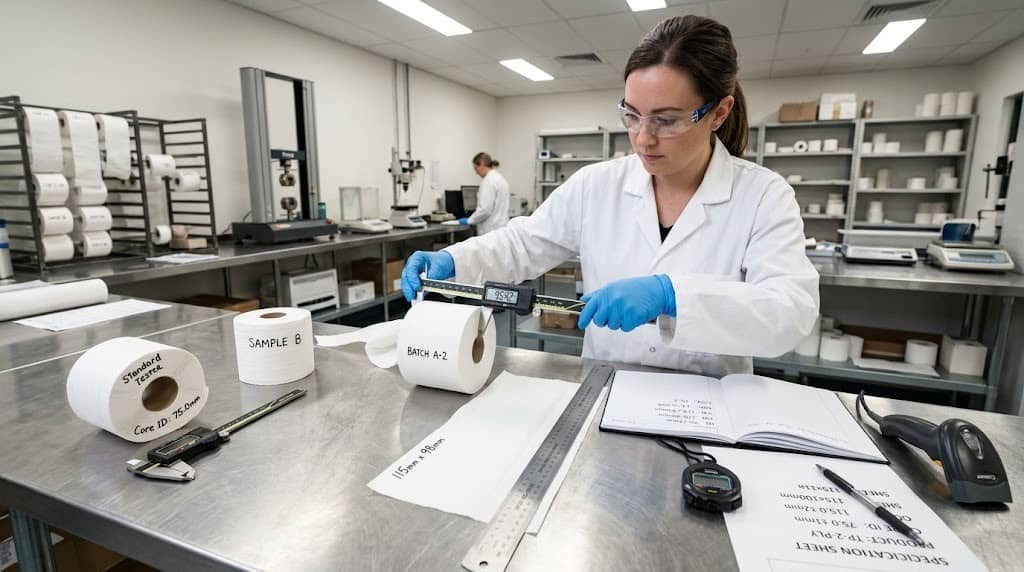
Physical testing verifies whether the delivered product matches the agreed construction and dimensions.
GSM: Is the Actual Weight Within Specification?
GSM, or grams per square meter, can be measured from a controlled sample and compared with the agreed range. Buyers should focus on actual batch consistency, not simply whether a product has a high or low GSM.
For information on selecting an appropriate basis weight for different tissue products, see our guide to toilet paper GSM.
Thickness: Does the Product Have Consistent Caliper?
Thickness should be evaluated separately from GSM. Two products with similar GSM can have different thickness because of differences in fiber structure, ply, embossing, and manufacturing conditions.
For buyers, the important point is to use the same measurement conditions when comparing supplier samples.
Ply: Does the Delivered Product Match the Specification?
Ply inspection confirms whether the agreed number of tissue layers is actually present. Buyers should also check whether the layers remain properly bonded and aligned during use.
Ply by itself should not be treated as a complete quality indicator. Strength, softness, absorbency, and other characteristics need to be evaluated separately.
Sheet Size, Count and Roll Length
A finished roll should be checked against the agreed sheet dimensions, sheet count, and roll length.
These measurements are particularly important when comparing quotations from different suppliers. A lower price per roll does not necessarily represent a lower cost if the roll contains fewer sheets or less usable paper.
How Are Strength, Absorbency and Softness Evaluated?
Physical measurements show whether a product meets its specification, while functional tests help determine how the tissue performs during use.
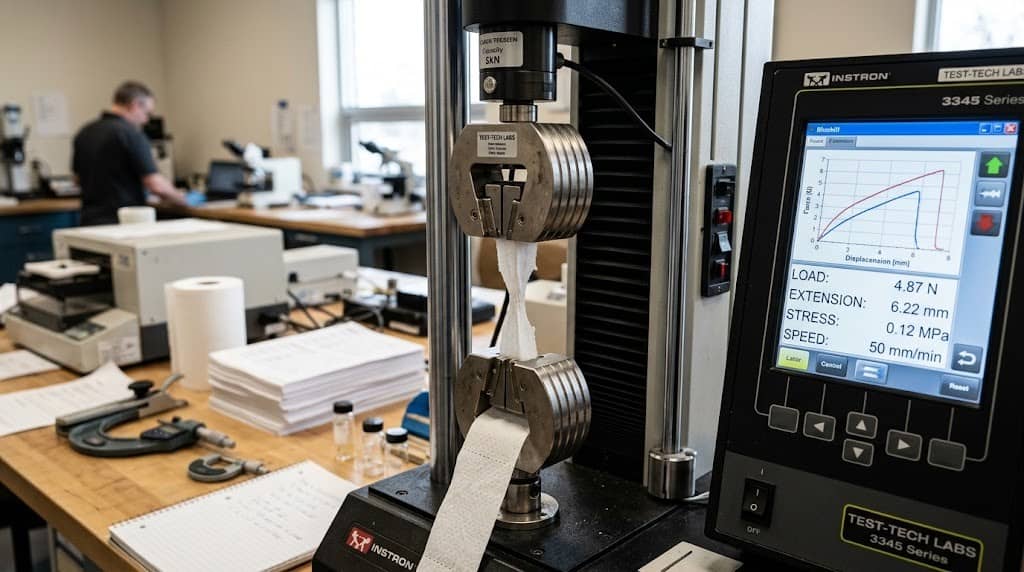
Tensile Strength
Tensile testing measures the force required to break a tissue sample. Depending on the testing program, strength may be evaluated in the machine direction (MD) and cross direction (CD).
For buyers, tensile strength is useful for checking whether different production batches maintain consistent structural performance.
Wet Strength
Wet strength evaluates how well tissue retains its integrity after contact with water or another liquid. It is particularly relevant when evaluating products designed for higher liquid-handling requirements, such as Bamboo TAD Kitchen Paper and Hand Paper Towel.
The required wet strength should be based on the product’s intended use rather than simply maximizing strength.
Absorbency
Absorbency can be evaluated using a defined test procedure that measures how quickly or how much liquid a tissue sample can take up.
For supplier comparisons, buyers should use the same sample preparation, liquid conditions, and measurement procedure. Otherwise, test results from different suppliers may not be directly comparable.
Softness
Softness is more difficult to reduce to a single simple measurement. Instrumental methods can be combined with controlled sensory evaluation.
For purchasing decisions, the key is consistency: samples from different suppliers should be evaluated using the same conditions and criteria rather than relying on an informal “soft” or “premium” claim.
How Are Disintegration and Water-Related Performance Checked?
For toilet paper, water-related behavior is an important quality consideration.
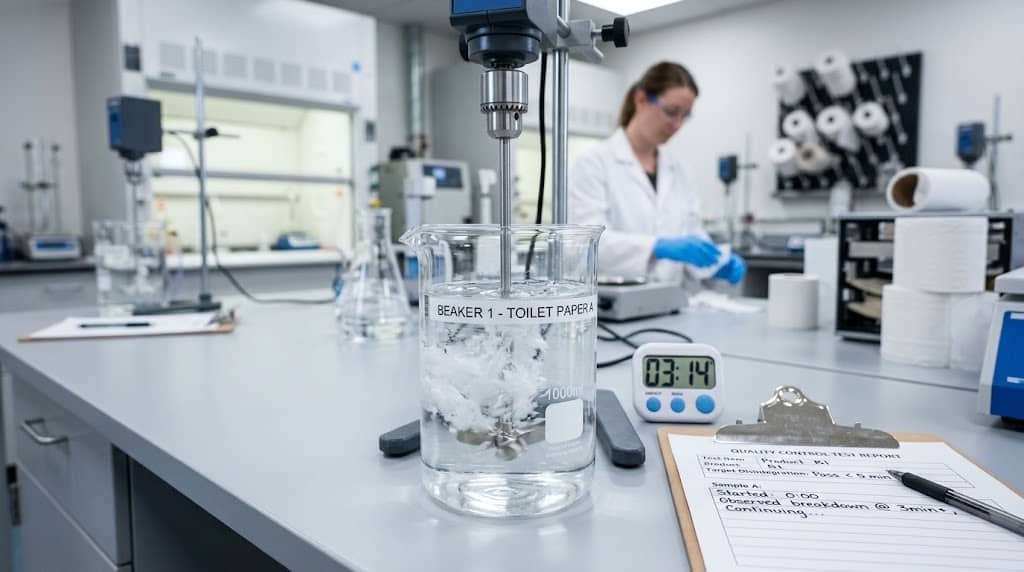
Disintegration
A disintegration test evaluates how tissue breaks down when exposed to water under defined conditions. Results can be affected by factors such as fiber structure, ply, bonding, agitation, and test conditions.
Buyers should therefore record the test method and conditions together with the result. A test result without its testing conditions may be difficult to compare.
Disintegration vs. Flushability
These terms should not be treated as interchangeable.
- Disintegration refers to how a tissue sample breaks down under defined test conditions.
- Flushability is a broader performance consideration involving the product and the flushing environment.
- Septic compatibility is a separate consideration depending on the wastewater or septic system.
Therefore, buyers should avoid accepting an unsupported “flushable” claim simply because a tissue sample disintegrates in water.
What Should Buyers Inspect in Finished Toilet Paper?
Laboratory testing is only part of quality control. Finished-product inspection can identify problems that may not appear in laboratory measurements.
1. Surface and Embossing
Check for uneven embossing, wrinkles, damaged surfaces, contamination, or obvious differences between rolls.
2. Perforation
Perforation should be reasonably consistent and allow sheets to separate as specified. Excessively weak or irregular perforation can affect the user experience and actual sheet consumption.
3. Roll Construction
Inspect for loose winding, telescoping, uneven edges, deformation, or damaged cores. The finished roll should maintain its shape during packaging, transport, storage, and dispensing.
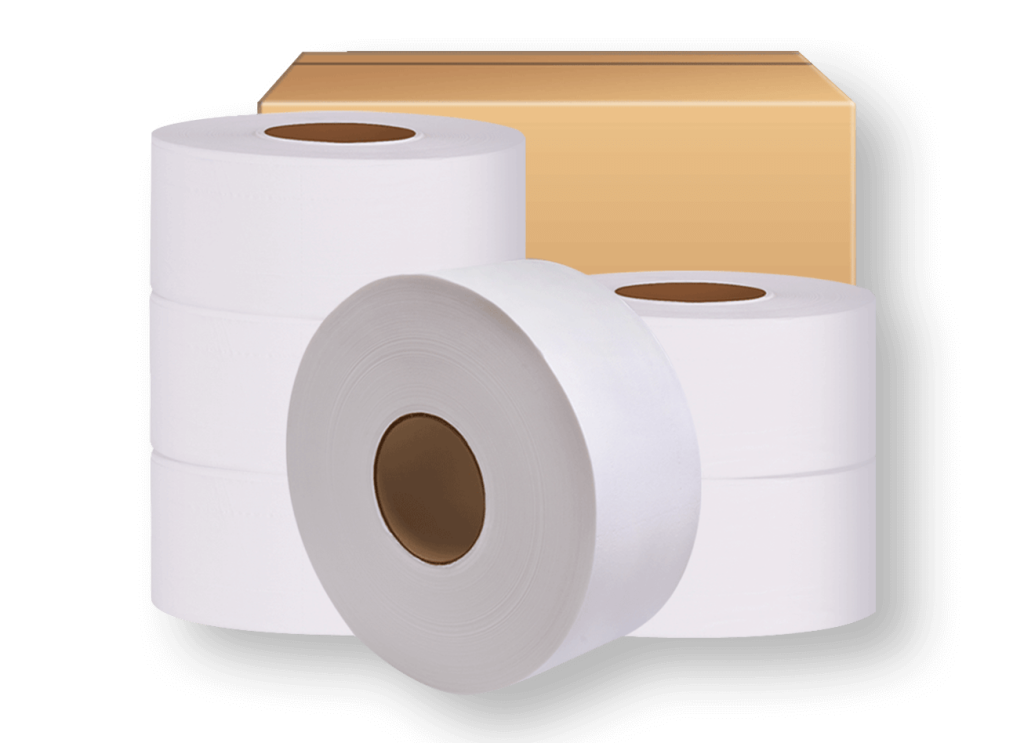
Products such as Mini Jumbo Toilet Rolls also require particular attention to core and roll dimensions because dispenser compatibility can depend on these measurements.
4. Packaging
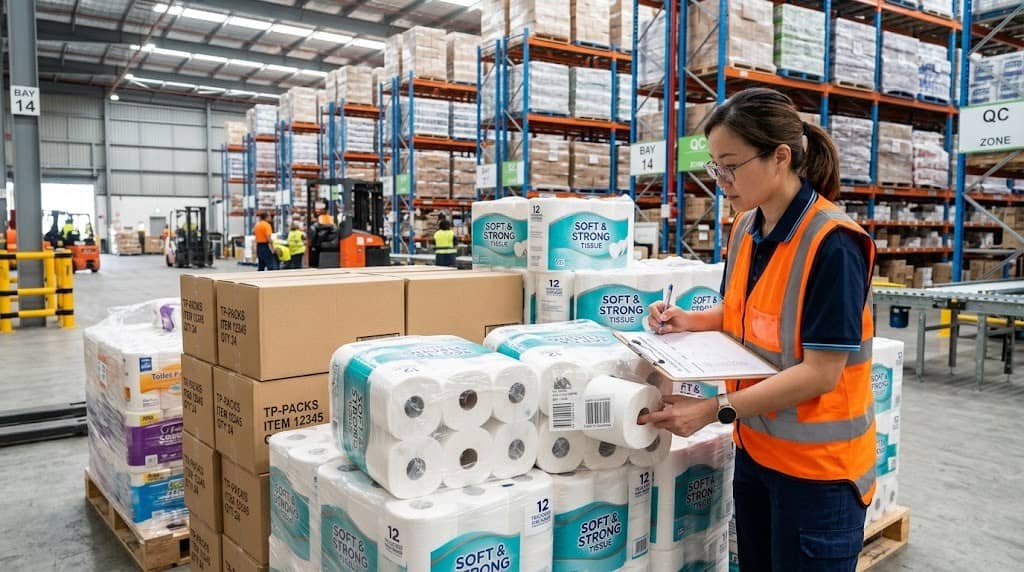
Inspect carton and individual packaging for moisture exposure, crushing, tearing, incorrect quantities, and labeling errors. Packaging quality is part of shipment acceptance because damaged packaging can affect the condition of the tissue itself.
How Should Buyers Inspect a Toilet Paper Shipment?
A practical B2B quality-control process can follow six steps:
Step 1: Confirm the approved specification.
Use the signed specification, approved sample, purchase order, and packaging requirements as the reference.
Step 2: Inspect the shipment condition.
Check cartons, packaging, labels, moisture exposure, and visible damage.
Step 3: Select samples according to the agreed inspection plan.
Sampling should follow the buyer’s quality agreement or an applicable sampling procedure rather than an arbitrary sample number.
Step 4: Verify physical specifications.
Check GSM, ply, sheet size, sheet count, roll length, core diameter, and roll diameter as applicable.
Step 5: Conduct product-specific performance tests.
Depending on the product, this may include tensile strength, wet strength, absorbency, softness, or disintegration.
Step 6: Record deviations.
A simple inspection record can use the format:
Specification → Actual Result → Tolerance → Pass/Fail → Corrective Action
This creates a traceable basis for discussing quality issues with the manufacturer.
Toilet Paper Quality Control Checklist for Buyers
| Checkpoint | What to Verify | When to Check |
| Material | Agreed fiber/pulp type | Pre-production/sample |
| GSM | Actual vs. specification | Sample/batch |
| Ply | Number of layers | Sample/batch |
| Sheet size | Length × width | Sample/batch |
| Sheet count | Sheets per roll | Batch |
| Roll length | Actual usable length | Batch |
| Core diameter | Dispenser requirement | Batch |
| Roll diameter | Dispenser capacity | Batch |
| Tensile strength | MD/CD where applicable | QC testing |
| Absorbency | Product-specific requirement | QC testing |
| Softness | Consistent evaluation method | Sample comparison |
| Disintegration | Required water-related performance | Product-specific |
| Packaging | Quantity, labels, damage | Final inspection |
| Certification | Validity and scope | Before order |
The most effective buyer quality check is not a single laboratory result. It is the consistency between the approved specification, tested sample, production batch, and delivered shipment.
For manufacturers and distributors, a documented quality-control process also makes it easier to compare suppliers objectively and resolve deviations before they become recurring purchasing problems.
FAQ
Q1. What are the main quality tests for toilet paper?
Common checks include GSM, thickness, ply, sheet dimensions, roll length, tensile strength, absorbency, softness, disintegration, and finished-roll inspection. The exact testing program should depend on the product specification and intended use.
Q2. How do you test toilet paper GSM?
A representative tissue sample is weighed over a known area and the result is calculated as grams per square meter. Buyers should compare the measured value with the agreed specification and tolerance.
Q3. How do you test toilet paper strength?
Tensile strength is commonly evaluated by measuring the force required to break a tissue sample. Depending on the quality specification, testing may distinguish between machine direction and cross direction.
Q4. How is toilet paper softness evaluated?
Softness can be assessed through instrumental measurement, controlled sensory evaluation, or a combination of both. For supplier comparisons, the same evaluation method and conditions should be used for each sample.
Q5. What is a toilet paper disintegration test?
A disintegration test evaluates how tissue breaks down in water under defined conditions. The result should be interpreted together with the test method and conditions rather than as an independent guarantee of flushing performance.