
Tissue Paper Supplier Checklist for Importers: Quality, Certification & Procurement Guide
Choosing a tissue paper supplier is an important decision for importers, distributors, retailers, hospitality suppliers, and private-label brands. A competitive quotation alone does not show whether a supplier can consistently meet product specifications, quality requirements, certification needs, packaging standards, and delivery schedules.
Before importing tissue paper, buyers should evaluate the supplier across eight areas: product specifications, raw materials, quality control, certifications, OEM capability, production capacity, MOQ, and export logistics. This tissue paper supplier checklist provides a practical framework for evaluating a tissue paper manufacturer before approving samples or placing a commercial order.

How Do You Evaluate a Tissue Paper Supplier?
Importers should evaluate a tissue paper supplier based on product specifications, raw-material traceability, quality control, certifications, OEM capability, production capacity, MOQ, lead time, packaging, and export experience. Before placing a bulk order, buyers should verify documentation, test samples, approve final specifications, and confirm production and shipping requirements in writing.
Tissue Paper Supplier Evaluation Checklist
| Evaluation Factor | What Importers Should Verify |
| Product specifications | GSM, ply, sheet size, sheet count, roll diameter and core |
| Raw materials | Bamboo pulp, virgin pulp, recycled fiber or specified blend |
| Quality | Strength, absorbency, softness, dimensions and perforation |
| Certification | Certificate holder, scope, validity and applicable products |
| OEM | Custom product specifications and private-label packaging |
| MOQ | Minimum order quantity for standard and customized products |
| Capacity | Monthly production capacity and available production slots |
| Lead time | Sample, production and shipping schedules |
| Packaging | Carton, pallet, labeling and transport protection |
| Traceability | Batch identification and quality records |
| Logistics | Export documentation, Incoterms and shipping arrangements |

What Should Importers Check When Choosing a Tissue Paper Supplier?
A professional tissue paper manufacturer should be evaluated on more than product price. Importers need to determine whether the supplier can provide consistent quality and support the complete purchasing process from sample development to repeat orders.
Key questions include:
- Does the manufacturer produce the required tissue category?
- Are product specifications clearly documented?
- Is the raw-material source identifiable?
- Does the factory have a defined quality-control process?
- Are applicable certifications current and verifiable?
- Can the supplier provide OEM or private-label production?
- What are the MOQ and production lead times?
- Can the supplier support international packaging and shipping?
- Can production batches be traced if a quality issue occurs?
A supplier that can answer these questions with documentation provides a stronger basis for procurement than a supplier offering only a low quotation.
Tissue Paper Specifications: GSM, Ply, Size and Core
Before comparing suppliers, importers should establish a clear product specification. The same product category can have significantly different performance and cost depending on its construction. Important tissue paper roll size and specifications include:
| Specification | What to Confirm |
| Raw material | Bamboo pulp, virgin wood pulp, recycled fiber or specified blend |
| GSM | Actual basis weight and production tolerance |
| Ply | 1-ply, 2-ply, 3-ply or 4-ply |
| Sheet size | Length and width of individual sheets |
| Sheet count | Number of sheets per roll or pack |
| Roll diameter | Storage and dispenser compatibility |
| Core size | Compatibility with the target dispenser |
| Color | White, natural or customized |
| Embossing | Pattern and customization requirements |
| Packaging | Individual wrap, paper, plastic or custom packaging |
These parameters should appear consistently on the quotation, product specification sheet, approved sample, and purchase order. For example, Donsea Paper’s bamboo toilet paper page specifies bamboo pulp, 15.5–16 gsm, 2–4 ply, 190–400 sheets, 38–45 mm core options, and customized sheet sizes and packaging.
Raw Materials and Fiber Source Verification
The raw material affects tissue softness, strength, absorbency, appearance, and the sustainability claims that can be made about the finished product. When evaluating a bamboo tissue paper supplier, buyers should ask:
- What type of pulp is used?
- Is the fiber virgin or recycled?
- What percentage of the specified material is used?
- Can the supplier provide supporting documentation?
- Is the raw-material specification consistent between orders?
- Can material substitutions occur during production?
For bamboo tissue products, buyers should distinguish between a product containing bamboo fiber and a product manufactured according to a specified bamboo pulp composition.
This is particularly important when products are marketed using claims such as bamboo-based, tree-free, sustainable, or FSC-certified. Importers should therefore evaluate both the product specification and the documentation supporting the relevant material claim.
Tissue Paper Quality Control and Testing
A good sample does not necessarily prove that every production batch will meet the same specification. Importers should therefore evaluate the manufacturer’s quality-control system. Depending on the product, tissue paper quality inspection may cover:
- GSM consistency
- Sheet dimensions
- Ply bonding
- Tensile strength
- Wet strength where applicable
- Absorbency
- Softness
- Perforation
- Roll diameter
- Core diameter
- Packaging integrity
- Printing and labeling accuracy
Buyers should also ask how non-conforming products are identified and handled. One useful question is: Can the manufacturer trace a finished product back to its production batch and relevant raw materials?
Batch traceability can help suppliers investigate complaints, identify production deviations, and improve subsequent orders. Donsea Paper states that its quality-traceability system can trace quality problems back to the relevant order batch. Donsea Paper

Certifications and Regulatory Compliance
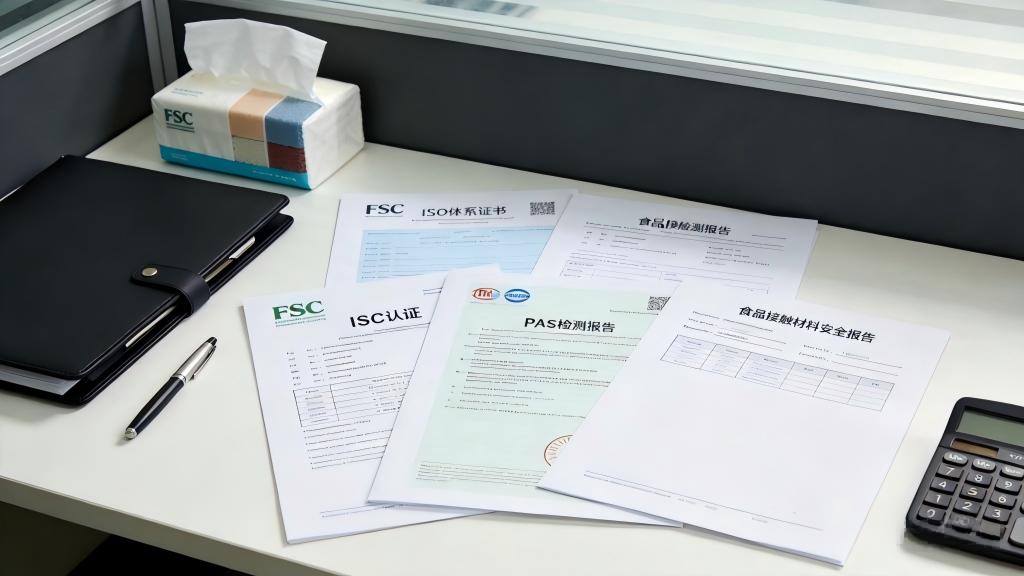
Certification requirements depend on the destination market, product application, and environmental or safety claims made on the packaging. Depending on the project, importers may need to review:
- FSC certification
- ISO management-system certification
- Social-compliance documentation
- PFAS testing
- Food-contact documentation where applicable
- Product safety reports
- Customer-specific compliance requirements
Importers should not rely solely on a certification logo. Verify the:
- Certificate holder
- Certificate number
- Certification scope
- Validity period
- Applicable products or materials
For example, Donsea Paper publishes certification information covering its manufacturing and product-related documentation. Buyers should verify the current certificate and applicable scope before using certification claims in their own market. This approach is particularly important for private-label products because the importer may become responsible for the claims printed on the final packaging.
OEM, Private Label and Packaging Capabilities
For retailers and brand owners, the ability to customize tissue products can be as important as the basic product quality. A capable private label tissue paper supplier should be able to discuss:
- Custom GSM
- Ply configuration
- Sheet dimensions
- Sheet count
- Core size
- Roll dimensions
- Embossing
- Product color
- Individual packaging
- Printed packaging
- Outer cartons
- Brand labeling
- Production arrangements
- Export shipping arrangements
Buyers should clearly distinguish between standard products and genuinely customized products.
Donsea Paper provides OEM/ODM customization covering areas such as layers, sheets, core, gram weight, embossing, packaging, production, and shipping arrangements. Donsea OEM/ODM information For customized orders, all critical parameters should be converted into a written specification before mass production.
Production Capacity, MOQ and Lead Time
Production capacity, tissue paper MOQ, and lead time should be evaluated together. A standard product may have a different MOQ from a private-label product because custom packaging, printing, embossing, sheet dimensions, and production setup can affect minimum production quantities.
Before placing an order, importers should confirm:
- Standard-product MOQ
- OEM/private-label MOQ
- MOQ per SKU
- MOQ per packaging design
- Sample-order requirements
- Standard production lead time
- Customized production lead time
- Repeat-order lead time
- Peak-season capacity
Donsea Paper’s company information reports approximately 35,200 m² of factory area, around 260 employees, and approximately 2,380 tons of monthly output, with multiple production lines. These figures should be confirmed with the supplier for the specific order and current production schedule. For importers, published capacity is useful evidence, but actual available production capacity should always be confirmed before issuing a purchase order.
Packaging and Export Logistics
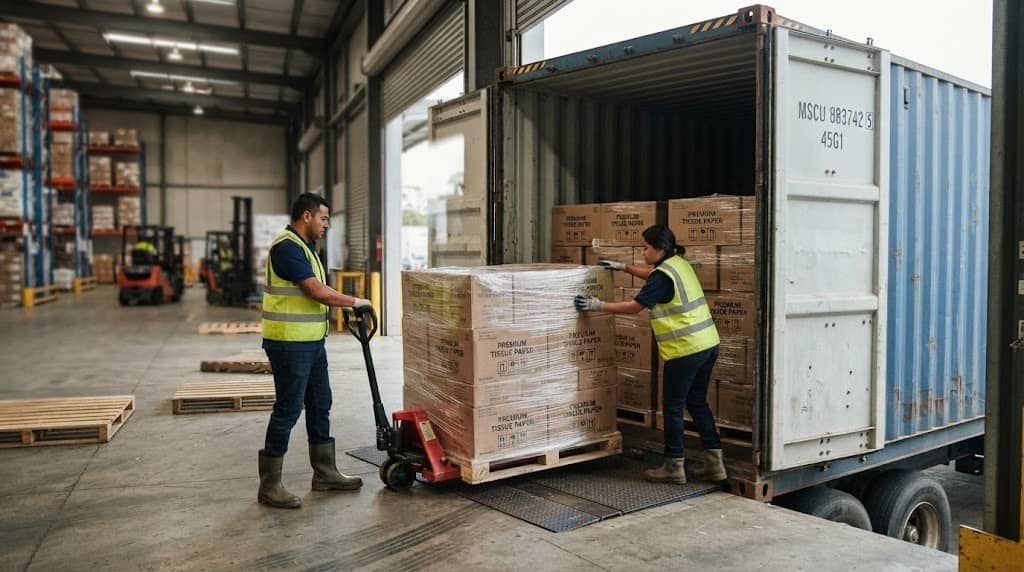
Tissue products can occupy substantial warehouse and shipping volume, so packaging directly affects transportation efficiency and landed cost. Before ordering, confirm:
- Units per carton
- Carton dimensions
- Carton gross weight
- Pallet configuration
- Container loading quantity
- Moisture protection
- Packaging materials
- Shipping marks
- Product labels
- Port of loading
- Incoterms
- Production-to-shipment lead time
The supplier should also explain how packaging is designed for international transportation. For importers, the relevant figure is not simply the factory quotation. The landed cost may include:
- Product cost
- Packaging
- Inland transportation
- International freight
- Insurance where applicable
- Duties and taxes
- Customs-related costs
- Local delivery
Buyers should also compare cost per roll, pack, sheet, or usable unit rather than comparing suppliers only on a per-carton basis.
Sample Approval and Pre-Production Control
A product sample should be treated as a technical reference rather than simply a demonstration of appearance. A practical tissue paper procurement process is:
Supplier Search → Specification Confirmation → Quotation & MOQ → Sample Approval → Certification Verification → Packaging Approval → Purchase Order → Pre-Production Confirmation → Mass Production → Quality Inspection → Shipment
For customized products, both the tissue and packaging should be approved before mass production. The approved specification should record critical parameters such as:
- Material
- GSM
- Ply
- Sheet dimensions
- Sheet count
- Core diameter
- Roll diameter
- Embossing
- Packaging configuration
- Artwork
- Labeling requirements
This process reduces the risk of receiving a finished product that differs from the sample originally evaluated.
What Should a Tissue Paper Manufacturer Be Able to Show?
A credible tissue paper manufacturer should be able to provide evidence rather than relying only on product claims.
Importers can request:
- Factory information
- Product specification sheets
- Raw-material information
- Quality-control procedures
- Applicable certificates
- Test reports
- Product samples
- Packaging specifications
- Production lead-time information
- Export documentation
- Batch or order traceability information
Donsea Paper was established in 2001 and manufactures bamboo toilet paper, bamboo kitchen paper, facial tissue, hand towels, central pull tissue, mini jumbo rolls, and other tissue products. The company also provides OEM/ODM customization for international customers.
Tissue Paper Supplier Checklist for Importers
Before approving a new supplier, buyers can use this checklist:
| Category | Verification Question |
| Product | Does the supplier manufacture the required tissue category? |
| Material | Is the fiber source documented? |
| Specifications | Are GSM, ply, sheet size and core clearly defined? |
| Quality | Are strength, absorbency and dimensional controls available? |
| Certification | Are certificates current and applicable? |
| Traceability | Can production batches be identified? |
| OEM | Can product and packaging be customized? |
| MOQ | Is the minimum quantity suitable for the business? |
| Capacity | Can the factory support the required volume? |
| Lead Time | Are sample, production and shipping schedules defined? |
| Packaging | Is the packaging suitable for international transportation? |
| Samples | Can samples be tested before mass production? |
| Logistics | Can the supplier provide export documentation? |
| Repeat Orders | Can specifications and quality be maintained consistently? |
FAQ About Choosing a Tissue Paper Supplier
Q1: How do I verify a tissue paper manufacturer’s quality?
A1: Request product specifications, samples, applicable test reports, quality-control information, certifications, and batch traceability records. Compare the approved sample with the final production specification.
Q2: What specifications should I include when ordering tissue paper?
A2: Important specifications include material, GSM, ply, sheet size, sheet count, roll diameter, core diameter, embossing, color, packaging, and labeling requirements.
Q3: How long does tissue paper production take?
A3: Lead time depends on product specifications, order quantity, customization, packaging requirements, and the manufacturer’s production schedule. Confirm sample, production, and shipping lead times before ordering.
Q4: How can I compare tissue paper suppliers?
A4: Compare suppliers using the same criteria: specifications, quality, certification, MOQ, price, production capacity, lead time, packaging, logistics, customization, and after-sales support.