2 Ply vs. 3 Ply vs. 4 Ply Bamboo Facial Tissue: Which Should You Choose?
When choosing bamboo facial tissue, ply count is one of the most important specifications to evaluate—but it should not be considered in isolation. A 2-ply, 3-ply, or 4-ply tissue can deliver very different levels of softness, strength, thickness, cushioning, material consumption, and perceived quality. For retailers, importers, hotels, distributors, and private-label brands, choosing the right ply is therefore not simply a question of selecting the highest number. The better approach is to match ply, GSM, bamboo pulp quality, sheet size, embossing, packaging, target application, and price positioning.
For example, 2-ply bamboo facial tissue may be ideal for high-volume everyday use, while 3-ply often provides a strong balance between softness, strength, and cost. 4-ply bamboo facial tissue can be more appropriate for premium products where thickness and cushioning are important selling points.
This guide explains the differences between 2-ply, 3-ply, and 4-ply bamboo facial tissue and provides a practical framework for choosing the right specification for your market.
What Does “Ply” Mean in Bamboo Facial Tissue?
Ply refers to the number of tissue layers combined to form one finished sheet of facial tissue. A 2-ply tissue sheet consists of two layers, while a 3-ply sheet consists of three layers and a 4-ply sheet consists of four layers. These layers are manufactured and combined to create the final tissue structure.
However, ply should not be confused with GSM. GSM (grams per square meter) measures the basis weight of the tissue material, while ply describes the number of layers used to construct the finished sheet. Two products can therefore have the same ply count but different GSM, fiber structures, softness, or strength.
For bamboo facial tissue, the final performance depends on the interaction between several specifications:
- Ply count
- GSM
- Bamboo pulp quality
- Fiber characteristics
- Tissue manufacturing process
- Creping
- Embossing
- Layer bonding
- Sheet dimensions
- Moisture content
- Packaging format
This is why simply comparing “2 ply” with “3 ply” does not provide enough information to determine which product is better.
What Is 2-Ply Bamboo Facial Tissue?
2-ply bamboo facial tissue contains two tissue layers combined into one sheet. It generally provides a practical balance of softness, strength, thickness, and material consumption. Because it uses fewer layers than 3-ply or 4-ply tissue, 2-ply products can be particularly attractive for markets where cost efficiency and high-volume consumption are important.
Typical characteristics include:
- Moderate thickness
- Good everyday softness
- Good flexibility
- Adequate strength for routine use
- Lower material consumption
- Competitive production cost
- Suitable for high-frequency consumption
2-ply is often a practical option for household, office, restaurant, and other everyday applications.
What Is 3-Ply Bamboo Facial Tissue?
3-ply bamboo facial tissue combines three tissue layers into one finished sheet. Adding another layer can increase the perceived thickness and cushioning of the tissue. When supported by good-quality bamboo pulp and appropriate manufacturing processes, 3-ply tissue can provide a more substantial hand feel than standard 2-ply products.
Typical characteristics include:
- Higher thickness than 2-ply
- Enhanced cushioning
- Very good softness
- Improved overall sheet strength
- More substantial tactile feel
- Higher material consumption than 2-ply
- Suitable for premium everyday products
For many brands, 3-ply represents a practical middle ground between cost efficiency and premium user experience.
What Is 4-Ply Bamboo Facial Tissue?
4-ply bamboo facial tissue contains four layers in each finished sheet. The additional layers can provide greater thickness and cushioning, making 4-ply products suitable for premium and luxury positioning.
Typical characteristics include:
- High thickness
- Strong cushioning
- Premium tactile experience
- High overall sheet integrity
- Greater material consumption
- Higher production cost
- Suitable for premium or luxury positioning
However, 4-ply does not automatically mean that the tissue is the highest-quality product in every category. Fiber quality, GSM, softness, manufacturing consistency, and embossing can all influence the actual user experience.
2 Ply vs. 3 Ply vs. 4 Ply Bamboo Facial Tissue at a Glance
The following comparison provides a practical starting point for buyers evaluating different ply options:
| Factor | 2 Ply | 3 Ply | 4 Ply |
| Layer Count | 2 | 3 | 4 |
| Thickness | Moderate | High | Very High |
| Softness | Good | Very Good | Excellent potential |
| Cushioning | Moderate | High | Very High |
| Strength | Good | Very Good | High |
| Material Consumption | Lower | Medium | Higher |
| Production Cost | Lower | Medium | Higher |
| Perceived Quality | Standard | Premium | Luxury |
| Everyday Use | Excellent | Excellent | Good |
| Premium Retail | Good | Excellent | Excellent |
| High-Volume Applications | Excellent | Good | Less economical |
| Luxury Positioning | Limited | Good | Excellent |
These characteristics are general guidelines rather than absolute performance values. A well-engineered 2-ply tissue can outperform a poorly manufactured 3-ply tissue in softness or strength. For this reason, buyers should evaluate the complete specification rather than relying on ply count alone.

How Does Ply Affect Bamboo Facial Tissue Performance?
Ply affects the physical structure of facial tissue and can influence its thickness, cushioning, strength, and tactile characteristics. However, its effect is closely connected to other production variables.
1. Softness and Skin Comfort
Softness is one of the most important purchasing factors for facial tissue because the product is commonly used directly on the face, nose, and other sensitive areas. Increasing the number of plies can create a thicker and more cushioned sheet. The additional layers can contribute to a softer and more substantial hand feel.
However, ply count is not the only factor determining softness. The quality and processing of bamboo pulp can have a significant effect on the final tissue. Fiber length, fiber bonding, refining conditions, creping, embossing, and tissue density can all influence how the sheet feels against the skin. For example, a poorly processed 4-ply tissue may feel rougher than a well-manufactured 2-ply product made from high-quality fibers.
For buyers targeting sensitive-skin or premium markets, it is therefore better to evaluate:
Ply + GSM + fiber quality + surface softness + manufacturing consistency
rather than selecting a product based solely on the number of layers.
2. Strength and Tear Resistance
Another important difference between ply levels is sheet integrity. When multiple layers are combined, the finished sheet can have greater structural stability. This can improve the user’s perception of strength and reduce the likelihood of the tissue immediately tearing during normal handling.
In general:
- 2-ply: suitable for normal everyday applications
- 3-ply: stronger and more substantial
- 4-ply: offers a thicker structure and high overall sheet integrity
However, ply count should not be treated as a direct measurement of tensile strength.
Strength also depends on:
- Bamboo fiber quality
- Fiber bonding
- GSM
- Refining
- Moisture level
- Embossing pattern
- Layer bonding
- Manufacturing process
This distinction is particularly important for B2B buyers. A manufacturer should be able to provide product specifications and samples rather than asking buyers to judge quality solely from ply count.
3. Absorbency
A common misconception is that more plies automatically mean higher absorbency.
That is not necessarily true. Absorbency depends on the structure and porosity of the tissue, not simply on the number of layers.
Important factors include:
- Fiber characteristics
- Tissue density
- GSM
- Creping
- Embossing
- Layer structure
- Internal void space
- Manufacturing conditions
A 4-ply tissue may have a greater total material structure, but that does not automatically guarantee proportionally higher liquid absorption. For facial tissue, the optimal balance is often more important than maximizing absorbency. A product needs to remain soft and comfortable while maintaining sufficient strength when exposed to moisture.
4. Thickness and Cushioning
Thickness is one area where ply has a more direct influence. In general:
- 2-ply → moderate thickness
- 3-ply → higher thickness
- 4-ply → very high thickness
Additional layers can create a more cushioned structure, which is particularly noticeable when the tissue is folded or pressed. This creates an important distinction in product positioning.
- A 2-ply tissue can emphasize: Lightweight + practical + cost-efficient
- A 3-ply tissue can emphasize: Softness + strength + balanced premium performance
- A 4-ply tissue can emphasize: Thickness + cushioning + premium tactile experience
For private-label brands, this difference can help create distinct product tiers within the same bamboo tissue product family.
Does Higher Ply Mean Better Bamboo Facial Tissue?
No. Higher ply does not automatically mean better bamboo facial tissue. Ply is only one component of product performance. A better way to evaluate a bamboo facial tissue is to consider the following relationship:
Overall Tissue Performance = Ply + GSM + Fiber Quality + Manufacturing Process + Embossing + Layer Structure + Product Design
For example, GSM affects how much material is contained within a given area, while ply determines how that material is organized into layers.
A product with a carefully optimized 2-ply structure may offer excellent softness, strength, and usability without requiring the additional material consumption associated with 4-ply tissue. Likewise, a 4-ply product may be justified when the target market values a thicker, more luxurious feel.
Key Specifications Buyers Should Evaluate
| Specification | Why It Matters |
| Ply | Determines the number of tissue layers |
| GSM | Indicates basis weight and material amount |
| Bamboo Pulp Quality | Influences softness and strength |
| Fiber Processing | Affects texture and structural performance |
| Embossing | Influences texture, appearance, and perceived thickness |
| Layer Bonding | Helps maintain sheet integrity |
| Sheet Size | Determines coverage and usability |
| Sheet Count | Affects product value and usage duration |
| Packaging | Influences retail positioning and brand presentation |
This is particularly important when sourcing bamboo facial tissue for private-label products. The goal should be to optimize the complete specification for the intended market, rather than simply maximize ply count.

2 Ply vs. 3 Ply vs. 4 Ply: Which Is Best for Different Applications?
There is no single ply specification that is ideal for every application. The best choice depends on usage frequency, target consumers, price positioning, packaging, distribution channel, and desired user experience.
2-Ply Bamboo Facial Tissue — Best for Everyday Use
2-ply bamboo facial tissue is often the most practical option when cost efficiency and everyday usability are priorities. It can be suitable for:
- Household daily use
- Offices
- Restaurants
- Cafés
- High-volume environments
- Promotional tissue products
- Value-oriented retail products
- Cost-sensitive markets
The main advantage is its balance between adequate performance and material consumption. For products that are used frequently and purchased in relatively large quantities, reducing unnecessary material consumption can be commercially important. 2-ply is therefore a strong choice when the primary goal is dependable everyday performance at a competitive cost.
3-Ply Bamboo Facial Tissue — Best for Premium Everyday Use
3-ply bamboo facial tissue is often suitable for brands that want to move beyond basic everyday tissue without entering the highest-cost product category. It can be appropriate for:
- Premium household tissue
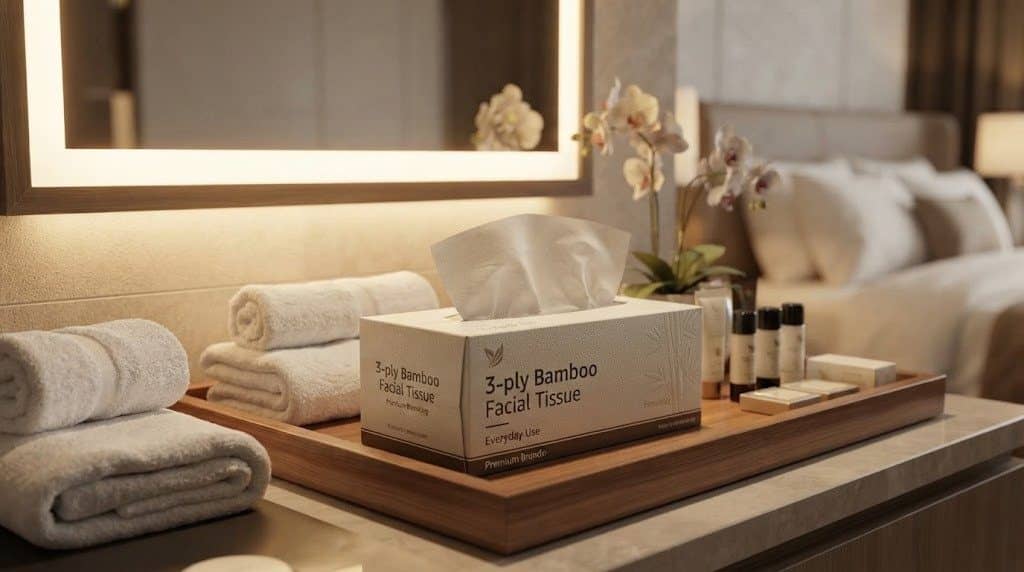
- Hotels
- Hospitality
- Premium retail
- Office premium ranges
- Sensitive-skin-oriented products
- Mid-to-high-end private-label brands
The additional layer can provide a more substantial feel while maintaining practical usability.
For many brands, 3-ply offers one of the most attractive balances between softness, strength, thickness, and cost. It can also provide a useful foundation for product differentiation when a brand wants to position bamboo facial tissue as a premium alternative to conventional facial tissue.
4-Ply Bamboo Facial Tissue — Best for Luxury Positioning
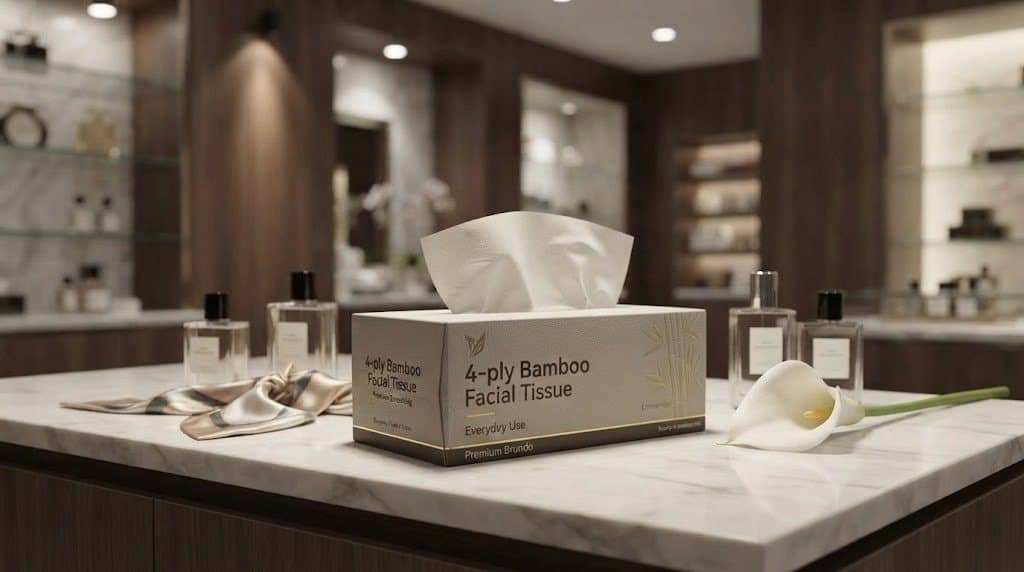
4-ply tissue is generally better suited to products where thickness, cushioning, and premium tactile experience are important. Potential applications include:
- Luxury facial tissue
- Premium hotel amenities
- High-end retail
- Luxury private-label products
- Premium gift sets
- Brands targeting an elevated user experience
The main consideration is cost. Because more tissue layers require more material, 4-ply products may have higher material consumption than 2-ply alternatives. Buyers should therefore determine whether the additional thickness creates enough perceived value to justify the higher product cost.
For premium brands, however, that additional tactile experience can become an important selling point.
How GSM and Ply Work Together
One of the most important concepts for professional tissue buyers is that ply and GSM describe different aspects of the product structure.
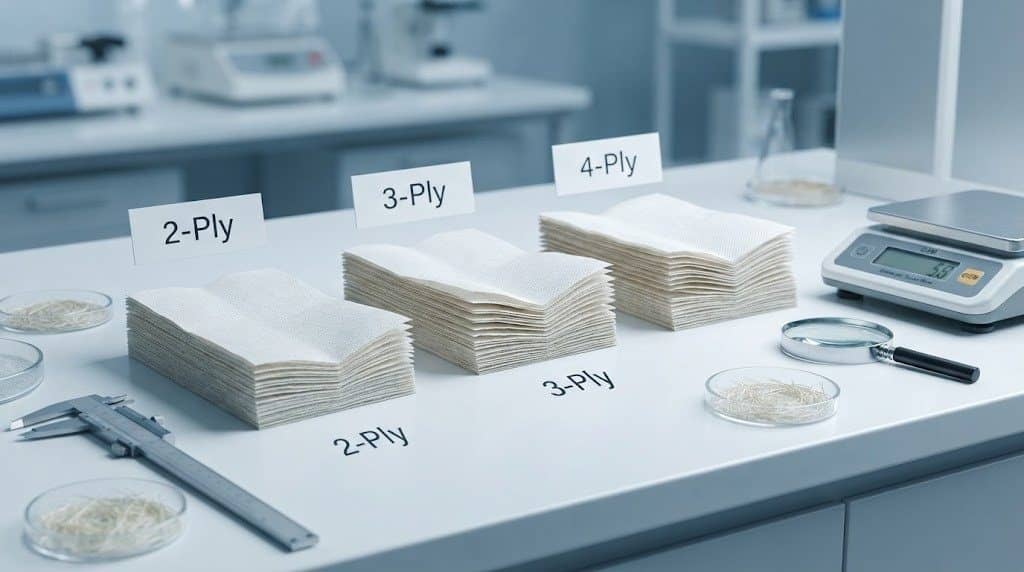
GSM stands for grams per square meter and describes the basis weight of the tissue material. Ply describes how many layers are combined to make one finished sheet. Therefore, GSM tells you how much tissue material is present per unit area, while ply tells you how many layers make up the finished sheet. This distinction matters because buyers sometimes assume that a higher ply automatically means a higher GSM or a stronger product.
That is not necessarily the case.
Ply vs. GSM: What Is the Difference?
Consider a bamboo facial tissue specification with a defined GSM and different ply counts. Increasing the number of layers changes the overall structure of the finished sheet, while changing GSM changes the basis weight of the tissue material itself.
These specifications can therefore be optimized independently. A manufacturer may offer:
- Different ply options
- Different GSM levels
- Different sheet sizes
- Different embossing patterns
- Different packaging formats
This creates more flexibility for brands developing a product for a specific market.
Should You Choose Higher GSM or More Ply?
There is no universal answer.
- If your primary goal is: Better cushioning and multi-layer structure → evaluate ply
- If your priority is: Material basis weight and overall sheet substance → evaluate GSM
For a complete evaluation, both should be considered together.
Donsea‘s bamboo facial tissue specifications include 14 GSM and 2–4 ply options, while sheet dimensions and packaging can also be customized for different product requirements.
How Ply Affects Bamboo Facial Tissue Cost
For B2B buyers, product performance is only one part of the decision. Cost per usable sheet and total purchasing cost are equally important. Generally, increasing the number of plies increases material consumption. A simplified relationship is:
More plies → more tissue material → higher material consumption → potentially higher product cost
However, the actual cost difference is not determined by ply alone. Other important variables include:
- GSM
- Sheet dimensions
- Sheet count
- Bamboo pulp cost
- Packaging materials
- Printing
- Embossing
- Order quantity
- Customization
- Production efficiency
- Shipping requirements
Therefore, a 4-ply product does not necessarily cost exactly twice as much as a 2-ply product. Production economics include many fixed and variable components, and large-volume orders can also affect the final unit cost.
Why 4-Ply Does Not Simply Cost Twice as Much as 2-Ply
A tissue product’s total cost includes more than the tissue layers themselves. Packaging, converting, printing, labor, quality control, logistics, and other production costs contribute to the final price.
For example, changing from 2-ply to 4-ply increases the tissue material requirement, but it does not necessarily double every other production cost. This is why B2B buyers should request quotations based on the complete finished product specification rather than comparing ply count alone.
How to Compare Cost Per Sheet Instead of Cost Per Box
Comparing price per box can sometimes produce misleading conclusions.
For example:
- Box A contains 100 sheets
- Box B contains 150 sheets
- Box C contains 200 sheets
Even if Box B has a higher purchase price, it may provide a lower cost per sheet.
A better comparison is: Cost per sheet = Total product price ÷ Number of sheets
For more detailed procurement analysis, buyers can also evaluate: Cost per 1,000 sheets
This makes it easier to compare products with different sheet counts, packaging formats, and ply configurations.
Which Ply Is Best for Private Label Bamboo Facial Tissue?
For private-label brands, ply should be selected according to the target market and intended retail positioning. A manufacturer may be able to customize ply, GSM, sheet size, sheet count, embossing, and packaging, allowing brands to create different product tiers.
1. Choose 2-Ply for Value-Oriented Brands
2-ply is suitable when the brand emphasizes:
- Affordability
- Everyday use
- High-volume consumption
- Competitive retail pricing
- Efficient material usage
It can work particularly well for supermarkets, general retail, foodservice, offices, and other high-frequency applications.
2. Choose 3-Ply for Premium Mainstream Brands
3-ply can be a strong choice when a brand wants:
- Improved softness
- Better cushioning
- Higher perceived quality
- Stronger positioning
- A balance between premium performance and cost
This makes 3-ply particularly attractive for brands targeting the premium mainstream market.
3. Choose 4-Ply for Luxury Brands
4-ply is more suitable when the product is designed around:
- Luxury positioning
- Maximum thickness
- Enhanced cushioning
- Premium packaging
- High-end hospitality
- Premium retail presentation
The higher material consumption should be considered as part of the product’s overall pricing strategy.
4. How to Match Ply With Your Target Retail Price
A useful approach is to define the desired market position first.
| Brand Position | Recommended Direction |
| Value | 2-ply |
| Standard Premium | 2-ply or 3-ply |
| Premium | 3-ply |
| High-End Premium | 3-ply or 4-ply |
| Luxury | 4-ply |
This is only a starting point. The final specification should also consider GSM, sheet size, sheet count, packaging, and target market expectations.
What Other Specifications Should You Compare Before Ordering?
A professional bamboo facial tissue purchase should never be based on ply alone.
1. Bamboo Pulp Source
The raw material is fundamental to tissue quality.
Buyers should clarify:
- Is the tissue made from bamboo pulp?
- Is virgin bamboo pulp used?
- What is the pulp sourcing standard?
- Is FSC-certified material available?
- Is the product bleached or unbleached?
For sustainability-focused brands, raw material traceability and certification can also become important marketing and compliance considerations.
2. GSM
GSM provides information about the basis weight of the tissue. When comparing products, buyers should evaluate:
GSM + ply + sheet size
rather than considering any one specification independently.
3. Sheet Size
Sheet dimensions directly affect the amount of tissue available per sheet and the user’s perception of product value.
Custom sheet dimensions may be useful when:
- Matching an existing dispenser
- Creating a private-label product
- Developing a compact package
- Optimizing packaging dimensions
- Targeting a specific regional market
4. Sheet Count
Sheet count affects:
- Product lifespan
- Cost per use
- Package size
- Retail value
- Shipping efficiency
A buyer should therefore compare both sheet count and sheet size, not simply the number printed on the package.
5. Bleached vs. Unbleached
Bamboo facial tissue can be developed in different appearance and processing directions.
Bleached tissue generally provides a clean white appearance that is widely used in conventional retail and premium tissue products.
Unbleached tissue can provide a more natural appearance and may be attractive to brands emphasizing natural materials and environmentally conscious positioning.
The appropriate option depends on the target market, brand identity, and customer expectations.
6. Embossing
Embossing can influence both product appearance and tactile characteristics. Different embossing patterns can affect:
- Surface texture
- Layer bonding
- Perceived thickness
- Visual presentation
- Brand differentiation
For private-label products, embossing can therefore be more than a decorative feature.
7. Packaging Format
Packaging should also be considered together with ply. Common formats include:
- Rectangle boxes
- Cube boxes
- Soft packs
- Car tissue boxes
- Custom printed packaging
The choice depends on the sales channel and application. For example, cube boxes can create a distinctive retail appearance, while soft packs can be convenient for high-volume or space-sensitive applications.
2 Ply, 3 Ply or 4 Ply? A Simple Decision Guide
If you need to select a ply specification quickly, the following framework can help.
Choose 2-Ply If:
- Cost efficiency is a major priority
- The product is designed for everyday use
- High-volume consumption is expected
- The target market is price-sensitive
- The brand needs a competitive entry-level product
Choose 3-Ply If:
- You want a strong balance of softness and strength
- The product targets premium mainstream consumers
- User comfort is an important selling point
- The brand wants a more substantial tissue feel
- The additional material cost is acceptable
Choose 4-Ply If:
- Premium positioning is the primary objective
- Maximum thickness and cushioning are important
- The target customers value a luxurious tactile experience
- The product is intended for premium retail or hospitality
- Higher material consumption can be incorporated into the pricing strategy
The decision becomes much easier when the intended market position is clearly defined first.
Frequently Asked Questions
Q1: Is 3-ply bamboo facial tissue better than 2-ply?
Not necessarily. 3-ply generally provides greater thickness and cushioning, but 2-ply can be more economical and is often sufficient for everyday applications. The better choice depends on the desired balance between performance and cost.
Q2: Is 4-ply bamboo facial tissue softer than 2-ply?
4-ply can provide a thicker and more cushioned tactile experience, but ply count alone does not determine softness. Bamboo pulp quality, fiber processing, GSM, creping, embossing, and manufacturing quality also affect softness.
Q3: Does higher ply mean stronger facial tissue?
Higher ply can contribute to greater sheet integrity, but higher ply does not automatically guarantee higher tensile strength. Fiber quality, GSM, bonding, embossing, and production processes are also important.
Q4: Does 4-ply facial tissue absorb more than 2-ply?
Not automatically. Absorbency depends on fiber structure, GSM, porosity, creping, embossing, and tissue density. More layers can increase the overall material structure, but they do not guarantee proportionally higher absorbency.
Q5: Is 2-ply bamboo facial tissue suitable for daily use?
Yes. 2-ply bamboo facial tissue can be a practical choice for everyday household, office, restaurant, and high-volume applications, particularly when cost efficiency is important.
Q6: Which ply is best for sensitive skin?
There is no universal answer. Softness and surface texture are generally more important than ply count alone. Buyers targeting sensitive-skin applications should evaluate bamboo pulp quality, surface softness, processing, additives, and overall product formulation in addition to ply.
Q7: Which bamboo facial tissue ply is best for hotels?
For hotels, 3-ply is often a strong starting point because it can provide a balance of softness, strength, premium feel, and cost. Higher-end hotels may consider 4-ply when luxury positioning is more important than material efficiency.
Q8: How does GSM affect bamboo facial tissue performance?
GSM represents the tissue’s basis weight. It can influence the overall substance, thickness, and material content of the product. GSM should be evaluated together with ply rather than treated as a replacement for ply.
Q9: Can bamboo facial tissue ply be customized for private-label products?
Yes. For OEM and private-label projects, manufacturers may offer different ply configurations along with customization of sheet size, GSM, sheet count, embossing, and packaging. The available options depend on the manufacturer’s production capabilities and order requirements.