What Should You Ask a Tissue Paper Manufacturer Before Placing an Order?
Choosing a tissue paper manufacturer is not simply a matter of finding the lowest quotation. For importers, distributors, retailers, hotels, commercial suppliers, and private label brands, the right supplier must consistently deliver the agreed product specifications, quality, packaging, certifications, and production schedule.
Before placing a bulk order, buyers should ask specific questions about tissue paper specifications, raw materials, MOQ, pricing, quality control, certifications, OEM capabilities, production capacity, and delivery. These questions help identify potential risks before they become costly problems.
A reliable tissue paper manufacturer should be able to provide clear technical information, samples, documentation, and a defined production process before accepting a commercial order.
1. What Tissue Paper Products and Materials Do You Offer?
Start by confirming whether the manufacturer actually produces the products you need. A supplier may list many tissue products, but its in-house manufacturing capabilities can vary significantly.
Ask what types of tissue products are manufactured, such as:
- Toilet paper
- Facial tissue
- Kitchen paper
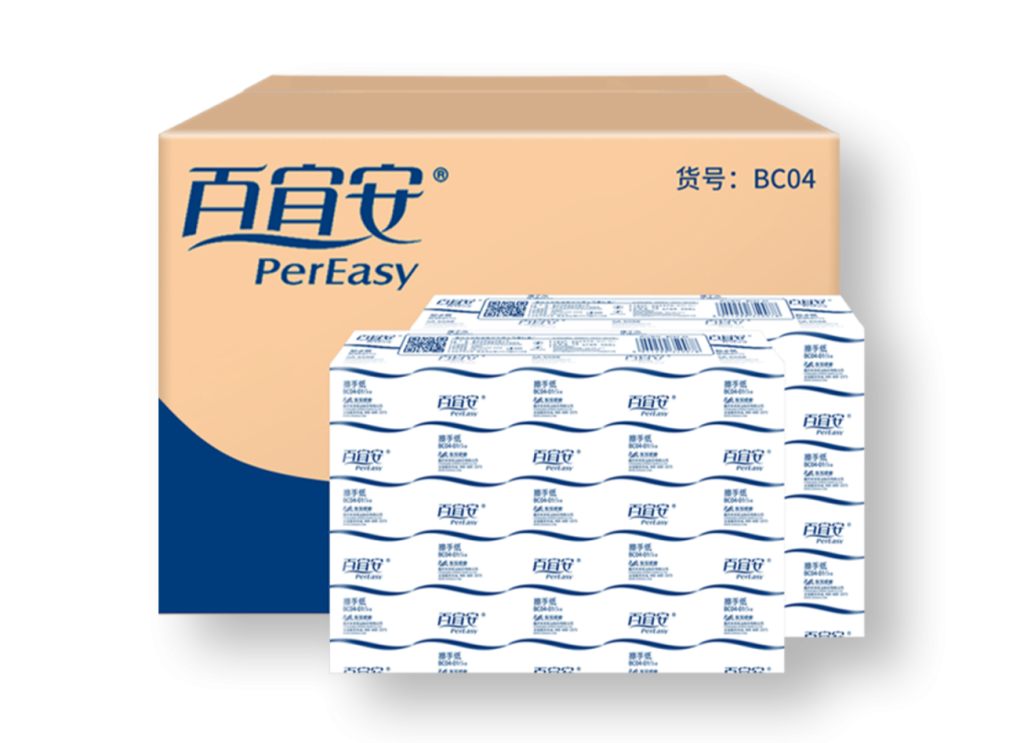
- Hand paper towels
- N-fold hand towels
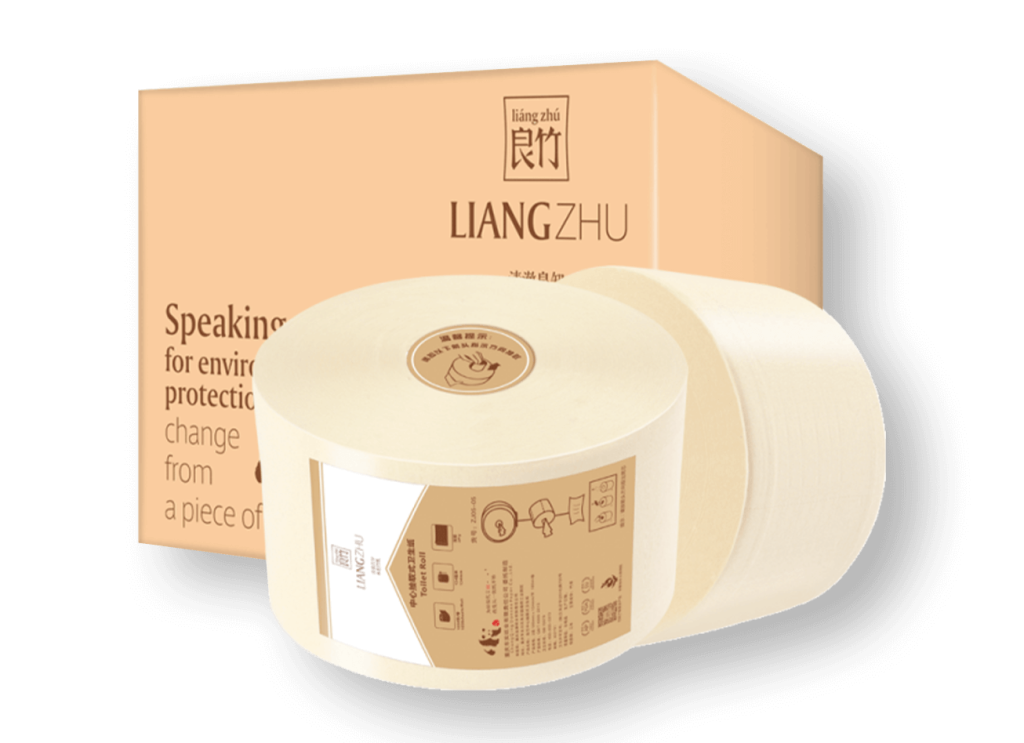
- Central pull tissue
- Commercial jumbo rolls
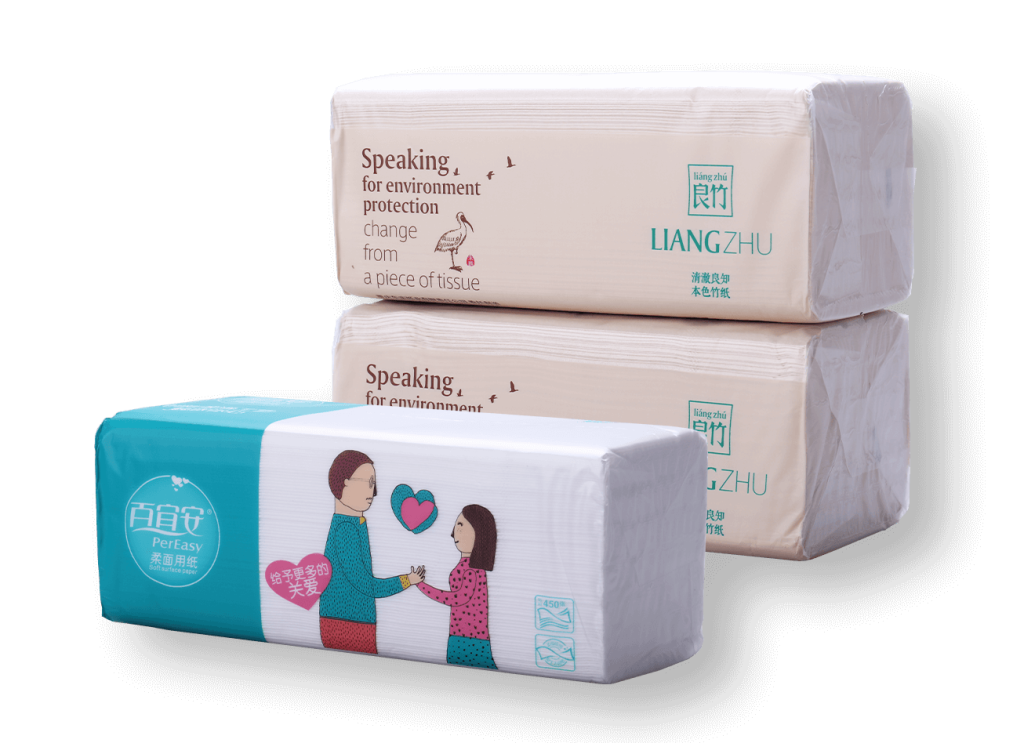
- Bamboo tissue products
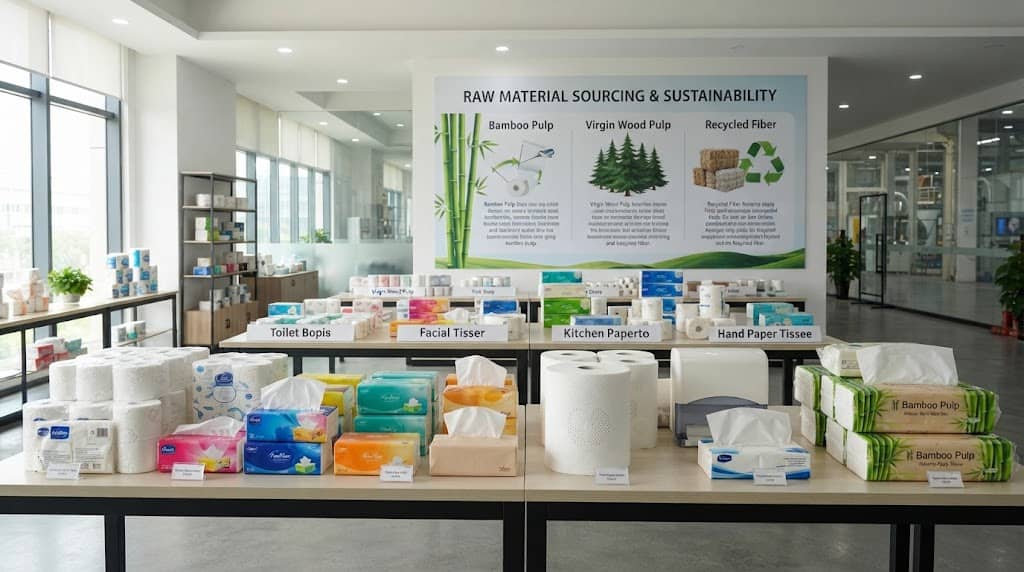
You should also ask about the raw materials used. Depending on the product and target market, manufacturers may work with bamboo pulp, virgin wood pulp, recycled fiber, or blended materials. Do not only ask where the material comes from. Ask whether the supplier can maintain consistent raw material quality between production batches. Material variation can affect softness, strength, absorbency, color, and converting performance.
For long-term supply, it is also useful to ask whether raw materials are sourced under documented quality-control procedures and whether batch traceability is available.
2. What Product Specifications Can You Customize?
Product specifications should be confirmed before discussing the final price because a quotation without detailed specifications can be misleading. For tissue products, important parameters may include GSM, ply, sheet size, sheet count, roll dimensions, core size and embossing requirements.
| Specification | What to Confirm |
| Material | Bamboo, virgin pulp, recycled or blended fiber |
| GSM | Target weight per square meter |
| Ply | 1-ply, 2-ply, 3-ply, 4-ply, etc. |
| Sheet size | Exact length and width |
| Sheet count | Sheets per roll or pack |
| Roll dimensions | Diameter, width and length where applicable |
| Core size | Core diameter and compatibility |
| Embossing | Pattern and embossing requirements |
| Color | Natural, white or other requirements |
| Packaging | Individual, multipack, carton or bulk packaging |
GSM and ply should not be treated as interchangeable specifications. Two products with the same ply can have different GSM, thickness, strength, and softness. Likewise, increasing GSM does not automatically produce a product that performs better in every application.
For commercial products, also confirm whether the finished tissue dimensions are compatible with the intended dispenser or equipment. A good manufacturer should be able to convert your requirements into a written product specification that both parties can approve before production.

3. What Are Your MOQ, Pricing, and Lead Times?
MOQ, price, and lead time directly affect the feasibility of a tissue paper project. Ask the manufacturer for the MOQ per SKU, rather than only asking for a general minimum order quantity. Customized packaging, special dimensions, embossing, and different raw materials may have different MOQs.
For pricing, request a detailed quotation based on the exact approved specification. Confirm whether the price includes:
- Tissue paper
- Inner packaging
- Printed packaging
- Cartons
- Labels
- Custom printing
- Special embossing
- Pallets or other packing requirements
For private label products, packaging development and printing can significantly affect the total cost. Lead time should also be divided into different stages. Ask for separate estimates for:
Sample production → Packaging approval → Bulk production → Final inspection → Shipment preparation
A supplier quoting a very low unit price but requiring a long production cycle may not provide the lowest total procurement cost. For repeat orders, ask whether the manufacturer can maintain similar pricing and reserve production capacity when order volumes increase.
4. How Do You Control Tissue Paper Quality?
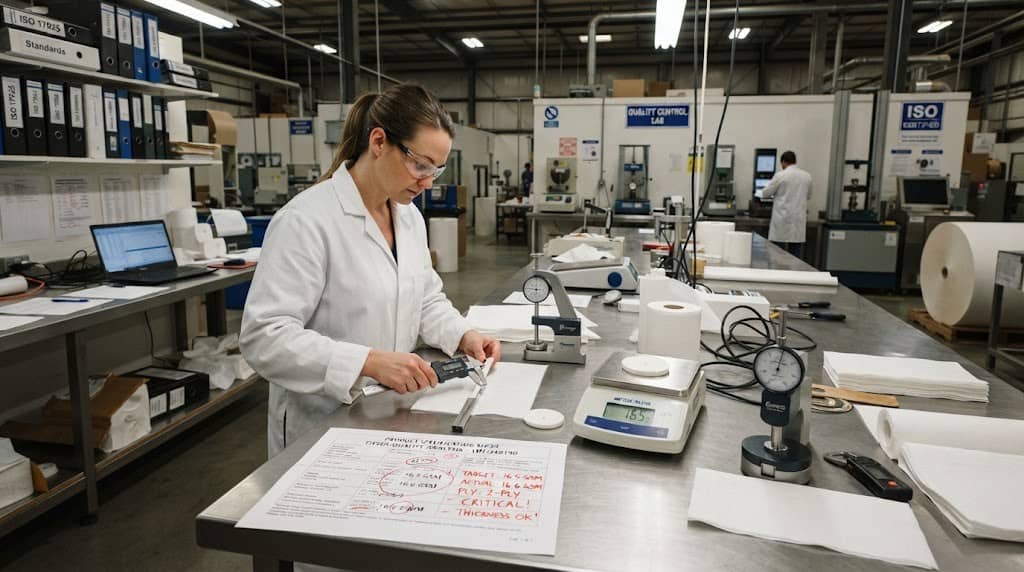
Quality control should be discussed before the order is placed, not after a production problem occurs. Ask the manufacturer how quality is controlled from raw material receipt through finished-product inspection.
A professional tissue manufacturing process may include several control stages:
Raw material inspection → Production control → Converting → Finished-product inspection → Packaging inspection
Depending on the FSC certified bamboo tissue, buyers may request information about:
- GSM consistency
- Sheet dimensions
- Ply bonding
- Tensile strength
- Wet strength
- Absorbency
- Thickness
- Softness
- Surface appearance
- Lint or fiber shedding
- Embossing consistency
- Packaging integrity
The specific tests required should depend on the intended application. For example, a commercial hand towel may require a different performance balance from facial tissue, while kitchen paper may place greater emphasis on absorbency and wet strength.
It is also important to ask how the manufacturer handles non-conforming products. A useful question is: “What happens if the finished batch does not meet the agreed specification?” The answer can reveal how mature the supplier’s quality-management process really is.
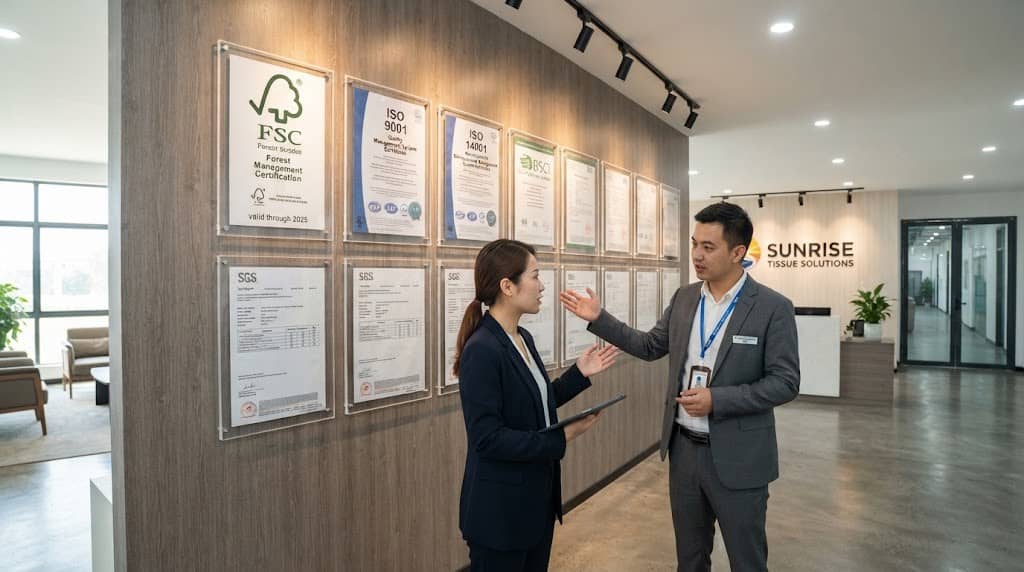
5. What Certifications and Compliance Documents Can You Provide?
Certifications should be evaluated based on your market, product, and application rather than simply counting how many certificates a supplier has.
Ask the manufacturer which certifications and supporting documents are available for the products you are purchasing. Depending on the target market and product type, buyers may encounter requirements or requests involving:
- FSC certification
- ISO management-system certification
- BSCI or social-compliance documentation
- SGS inspection or testing
- Product test reports
- Raw material documentation
- Customer-specific compliance requirements
More importantly, confirm what exactly each certification covers. For example, a certification may relate to the factory, raw material, management system, or a specific product chain of custody. Buyers should not assume that a factory-level certificate automatically applies to every finished product.
If certification is important for your retail or institutional customers, request copies of the relevant documents and verify that the certification scope matches your order.
6. Can You Provide OEM, Private Label, and Packaging Customization?
For brands and distributors, OEM and private label capability can be more important than a standard product catalog. Ask what can actually be customized.
Product customization
Possible options may include:
- GSM
- Ply
- Sheet dimensions
- Roll size
- Sheet count
- Core size
- Embossing
- Material selection
Packaging customization
Depending on the product, customization may include:
- Brand logo
- Printed paper packaging
- Paper bags
- Paper wraps
- Boxes
- Multipacks
- Shipping cartons
- Retail-ready packaging
Before approving packaging, confirm who is responsible for artwork review, printing, color approval, packaging samples, and final production approval. A clear OEM workflow should look something like:
Product specification → Sample development → Testing → Packaging design → Artwork approval → Pre-production confirmation → Mass production → QC → Shipment
Buyers should also ask whether customization is performed directly by the manufacturer or outsourced to third parties. This can affect lead time, quality control, communication, and minimum order quantities.
7. What Is Your Manufacturing and Supply Capacity?
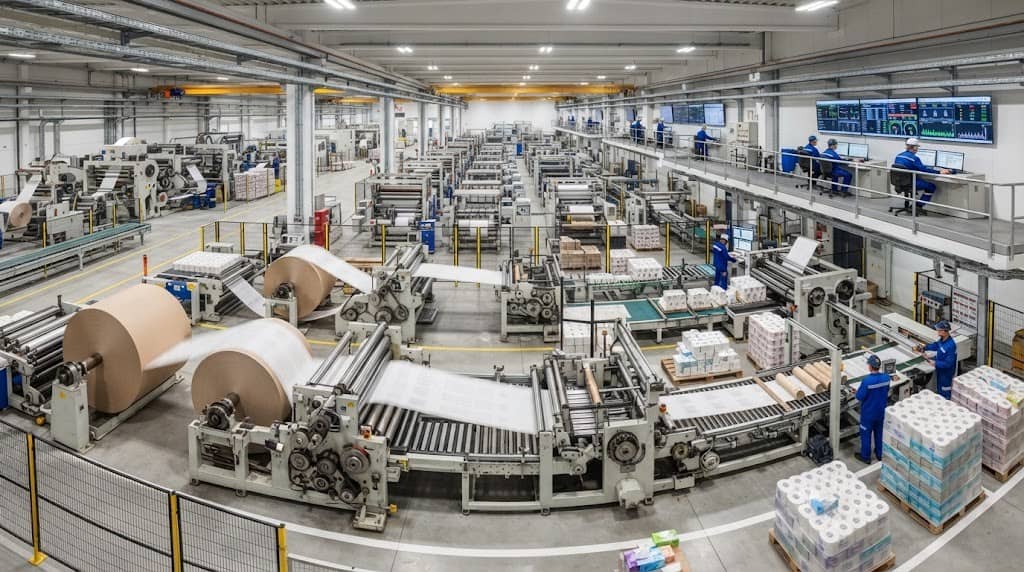
A supplier that can produce a sample is not necessarily capable of supporting long-term commercial orders. Before selecting a tissue paper factory, ask about its actual manufacturing capacity.
Useful questions include:
- Where is the manufacturing facility located?
- How many production lines are available?
- Which products are manufactured in-house?
- What is the approximate monthly production capacity?
- Can the factory support repeat orders?
- How does it handle peak-season demand?
- Can it maintain consistent quality across different batches?
- How are production schedules managed for customized orders?
For large or recurring buyers, production capacity should be evaluated together with order history and quality consistency. A manufacturer with sufficient capacity should be able to scale production without making major changes to the approved product specification.
It is also worth asking whether the supplier can support long-term supply planning. If your business depends on regular monthly or quarterly shipments, production capacity should be part of the supplier evaluation rather than an afterthought.
8. What Should You Confirm Before Approving the Final Order?
Before placing a purchase order, make sure the key commercial and technical requirements are documented. A practical pre-order checklist includes:
| Item | Confirmation Required |
| Product | Exact tissue product |
| Material | Approved raw material |
| GSM | Agreed GSM |
| Ply | Confirmed ply |
| Sheet size | Exact dimensions |
| Sheet count | Quantity per roll or pack |
| Roll size | Agreed dimensions |
| Core | Core diameter |
| Embossing | Approved pattern |
| Packaging | Final artwork and format |
| MOQ | Minimum quantity per SKU |
| Price | Final quotation |
| Lead time | Confirmed production schedule |
| Quality | Inspection requirements |
| Certifications | Required documents |
| Carton | Packing configuration |
| Shipping | Loading and shipment requirements |
| Payment | Agreed payment terms |
Do not rely only on email discussions or verbal agreements for critical specifications. The final purchase order should reference the approved product specification, packaging artwork, sample, inspection requirements, and commercial terms. For customized tissue products, the approved sample should also be clearly identified and retained as a reference standard.
FAQs
Q1. How do I verify whether a tissue paper manufacturer is a real factory?
Ask for the factory address, production facilities, product range, manufacturing capacity, certifications, and recent factory or production-line information. For larger orders, buyers can also arrange a factory audit or third-party inspection to verify production and quality-control capabilities.
Q2. What is the typical MOQ for private label tissue paper?
MOQ varies by product, packaging, customization level, and manufacturer. Standard products may have lower MOQs, while customized packaging, special dimensions, or new product development may require higher quantities. Always confirm the MOQ per SKU before approving the order.
Q3. Can a tissue paper manufacturer develop custom products for my brand?
Yes. An experienced tissue paper OEM manufacturer may customize GSM, ply, sheet size, roll dimensions, embossing, material, sheet count, and packaging. Buyers should confirm the manufacturer’s actual in-house capabilities and whether any part of the customization is outsourced.
Q4. How can I make sure the bulk order matches the approved sample?
Create a written product specification based on the approved sample and define measurable quality requirements such as GSM, dimensions, ply, strength, absorbency, appearance, and packaging. For larger orders, consider pre-shipment inspection against the approved sample and agreed specifications.
Q5. What should I consider besides the unit price when choosing a tissue paper supplier?
Compare the total procurement cost, including product price, packaging, printing, MOQ, tooling or customization costs, shipping volume, lead time, quality consistency, inspection costs, and potential rejection or replacement risks. The lowest unit price does not always mean the lowest total cost.
Q6. How should I choose a long-term tissue paper manufacturing partner?
Evaluate the supplier’s product quality, manufacturing capacity, OEM/ODM capabilities, communication, certifications, quality-control system, delivery performance, and ability to support repeat orders. A suitable long-term tissue paper manufacturer should be able to maintain consistent specifications while scaling production as your business grows.