What Are the Toilet Paper Raw Materials and Their Cost Differences?
In the production of industrial tissue, the choice of toilet paper raw material directly determines the physical properties, production efficiency, and cost structure of the final product. From a paper mill engineering perspective, the production process converts raw plant fibres into a uniform tissue web that must adhere to strict operating limits for tensile strength, water absorbency, and softness. The financial reality of tissue mill operations dictates that fiber procurement accounts for approximately 65% to 70% of total manufacturing costs. Consequently, an optimized understanding of the available raw materials for making toilet paper is essential for technical plant operations, supply chain management, and product development.
Primary Classifications of Toilet Paper Raw Materials
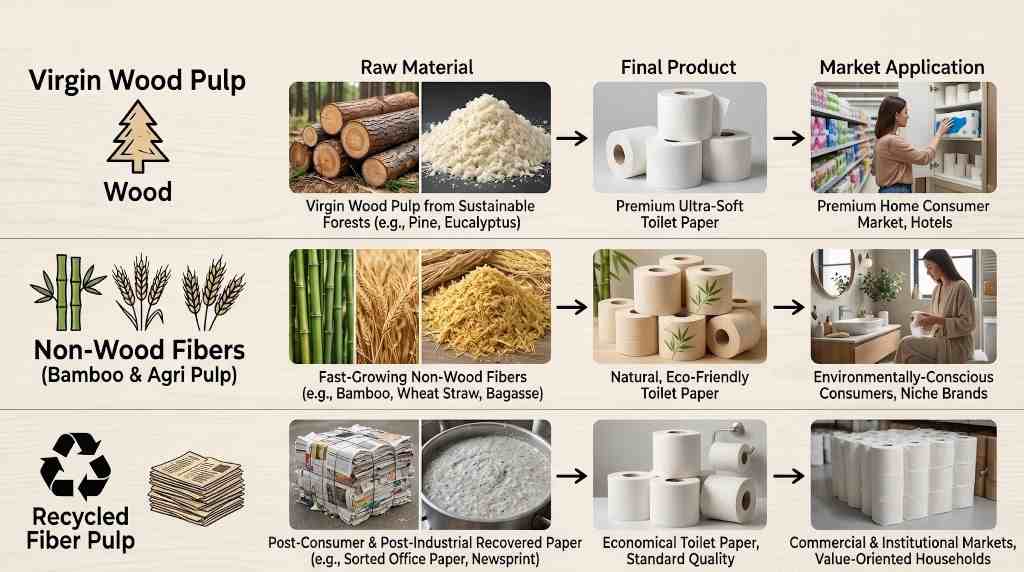
Classification of cellulose fibres used in tissue manufacture is based on botanical origin, extraction method, and processing history. The three main groups are virgin wood pulp, non-wood plant pulp, and recycled fibre pulp.
1. Virgin Wood Pulp
Virgin wood pulp remains the primary chemical benchmark for high-performance tissue products. It is produced via the chemical cooking of wood chips, which removes lignin and isolates pure cellulose fibers. In the mill, engineers blend two distinct sub-categories of wood pulp to balance opposing physical parameters:
- Elemental Chlorine-Free (ECF) Softwood Kraft Pulp: Derived from coniferous trees such as pine and spruce, softwood pulp provides long fibers averaging 2.5 to 3.5 mm in length. These long fibers form an interconnected matrix that delivers the primary tensile strength required to prevent the web from breaking during high-speed rewinding and converting processes. It is a critical component within the overall toilet paper raw material mix to guarantee wet and dry strength.
- Hardwood Kraft Pulp: Derived from deciduous trees, primarily Eucalyptus, hardwood pulp provides short fibers averaging 0.8 to 1.2 mm in length. Due to the high number of fibers per gram, hardwood pulp creates a smooth, dense surface structure that provides tactile softness. An optimal industrial recipe for premium tissue typically consists of a 70% hardwood and 30% softwood fiber blend.
2. Non-Wood Fibers (Bamboo and Agricultural Pulp)
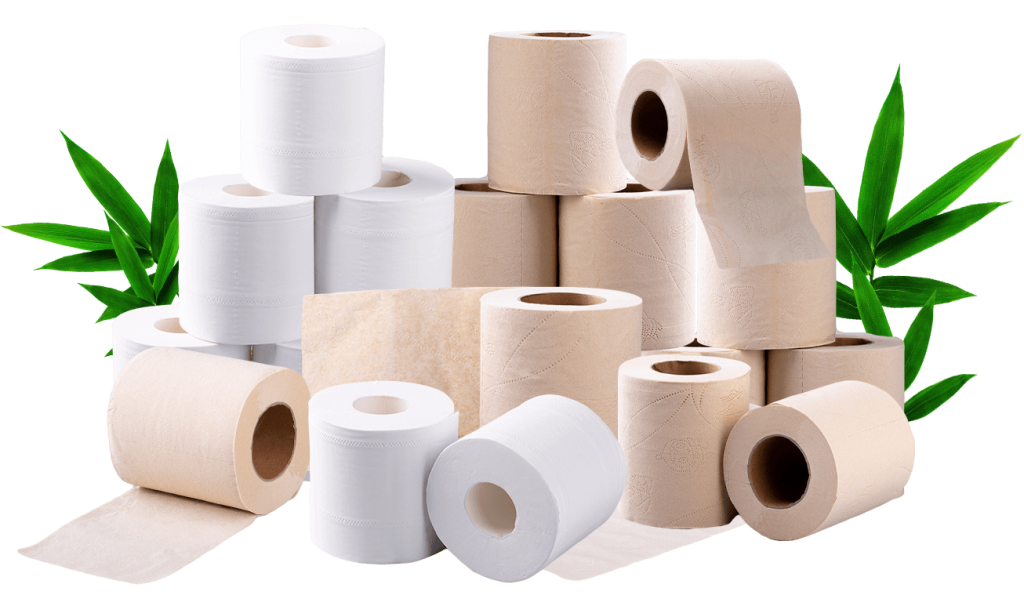
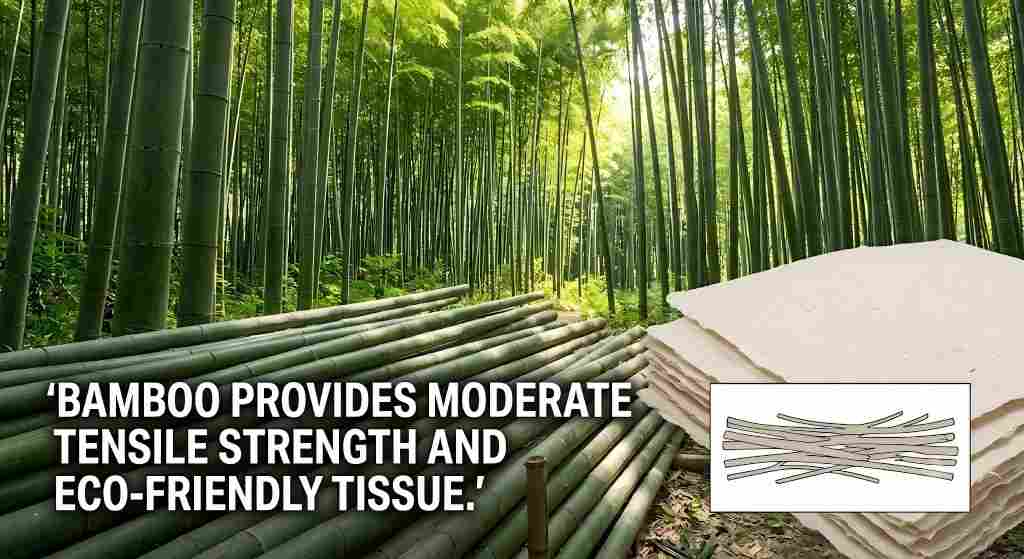
Non-wood fibers are increasingly utilized as alternative raw materials for making toilet paper. Bamboo pulp is the most industrially viable non-wood alternative. Chemically, bamboo fibers exhibit a length distribution between 1.5 and 2.0 mm, which falls precisely between softwood and hardwood wood fibers. This intermediate fiber geometry allows bamboo pulp to provide moderate natural tensile strength. Nevertheless, due to its thicker cell wall, bamboo requires specific enzymatic or mechanical refining adaptations in the mill to reduce its structural rigidity and achieve acceptable softness levels. Other agricultural residues, such as sugarcane bagasse and wheat straw, give rise to short-fiber pulps which are normally blended with wood pulp in order to cut production costs in some specific geographic markets.
3. Recycled Fiber Pulp
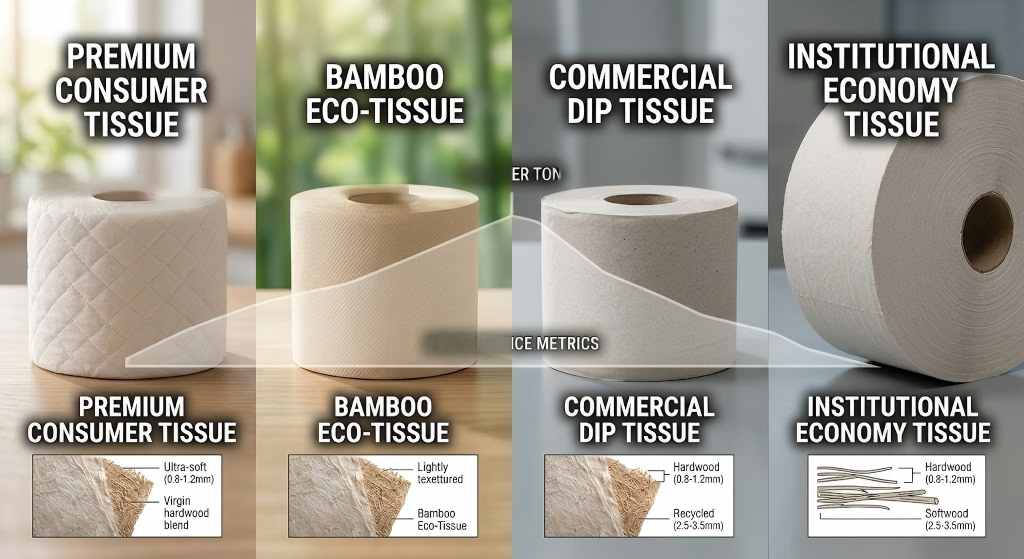
Recycled pulp, also called de-inked pulp (DIP), uses post-consumer or post-industrial recovered paper streams as the basic raw material for toilet paper. The industrial grades used are Sorted Office Paper (SOP) and Old Newspapers (ONP). The manufacturing process in fibre recycling involves further steps such as flotation de-inking, mechanical dispersion, and bleaching loops to remove inks, adhesives, and mineral fillers. From an engineering point of view, each recycling cycle mechanically shears the cellulose fibres, cutting and wearing them down. As a result, 100% recycled pulp has less tensile strength and less bulk density than virgin pulp and is therefore only suitable for commercial, industrial, and institutional markets where cost reduction is more important than premium softness.
Industrial Cost Analysis and Market Metrics
The economic value of raw materials used in the production of toilet paper depends on the state of the world commodity markets, the chemical processing needs, and the energy input. Global indexes track chemical wood pulp prices. Non-wood and recycled fibres are largely at the mercy of local supply and regional environmental regulations.
| Raw Material Type | Fiber Length (Average) | Relative Commodity Cost (USD/Ton) | Mill Processing Energy Demand | Primary Target Application |
| Virgin Softwood Pulp | 2.5 – 3.5 mm | $900 – $1,200 | Medium-High (Refining required) | Premium structured tissue, Strength agent |
| Virgin Hardwood Pulp | 0.8 – 1.2 mm | $750 – $950 | Medium | Ultra-soft consumer tissue, Facial tissue blend |
| Bamboo Pulp | 1.5 – 2.0 mm | $850 – $1,100 | High (Chemical/Mechanical adjustments) | Unbleached natural eco-tissue, Niche consumer rolls |
| Recycled Fiber Pulp (DIP) | < 0.8 mm (Degraded) | $550 – $750 | High (Chemical flotation & Washing) | Commercial away-from-home rolls, Budget institutional tissue |
The cost disparity between these materials is not solely determined by the purchase price of the raw fiber. The yield factor is a critical variable: virgin wood pulp lines operate at an efficiency yield of 90-95% from pulp sheet to paper web, whereas recycled pulp lines experience material losses of 20-35% due to the removal of fillers, coatings, and short fines during the washing and de-inking processes. Furthermore, wastewater treatment costs for processing recycled toilet paper raw material are significantly higher due to the elevated chemical oxygen demand (COD) of the effluent.
Technical Performance Matrix
In tissue mills, engineers evaluate how different raw materials for making toilet paper perform across three vital structural metrics: bulk, tensile strength, and water absorption capacity. These parameters determine how the paper behaves on the Yankee dryer and during high-speed converting operations.
- Bulk and Softness: Hardwood fibers maximize bulk because their short, flexible nature allows them to create a high-volume structure under creping blades. Recycled fibers have lost their natural elasticity, resulting in a flat, dense sheet with lower bulk and a rougher surface texture.
- Tensile Strength: Softwood kraft pulp establishes a dense hydrogen-bonded network. Without a baseline configuration of softwood or high-grade bamboo fiber, a paper web consisting entirely of short or recycled fibers cannot withstand the mechanical tension of converting machines running at speeds exceeding 1,500 meters per minute.
- Absorbency: The void volume within the fiber matrix governs water absorbency. Virgin fibers maintain hollow internal structures (lumens) that facilitate capillary action. Recycled fibers are structurally collapsed (hornified) during previous drying cycles, which limits their intrinsic fluid retention capabilities.
Conclusion
Industrial tissue manufacturing requires a continuous optimization of fiber parameters against shifting economic variables. Virgin wood pulp remains the industry benchmark for high-speed production and premium product tiers due to its predictable fiber geometry and high yield. Bamboo serves as a functional alternative that satisfies specific sustainability mandates but demands precise refining configurations to control mechanical stiffness. Recycled fiber represents a highly cost-effective option for the commercial sector, provided the manufacturing facility possesses the advanced de-inking and chemical water treatment infrastructure required to process degraded fiber streams. Ultimately, the systematic selection and blending of raw materials for making toilet paper dictate both the operational viability of the mill and the competitive positioning of the product in the global marketplace.
Frequently Asked Questions (FAQ)
Q1: Which is the most common raw material for toilet paper in premium products?
A1: Premium products are mainly an engineered blend of virgin chemical wood pulp, about 70% hardwood kraft pulp for tactile softness and 30% softwood kraft pulp for mechanical tensile strength.
Q2: What are the environmental impacts of toilet paper raw material production?
A2: Environmental impact depends on the fiber’s source. Certified virgin wood pulp is wood from sustainable forests. Bamboo pulp is derived from a species of grass that regrows quickly and so requires less forest land. Using recycled pulp to make paper cuts down on the amount of waste that goes to landfills, but the process of de-inking the paper at the industrial level creates more chemical by-products.
Q3: Why is recycled fibre pulp cheaper than virgin wood pulp?
A3: Recycled fibre pulp uses less expensive post-consumer paper waste base inputs. However, the initial cost savings are partially offset by the lower fibre yields and the need for intensive chemical processing and waste management infrastructure.