Bamboo Paper vs Wood Pulp Paper: An Engineer’s Technical Comparison
As a paper engineer working daily on the production floor and in chemical laboratories, I analyze the mechanical and chemical transformation of plant fibers into technical paper products. Over the past few years, our facility has executed a significant shift in production lines, driven by international commercial procurement orders moving away from traditional wood pulp. Global sourcing entities are no longer looking exclusively at brightness percentages; they now demand quantifiable lifecycle carbon accounting. Understanding the raw material parameters and industrial processing variables explains why bamboo paper has emerged as a distinct, technically viable alternative to wood pulp paper.
Environmental efficiencies of producing paper from bamboo stems from its quick growth rate of about three to four years, its ability to regenerate through root formation that does not allow for soil erosion, and much lower use of chemicals and energy in the pulping process.
Cell Structure & Growth Cycle: Why Bamboo Outperforms Wood
1. The 3-Year vs. 30-Year Regeneration Cycle
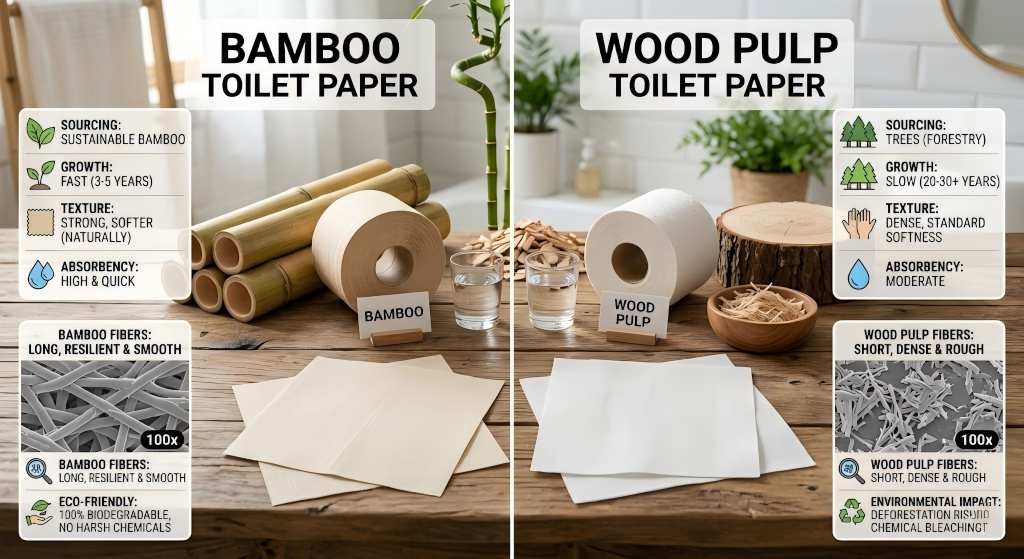
From an agricultural and forestry input perspective, timber sourcing requires prolonged capital and land commitment. Softwood trees used in the production of paper take between 20 and 30 years to attain the appropriate DBH. Hardwood trees, on the other hand, take 10 to 15 years. In contrast, industrial bamboos like Phyllostachys pubescens attain full structural maturity in just three to four years.
2. The Non-Destructive Harvesting Process
The botanical classification of bamboo as a grass dictates its harvesting methodology. Unlike arborescent trees, which have to be clear-cut, which means the termination of the biological organism, bamboo uses an underground rhizome system. When mature culms are cut, the subterranean network of roots is left intact and active. It sends nutrients up through the rhizome network to produce new shoots each year. Therefore, harvesting does not lead to deforestation or destabilization of the topsoil, and the same land mass can be used repeatedly for raw materials without the need for replanting or land clearing.
The Shop Floor Contrast: Processing of Bamboo Paper vs. Wood Pulp Paper
1. Lignin Content and Chemical Consumption
In chemical pulping, the objective is to separate cellulose fibers from lignin, the natural polymer that binds plant cells together. Wood raw materials possess highly complex, cross-linked lignin structures that require aggressive chemical treatment. In our digestors, treating wood chips requires prolonged cooking times at elevated temperatures using high concentrations of sodium hydroxide and sodium sulfide under the Kraft pulping process. Bamboo possesses a more accessible corporate cellular matrix, allowing the lignin to be dissolved under shorter retention times. This processing characteristic directly translates to decreased chemical loading and lower thermal energy expenditure per ton of pulp produced.
2. Fiber Morphology: The Sweet Spot Between Softwood and Hardwood
Microscopic evaluation of fiber length dictates the physical properties of the finished paper sheet. Softwood fibers are long (approx. 3.0 to 5.0 mm), providing high tensile strength but lower surface smoothness. Hardwood fibers are short (approx. 1.0 mm), yielding softness but low tear resistance. Bamboo fibers occupy a median position, typically measuring between 1.5 and 2.5 mm.
This natural configuration allows a bamboo paper manufacturer to produce tissue with sufficient tensile strength and surface softness without incorporating synthetic dry-strength agents or excessive mechanical refining, which degrades fiber integrity and consumes electricity.
3. The True Impact of “Unbleached” Processing
A critical assessment of bamboo paper vs wood pulp paper involves the bleaching phase. Conventional white paper requires multi-stage bleaching sequences, typically Elemental Chlorine Free (ECF) or Totally Chlorine Free (TCF) processes using chlorine dioxide, oxygen, and hydrogen peroxide to eliminate residual lignin. When processing unbleached bamboo paper, the bleaching sequence is omitted entirely. This structural change in the manufacturing process eliminates the generation of chlorinated organic compounds in the plant effluent, substantially lowering the Chemical Oxygen Demand (COD) and Total Suspended Solids (TSS) in the wastewater treatment facility.
Data Comparison: Environmental KPIs of Paper Production
The operating parameters and environmental indicators of both manufacturing inputs are quantified in the technical matrix below:
| Environmental Metrics (per ton of pulp) | Virgin Wood Pulp | Eco-friendly Bamboo Pulp |
| Raw Material Maturation Period | 15 – 30 Years | 3 – 4 Years |
| Biomass Carbon Sequestration Rate | Baseline Reference (100%) | +35% vs. Equivalent Forest Area |
| Post-Harvest Soil Erosion Risk | High (due to clear-cutting) | Near Zero (Root system remains intact) |
| Bleaching Stage Effluent Toxicity | High (due to whitening demand) | Minimal to Zero (Unbleached standard) |
Addressing the Myths: Is Bamboo Paper Always 100% Eco-Friendly?
To maintain technical objectivity, engineers must evaluate the complete supply chain, as raw material efficiency can be compromised by external industrial variables.
- Transportation Logistics: If an industrial facility processes bamboo pulp efficiently but relies on long-range, fossil-fuel-powered marine or land transport to reach the end consumer, the scope 3 carbon emissions accumulated during logistics will offset a portion of the raw material’s biogenic carbon advantages. Proximity to raw material sources is a critical factor in true sustainability.
- Forestry Management Certifications: The sustainability of bamboo paper relies on how the land is managed. Converting natural forests with diversity into bamboo plantations of monoculture will threaten the local biodiversity. Industrial procurement managers should check that the bamboo paper supplier has the Forest Stewardship Council (FSC) chain of custody certification to demonstrate that the raw materials come from sustainable forests.
A Technical Recommendation for B2B Sourcing Managers
From an industrial engineering perspective, bamboo paper provides a quantifiable reduction in environmental processing inputs compared to virgin wood pulp. It delivers the mechanical strength requirements needed for commercial converting operations while reducing chemical processing steps and preserving forest ecosystems. For corporate purchasing entities managing regulatory compliance, such as the European Union Deforestation Regulation (EUDR), transitioning to certified bamboo pulp represents a verifiable method to mitigate supply chain risks and achieve corporate decarbonization targets.