Private Label Tissue Paper: How Custom Branding Works
If you run a retail brand, manage a supermarket supply chain, or source products for an eco-friendly business, you’ve probably seen that the consumer market is changing fast. People don’t just get any random household product off the shelf anymore. They are interested in where things come from, how they are made, and what happens to the environment when they use them. This change in buyer habits is a huge reason why retailers are shifting to private label tissue paper solutions. Instead of selling standard national brands that have low margins and no brand loyalty, businesses want to own their identity and build something that keeps shoppers coming back to their particular stores.
When you look at the green product space, bamboo tissue paper is leading the way. Traditional paper made from trees takes decades to grow back, and the manufacturing process uses an incredible amount of energy and chemicals. Bamboo is completely different. It is actually a fast-growing grass that can shoot up three feet in a single day, uses way less water, and releases more oxygen into the atmosphere during its growth cycle. More importantly for businesses looking at private label tissue paper options, the actual carbon footprint of bamboo paper is about 65% lower than traditional wood pulp alternatives. In fact, you save roughly one ton of carbon for every 4,500 rolls you produce. So, when you choose private label tissue paper made from bamboo, you are not just jumping on a marketing trend; you are providing a high-performance product that solves a real environmental issue.
The goal of this guide is straightforward. As a factory marketing team with over 24 years of manufacturing experience, we want to give you a transparent look at how custom branding actually works in the tissue industry. We will break down how private label tissue paper moves from raw materials in the forest straight to your retail shelves, covering everything from product specs and embossing to global shipping logistics.
Choosing Your Foundation: Core Product Categories
Before you start designing logos or choosing colors, you need to decide what kind of private label tissue paper products make sense for your specific target market. Every market has its own preferences, and you need to build your product lineup around what your customers use every day. Here are the core categories we handle for international private label tissue paper clients:
Household Staples
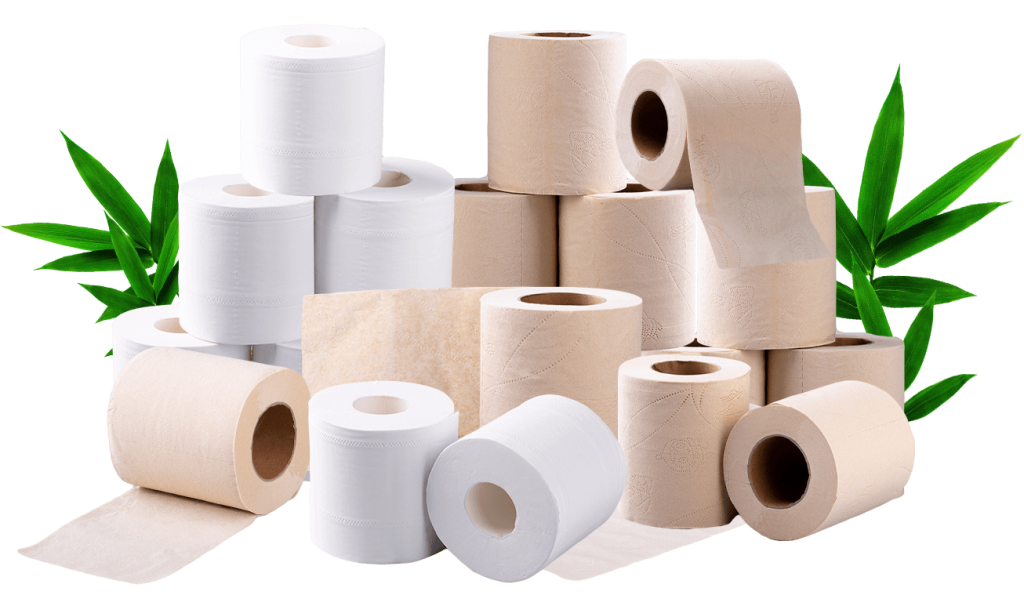
This is the foundation of most consumer brands. Standard roll toilet paper is always in high demand. We also manufacture mini jumbo rolls, which are becoming very popular for larger families and high-traffic households because they reduce the need for constant roll changes. When you develop private label tissue paper for home use, consistency and soft texture are the main things your customers will look for.
Kitchen & Dining
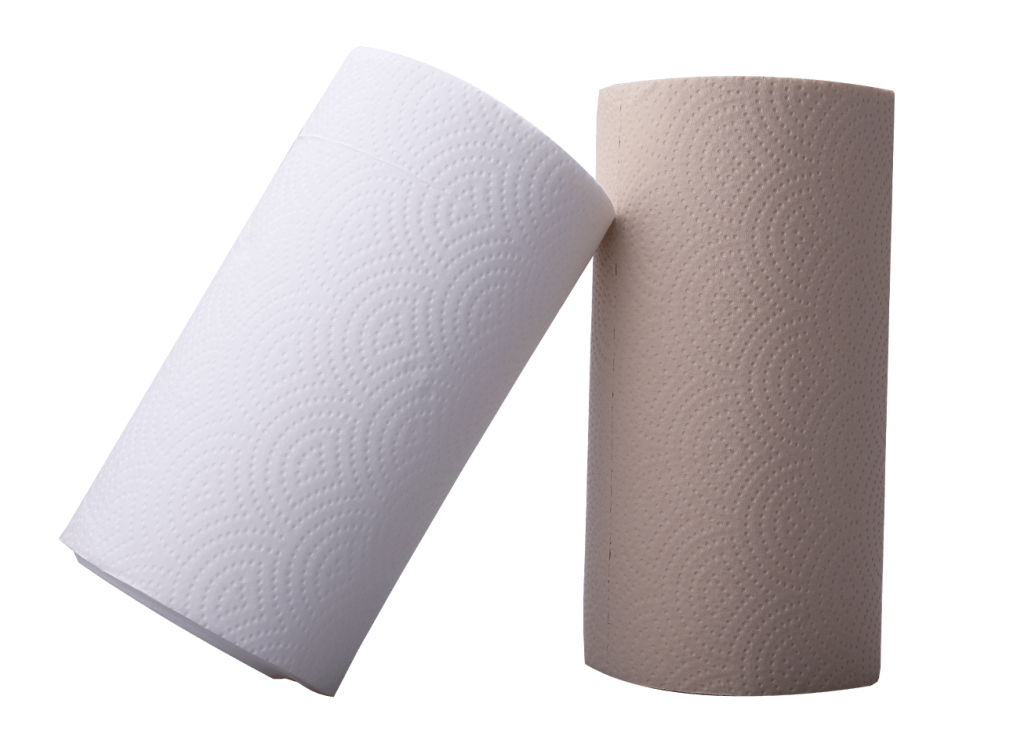
Kitchen paper towels need to be tough and highly absorbent. We produce these in both standard rolls and multi-fold formats. The main job here is dealing with liquid spills, cleaning counters, and handling food preparation. Because bamboo fibers are naturally strong and long, kitchen towels made from this material hold up really well even when they are completely soaked, making them an excellent choice for a premium private label tissue paper line.
Facial & Personal Care
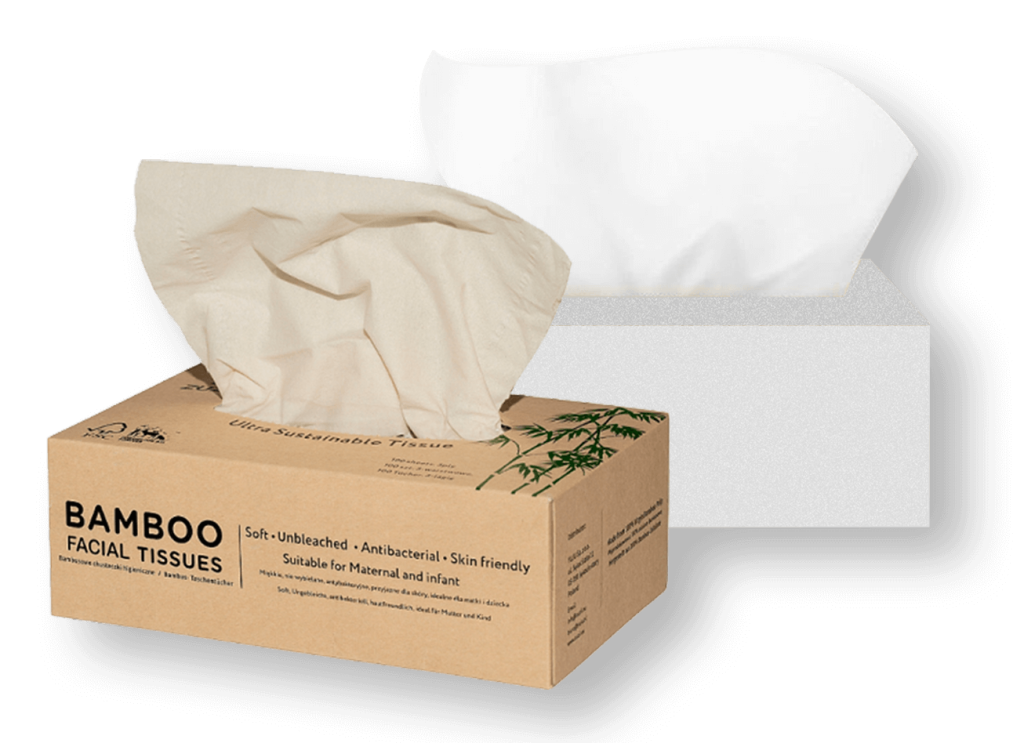
This category is all about how the paper feels against the skin. We offer bamboo facial tissue in two main styles: premium cardboard boxes and flexible soft packs. Soft packs are a huge seller right now because they are easy to pack into a bag, cost less to ship, and use minimal packaging materials. We also make compact pocket tissues for on-the-go convenience. Your private label tissue paper brand can easily mix and match these options depending on seasonal customer demands.
Commercial & Away-from-Home (AfH)
If you sell direct to office buildings, hotels, hospitals, or schools, you need commercial grade products. It offers N-fold hand towels, multi-fold paper towels, and central pull tissue systems. This part of your private label tissue paper catalogue must be cut precisely and sized correctly during manufacturing, as they are designed to fit into standard commercial dispensers.
How Private Label Tissue Paper Branding Works
A lot of people think that creating private label tissue paper just means taking a generic product and putting a different company logo on the outer box. That is not how it works at a professional manufacturing level. True custom branding means you get to control every single aspect of the product so that it matches your price point, performance needs, and brand values perfectly. Here is the matrix of choices you have when configuring your private label tissue paper:
| Customization Area | Available Options & Specifications | Strategic Benefit for Your Brand |
| Ply / Layer Configuration | 2-ply, 3-ply, or 4-ply structural options | Balances target production costs with the required softness and strength. |
| Gram Weight & Sheets | Adjustable base paper thickness; custom sheet counts per roll/pack | Allows you to match regional market expectations and local price points. |
| Core Types & Printing | Standard cardboard core, coreless options, or custom printed inner cores | Maximizes shelf space or adds subtle, premium branding inside the roll. |
| Embossing Patterns | Micro-embossing, standard floral patterns, or custom branded logo rollers | Improves the physical bulk, thickness, and liquid absorption of the paper. |
| Eco-Packaging Materials | Kraft paper wrap, biodegradable bags, or recycled cardboard boxes | Reinforces your environmental commitment right through the outer packaging. |
Embossing is very important, so let’s take a closer look. Embossing is not merely decoration. Small air pockets are formed between the layers when a pattern is pressed into the private label tissue paper. This process greatly enhances its ability to absorb liquids, makes the paper feel much softer, and gives it more body so it doesn’t feel flat. Select from our library of standard patterns, or we can create an entirely unique embossing roller that presses your specific brand icon right into the paper itself.
Packaging is where your private label tissue paper catches the customer’s eye. You can go with bright, full-color printing on standard poly bags, or you can stick to a highly sustainable look by using unbleached kraft paper wrapping with minimal ink. If you are targetting premium buyers, recycled cardboard boxes with clean, modern artwork usually perform best. Whatever path you choose, our engineering team works with your designers to make sure the final dimensions fit perfectly in shipping containers and on store shelves.
The Private Label Production Process
To run a successful private label tissue paper business, you need to understand how the factory actually makes your goods. A reliable supply chain is the difference between a brand that grows and a brand that constantly runs out of stock. Here is exactly how we handle the production journey from start to finish:
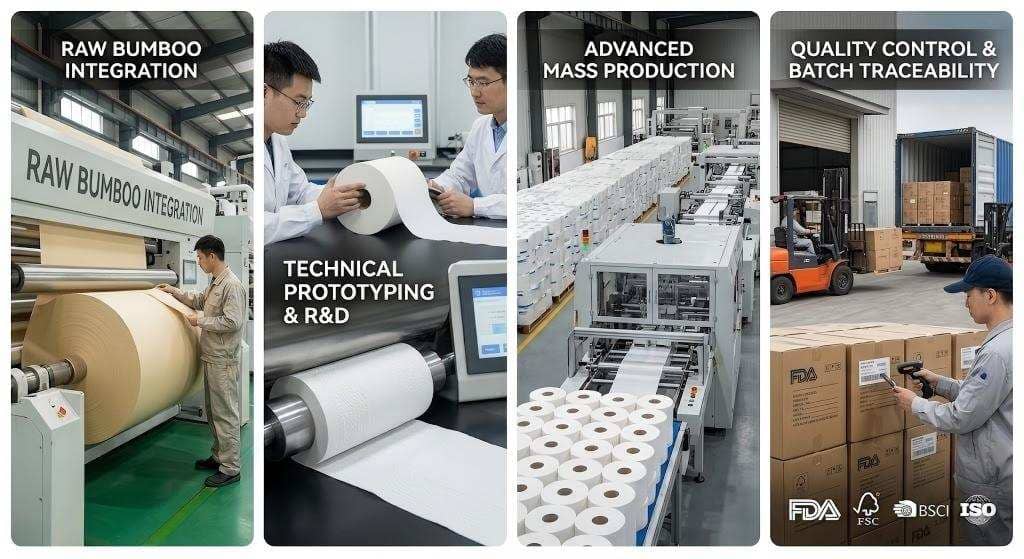
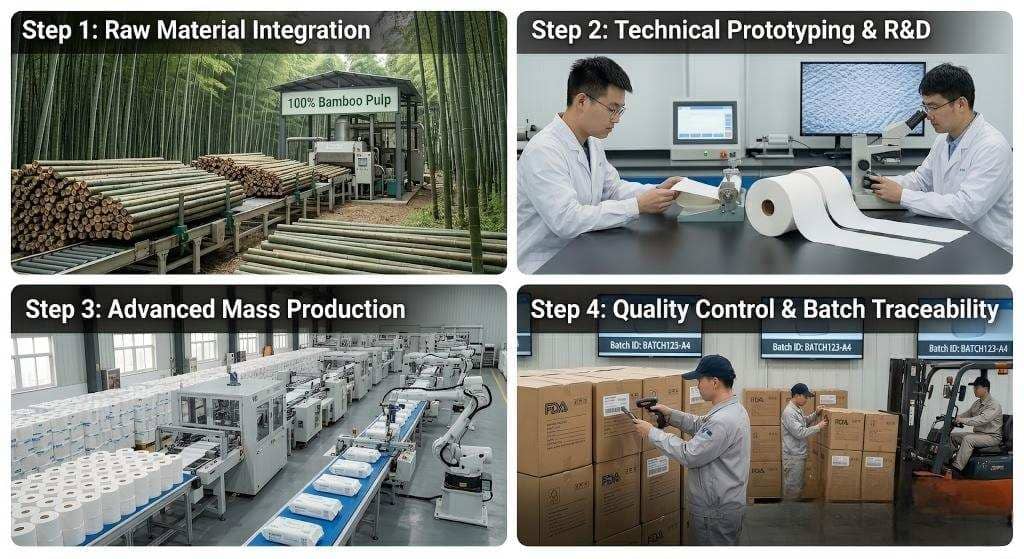
Step 1: Raw Material Integration
Everything starts in the forest. We run a fully integrated supply chain, which means we control the process from the raw bamboo forest to the pulp mill, to the base paper manufacturing, and finally to the processing plant. Why does this matter for your private label tissue paper? Because it keeps your prices stable. We do not buy base paper from third-party brokers, so we do not get hit by sudden market price spikes. This integration also guarantees that your paper is 100% pure bamboo, with absolutely no random wood pulp mixed in secretly.
Step 2: Technical Prototyping & R&D
Once you send us your brand artwork and product specifications, our engineering team gets to work. We create exact digital renderings of the packaging and build physical prototypes of the private label tissue paper rolls or packs. We test the sheet thickness, verify the tear lines, and ensure that the colors on the packaging film match your official brand guidelines perfectly before we start mass production.
Step 3: Advanced Mass Production
When you give the green light, your private label tissue paper moves to the main factory floor. We run over 20 advanced production lines, including fully automatic gluing, laminating, and high-speed converting systems. This level of automation is how we maintain a monthly production capacity of over 3,200 tons. It allows us to handle massive bulk orders for global supermarket chains while keeping the physical properties of the paper identical from the first roll to the last roll.
Step 4: Quality Control & Batch Traceability
Quality control is built into every stage of our production line. We use a complete quality traceability system. Every single batch of private label tissue paper we ship is given a unique identification code. If a customer ever sees something that’s not quite right in the softness or tightness of the roll, we can scan that code and tell him or her exactly when it was produced, who was operating the machine at the time, and even the original batch of raw bamboo pulp. This accountability, being transparent, makes our product quality very stable over long-term contracts.
De-risking the Supply Chain: Regulatory Compliance & Logistics
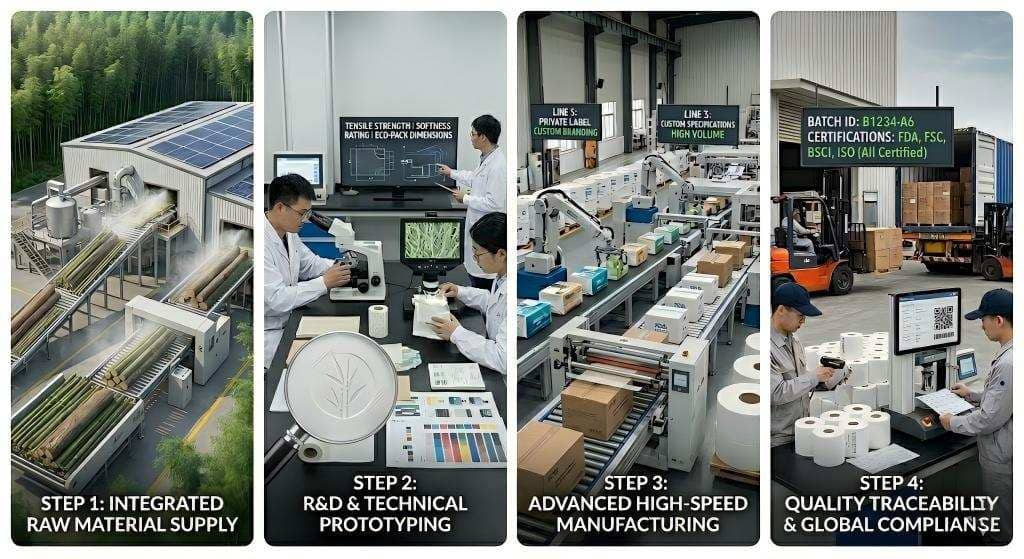
Sourcing private label tissue paper internationally can seem risky if you don’t have the right paperwork and logistics setup. Different areas have very strict laws about what types of products can touch human skin or come into contact with food. If your partner fucks up, your whole shipment can get seized at customs. To protect your brand, you need to break this risk down into 2 main areas: Regulatory compliance and smart shipping logistics.
Global Compliance and Certifications
When you import private label tissue paper into different target markets, your product must carry the correct local credentials. This is the only way to give your retail buyers absolute confidence that your private label tissue paper is safe, ethical, and fully legal to sell.
- The US Market: If you are importing private label tissue paper into the United States, your supplier needs strict FDA compliance since this paper touches human skin and handles kitchen food prep.
- The European and North American Markets: In these regions, consumers and supermarkets want to see the FSC (Forest Stewardship Council) stamp. This proves that the bamboo was harvested responsibly without damaging local ecosystems or treating workers poorly.
- Social and Management Audits: You should always ensure your manufacturer’s facilities are fully audited by BSCI (Business Social Compliance Initiative) for fair labor and certified under standard ISO protocols for manufacturing quality.
Streamlined Freight and Logistics
Logistics is another area where costs can pile up if you are not careful. Shipping lightweight, bulky items like private label tissue paper requires smart planning so you do not end up paying more for shipping than the actual paper.
- Direct Carrier Contracts: Because we handle high volumes of international freight to over 52 countries, we hold direct customer contracts with major global shipping lines. By bypassing middleman logistics brokers, we get highly stable container rates. This also ensures we secure reliable vessel space for your private label tissue paper even during peak shipping seasons.
- Local Infrastructure Utilization: We also utilize local inland shipping hubs like the Yongchuan Terminal. This allows us to move cargo efficiently from our factory gates straight onto container ships, reducing handling fees and keeping your total landed costs as low as possible.
Conclusion & Next Steps
Capturing the growing market of eco-conscious consumers can be best achieved by building a brand around private label tissue paper. By utilising 100% bamboo raw materials, you can offer a premium, high-strength, low-carbon alternative to traditional wood pulp products and develop real asset value for your own company brand name.
You don’t have to work out all the manufacturing technicalities yourself. Our team is here to help you choose specs, design packaging, and coordinate logistics. If you wish to see the physical quality of our bamboo material yourselves, just send us a message via our contact portal. We will gladly put together a free sample kit of our household and commercial lines and provide a detailed OEM/ODM price quote tailored to your specific market requirements. Let us work together to build a sustainable brand your customers will love.