How Unbleached Bamboo Tissue Achieves Yellowing Control
As a research and development engineer specializing in industrial tissue manufacturing, I have spent years optimizing fiber performance on the paper machine wet end and inside the pulp mill. In the global tissue market, a common commercial challenge faces every major bamboo tissue paper manufacturer: brightness reversion, commonly known as the yellowing or color degradation of tissue paper over its shelf life.
Consumers may believe that unbleached bamboo tissue is more stable because it has not been through harsh chemical bleaching, but the physical chemistry of papermaking says otherwise. The control of the color uniformity and the prevention of the darkening of unbleached bamboo pulp are far more complicated than the control of the brightness of fully bleached white paper.
This article provides a rigorous analysis of the chemical mechanisms behind tissue paper yellowing and details the four-stage color stabilization process developed to address these issues.
The Chemical Mechanisms of Bamboo Tissue Paper Yellowing
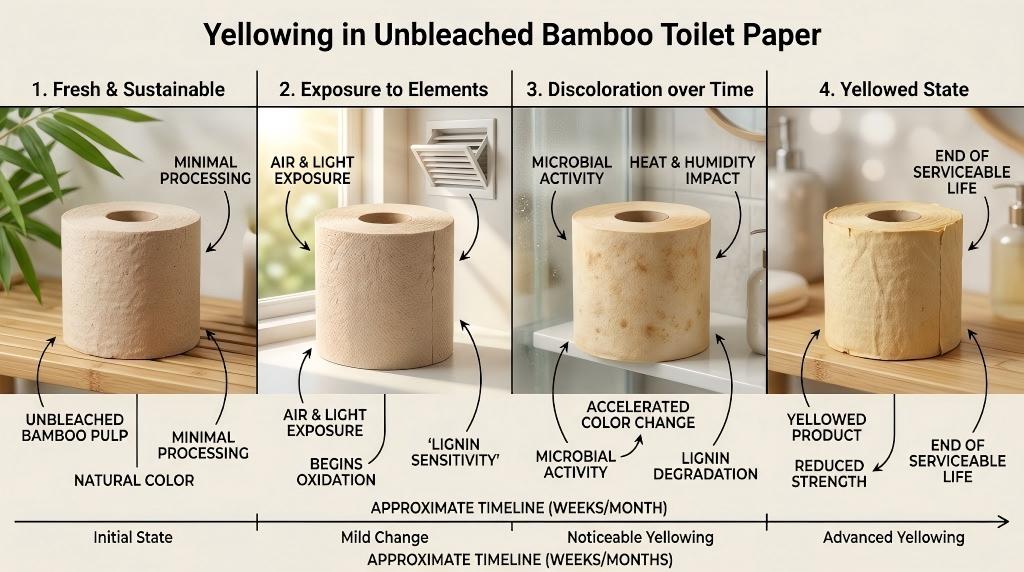
To control color uniformity, a bamboo tissue paper manufacturer must understand the exact molecular degradation pathways occurring within the organic structure of the sheet. Brightness reversion is driven by three primary chemical factors.
1. Lignin Photo-Oxidation and Quinoid Structures
Lignin is a complex aromatic polymer containing a high density of phenolic hydroxyl groups. In bleached white paper, the residual lignin content is generally driven below 1% via chemical extraction. In unbleached bamboo tissue, however, high concentrations of natural lignin are intentionally preserved to maintain the characteristic beige hue.
Under the influence of light energy or heat energy, these phenolic hydroxyl groups become capable of absorbing UV light energy. Photochemical energy brings about oxidation, which transforms the phenolic molecules into quinoid molecules (quinoid chromophores), which have an extensive conjugation of a double bond. These molecules absorb blue light energy, resulting in a shift towards reddish brown or yellowish appearance of the paper.
2. Carbohydrate Degradation and Carbonyl Formation
The carbohydrate fraction of cellulose and hemicellulose from bamboo fiber can also be degraded. The wet condition and the drying section of the paper machine (temperatures on the Yankee dryer cylinder surface above 100°C) induce hydrolytic and oxidative degradation during long-term storage.
This process breaks down the polysaccharide chains and puts carbonyl groups (like aldehyde groups and ketone groups) along the cellulose backbone. These new carbonyl groups act as secondary chromophores and contribute directly to the loss of brightness and the degradation of optical properties over time.
3. Functionality Additives Reactivity
Modern facial tissue manufacturing requires the use of wet-end functional chemicals, such as polyamide-epichlorohydrin (PAE) wet-strength agents and quaternary ammonium-based softening agents. Under the influence of the high thermal energy required for crepe generation and subsequent storage, these organic additives can undergo thermal aging or cross-linking side reactions. This chemical degradation further contributes to localized discoloration and a reduction in overall color purity.
Standard Industry Methods for Controlling White Paper Reversion
In standard bleached white paper production, paper mills deploy a strategy of absolute elimination to prevent yellowing:
- Extended Delignification: Mills prolong the cooking cycle and utilize oxygen delignification systems to reduce the pulp’s lignin content to a minimum before the bleaching sequences begin.
- Advanced Bleaching Sequences: Mills employ bleaching using either the ECF process involving chlorine dioxide (ClO2) or the TCF method that involves the use of ozone (O3) and hydrogen peroxide (H2O2). In this oxidation technique, all double bonds found in the structure of lignin molecules are effectively destroyed to prevent further quinoid structures from forming.
- Anti-Yellowing Additives: Mills introduces hindered amine light stabilizers (HALS) or ultraviolet absorbers directly into the stock preparation tank to intercept UV radiation before interacting with the fiber matrix.
Why is It More Difficult to Control Unbleached Bamboo Paper Yellowing?
For a specialized bamboo tissue paper manufacturer, the standard methods used for white paper are completely non-viable. Stabilizing unbleached bamboo pulp presents unique engineering constraints due to the following variables.
1. Extreme Lignin Concentrations
The fundamental challenge of unbleached bamboo paper yellowing control is the presence of an immense substrate volume. Because the bleaching sequence is omitted, the pulp retains a high concentration of native lignin. The total number of reactive phenolic hydroxyl sites is exponentially higher than that of bleached pulp. Consequently, the potential rate and scale of photo-oxidation reactions are magnified, creating a high risk of rapid darkening upon exposure to air and light.
2. Visual Sensitivities to Color Fluctuations
Human visual perception is highly sensitive to subtle shifts in wavelength within the yellow-orange spectrum. For bleached white paper, any slight reduction in brightness will go unnoticed by the end user. However, for the unbleached paper, any photo-oxidation that occurs causes patches in the form of dark spots. This makes the paper appear dirty, thus becoming commercially unsuitable.
3. Hemicellulose Retention and the Maillard Reaction
Bamboo species have high contents of pentosans and xylan-rich hemicellulose compared to conventional softwoods. In alkaline cooking, these hemicelluloses are partly degraded to soluble reducing sugars. Moreover, bamboo fibers have high levels of natural proteins and free amino acids naturally.
As the paper web moves over the high-temperature dryers, these reducing sugars react with the amino compounds. This non-enzymatic browning is called the Maillard reaction. This reaction also causes the paper to instantly darken during the manufacturing phase if the raw materials are not properly treated. This results in a burnt, dull aesthetic rather than a clean, bright beige color.
The Four-Stage Engineering Framework for Bamboo Color Stabilization
To overcome these physical limitations without using traditional bleaching sequences, modern mills implement a highly controlled, four-stage technical framework spanning from initial digestion to wet-end chemical modification.
1. Modified Displacement Cooking and Kappa Number Optimization
The baseline color properties are established entirely inside the digester. Mills utilize Rapid Displacement Heating (RDH) or SuperBatch digestion systems to execute modified alkaline cooking.
The primary control metric is the pulp Kappa number, which is maintained strictly within a target range of 15 to 25.
The effective alkali concentration is dosed continuously at a lower, uniform rate rather than in a single high-concentration injection. This low-alkali, low-temperature profile prevents the structural condensation of dissolved lignin back onto the cellulose fibers, which is the primary cause of dark, irreversible pulp discoloration.
2. Mild Peroxide Toning Phase
To achieve uniform bamboo pulp color uniformity optimization, the unbleached pulp passes through a mild, non-bleaching oxidation phase. This process uses low-dosage hydrogen peroxide (H2O2) under alkaline conditions.
The reaction parameters (temperature below 70°C, chemical charge under 0.5% on oven-dry pulp) are restricted so that the lignin matrix is not solubilized or stripped away. Instead, the peroxide selectively targets and oxidizes highly reactive, unstable natural pigments such as chlorophyll derivatives and anthocyanins. This process neutralizes the green and grey undertones, stabilizing the baseline pulp color into a consistent, light beige.
3. Multi-Stage Counter-Current Washing
To completely eliminate the risk of the Maillard reaction during thermal drying, the mill must remove all dissolved organic matter. This is achieved using a series of vacuum drum washers or twin-roll presses configured for multi-stage counter-current washing.
In the final washing stage, only clean process water is introduced and flows backwards through the system counter-current to the pulp flow. This engineering arrangement brings chemical extraction efficiency to a maximum and reduces residual black liquor solids, free reducing sugars, and degraded hemicelluloses to near-zero levels in the final slurry. These organic precursors are necessary for the thermal browning reaction on the Yankee dryer to take place.
4. Wet-End Chelation and Alkaline Papermaking
The final stage occurs within the approach flow system of the tissue machine, where specialized functional chemistry is applied to the stock:
- Polyphenol Passivation: Natural bamboo has large amounts of tannins and polyphenols, which form highly colored organo-metallic complexes upon contact with metallic ions such as Fe2+/Fe3+ in the process water. Mills incorporates certain organic chelating agents into the formulation to chelate these metal ions, thereby avoiding the formation of these colored complexes.
- Alkaline Papermaking Systems: Wet press white water loop is adjusted to a slice water of a stable, neutral, and weakly alkaline pH range of 7.5 to 8.5. This pH minimizes the effect of acid on the remaining chains of hemicellulose, which means that the colour will be preserved for a longer while during storage.
Industrial Technical Specifications Matrix
The following table summarizes the operational parameters required to manage brightness reversion across both white and unbleached manufacturing systems.
| Process Variable | Bleached Wood Pulp Tissue | Unbleached Bamboo Pulp Tissue |
| Target Lignin Content (Kappa Number) | Less than 1.0 | 15.0 – 25.0 |
| Bleaching Sequence Classification | ECF / TCF (Full Brightness) | None (Mild H2O2 Toning Only) |
| Primary Reversion Driver | Carbonyl generation on cellulose | Lignin photo-oxidation to quinoids |
| Wet-End pH Range | 6.5 – 7.0 (Slightly Acidic to Neutral) | 7.5 – 8.5 (Alkaline Papermaking) |
| Washing Efficiency Requirement | Standard (For chemical recovery) | Ultra-High (To eliminate Maillard precursors) |
Frequently Asked Questions on Bamboo Tissue Paper Yellowing Control
Q1: Why does unbleached bamboo tissue turn dark yellow or brown in sunlight much faster than white tissue?
A1: Unbleached bamboo paper skips the chemical bleaching process, leaving its natural lignin intact. Lignin contains UV-sensitive compounds that oxidize in sunlight, turning into dark pigments called quinones. White paper has virtually no lignin left, so it doesn’t change color.
Q2: What causes some unbleached bamboo papers to have a burnt smell and uneven dark tint right after drying?
A2: This is caused by the Maillard reaction (heat-driven browning). If the pulp isn’t washed thoroughly, leftover natural sugars and amino acids from the bamboo remain in the mix. When cooked by the drying cylinders, these residues caramelize, creating dark patches and a burnt odor.
Q3: How do metal ions in production water mess with the color uniformity of unbleached bamboo pulp?
A3: Unbleached bamboo is packed with natural tannins and polyphenols. If the water contains trace metals like iron or copper, they chemically bind to these plant compounds to form dark metal complexes, creating ugly grey or dark spots. Mills have to add chelating agents to trap these metals and keep the paper a uniform beige.