OEM vs ODM Tissue Paper: Which One is Better?
The tissue paper market continues to develop with consumers demanding better hygiene, sustainability, and product quality. The initial strategic choice for distributors, retailers, supermarkets and private label brands when launching a product line is often OEM vs ODM tissue paper. We are a tissue paper manufacturer with a customer base across the globe and have seen both models work well when aligned to business goals. It is not about selecting the “better” model but the one that provides the best trade-off between cost, quality, speed and long-term competitiveness.
What Is OEM Tissue Paper and ODM Tissue Paper?
If you understand the difference between OEM tissue paper and ODM tissue paper, it will help the buyer to save unnecessary costs and shorten the time to market.
What is Original Equipment Manufacturer (OEM)?
OEM tissue paper is a manufacturing model where the customer provides the product specifications, quality standards, packaging design, and branding while the factory handles production.
In an OEM partnership, customers usually choose:
- Tissue size and ply
- GSM (grams per square meter)
- Ratio of virgin wood pulp, bamboo pulp or recycled fiber
- Requirements for softness and absorbency
- Embossing patterns
- Scent or lotion choices
- Artwork and branding for packaging
Then the manufacturer manufactures according to these specific needs and applies strict quality control.
OEM is an ideal match for companies with a clear product positioning and total control of product differentiation.
What is Original Design Manufacturer (ODM)?
With ODM tissue paper, the customer can choose from among existing products already developed by the manufacturer.
Buyers don’t invest in product development; they just choose:
- Existing tissue formulations
- Standard sizes
- Proven packaging designs
- Branding on request
This drastically cuts down on development costs and allows brands to get products to market more quickly.
Many supermarkets, online retailers, wholesalers, and start-up brands prefer ODM, as it reduces the risk of entering a market.
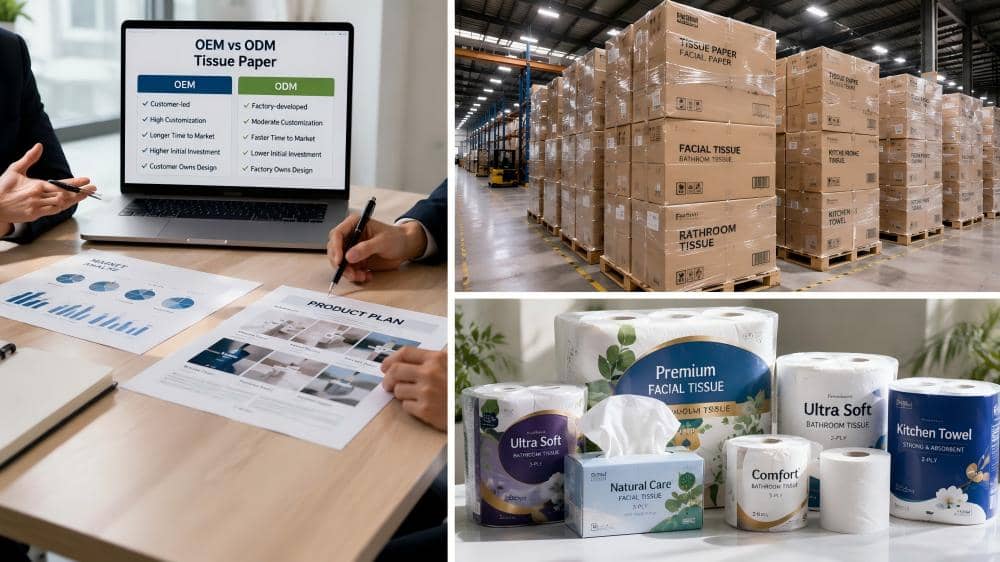
OEM vs ODM Tissue Paper Comparison
| Comparison Item | OEM Tissue Paper | ODM Tissue Paper |
| Product Development | Customer-led | Factory-developed |
| Customization Level | Very High | Moderate |
| Initial Investment | Higher | Lower |
| Production Cost at Scale | Lower after optimization | Stable |
| Time to Market | Longer | Faster |
| Intellectual Property | Customer owns design | Factory owns design |
| Product Differentiation | Excellent | Limited |
| Suitable Business Stage | Mature brands | New brands & startups |
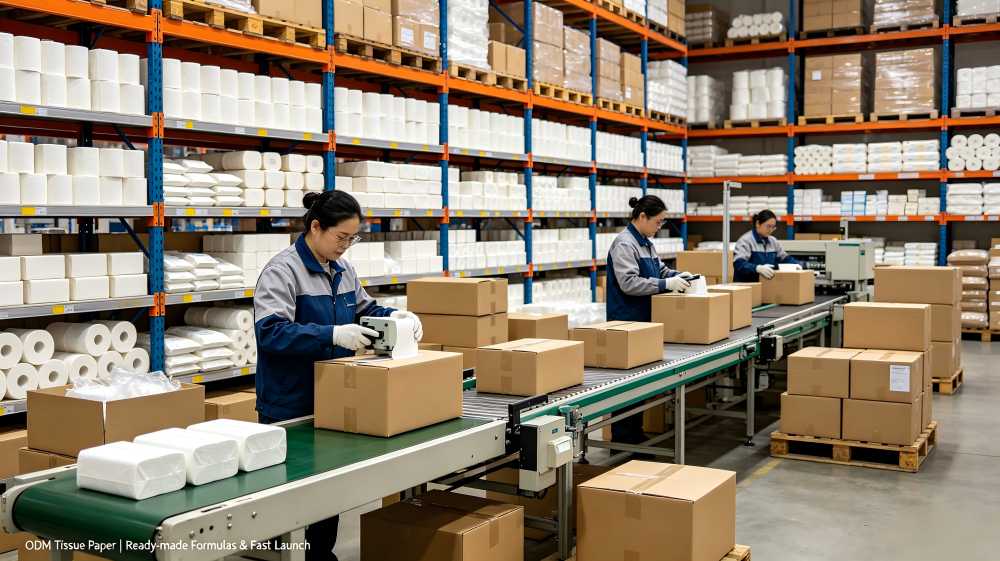
What Model Fits Your Business Stage?
The answer is less about company size and more about your commercial strategy.
Why Opt for OEM Tissue Paper?
OEM tissue paper offers significant competitive advantages for brands looking to differentiate themselves in the long term.
Firstly, it enables complete product uniqueness.
You can tailor everything about the tissue: the pulp composition, softness, absorbency, strength, and appearance. For example, upscale hospitality brands might focus on ultra-soft virgin wood pulp, whereas eco-conscious brands might create bamboo-based tissue products using certified sustainable sourcing.
Secondly, OEM adds value to the brand.
Consumers are becoming more aware of the subtle quality differences in everyday hygiene products. Unique embossing patterns, customized packaging, and exclusive product specs help build a stronger brand identity.
Third, OEM allows for ongoing product innovation.
With consumer preferences changing, manufacturers can work together to develop better formulations, more sustainable packaging, or more upscale product lines that are difficult for competitors to copy.
OEM is particularly useful for:
- High-end private label brands
- Retail chains – national
- Hospitality suppliers
- Healthcare product distributors
- Companies with experienced product development teams
Why Choose ODM Tissue Paper?
Speed and efficiency for market entry are offered by ODM tissue paper.
Buyers can benefit from products that have already been validated in manufacturing and quality testing, rather than waiting months for a new product to be developed.
Key benefits:
- Lower development costs: No need to invest in lab tests, material validation or product engineering.
- Faster time to market: Existing production lines can go live as soon as packaging is approved.
- Reduce business risk: ODM products have been supplied to various markets with proven quality consistency and manufacturing stability.
- Mature supply chain: Optimized raw materials, packaging components, and manufacturing processes lead to less delivery uncertainty.
ODM is especially suited for:
- Amazon Merchants
- Cross-border e-commerce brand
- Supermarket own labels
- Tissue brands launching l
- Regional distributors seeking new markets
For many new companies, ODM is a good starting point until sales volumes increase and they move into OEM.
Three Key Things to Know Before You Choose OEM or ODM
As factory marketing professionals, we always advise customers to consider these three areas before making a decision.
1. R&D Capabilities
Do you have detailed product specifications already?
If your team knows tissue performance, pulp selection, packaging requirements, and regulatory compliance, OEM can create greater long-term value.
Otherwise, ODM allows you to take advantage of the technical expertise of the manufacturer with minimum complexity of development.
2. Budget Allocations
Every company has limited resources to work with.
Ask yourself:
Would you prefer to invest in product development or customer acquisition?
OEM demands more upfront investment in product engineering, sampling, and validation.
ODM frees up more budget for marketing, distribution, digital advertising, and brand promotion.
Market expansion often provides a quicker return on capital for many growing businesses.
3. Positioning in the Market
Your competitive strategy directly affects the manufacturing model.
If you’re looking for premium positioning and higher margins, OEM builds sustainable product differentiation.
ODM offers great cost efficiency and ensures reliable product quality if your focus is on competitive pricing and rapid expansion.
Building Long-term Success From ODM to OEM
There are many successful tissue brands that don’t stay with one model forever.
Instead, their approach is phased.
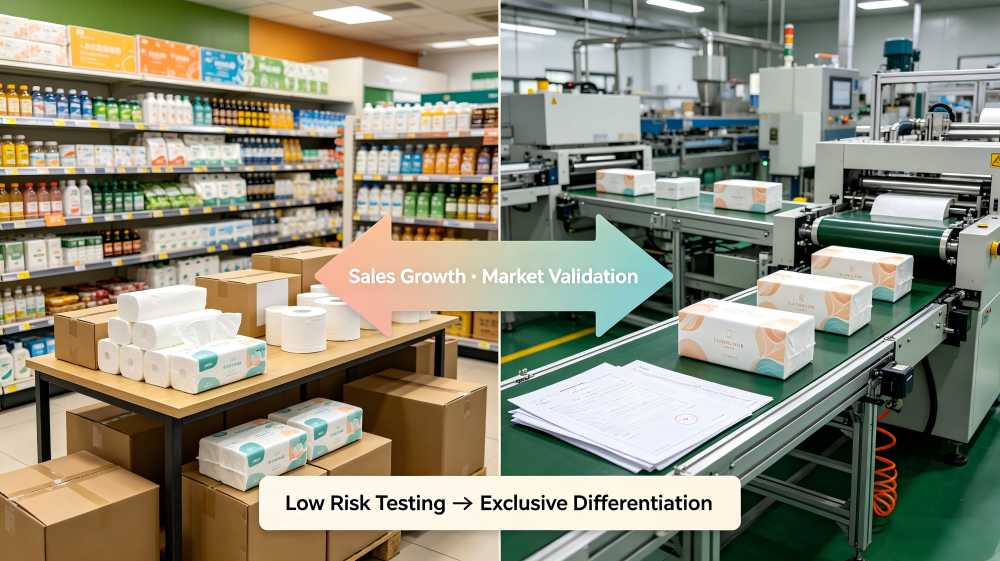
They begin with ODM tissue paper to test customer demand, learn market preference, and build sales channels.
With the sales stabilizing and brand awareness increasing, they gradually move to OEM tissue paper, introducing unique product features that other competitors find difficult to replicate.
This reduces early investments and creates long-term competitive advantages.
The right manufacturing partner is also key.
When you are assessing suppliers, consider:
- Certifications for manufacturing
- Automated production capacity
- Raw material sourcing
- Sanitation management system
- Quality inspection processes
- Consistent export experience
- Flexible customization abilities
- Dependable delivery record
An effective manufacturer should be a strategic partner, not just a manufacturer, who can help with product development, cost efficiency, and expanding markets.
Frequently Asked Questions
Q1: What’s the usual MOQ for OEM tissue paper?
A1: The minimum order quantities vary by product specifications, packaging complexity, and customization level. Most manufacturers are flexible with MOQs depending on the project. If you contact the factory directly, they can adjust the production plan to suit your target market and purchasing volume.
Q2: How can manufacturers ensure consistent ODM tissue paper quality?
A2: Professional tissue manufacturers implement full quality management systems covering the whole production process, including raw material inspection, automated production process monitoring, laboratory testing, and finished product verification. Standardized processes guarantee each production batch provides consistent softness, absorbency, strength, and hygiene standards.
Q3: What kind of model is suitable for a new tissue paper brand?
A3: ODM tissue paper is the first choice for most startups because it lowers development costs, speeds up market entry, and reduces commercial risk. Transitioning to OEM tissue paper allows for improved product differentiation and brand competitiveness over the longer term as the business matures and customer demand becomes more certain.