Mini Jumbo Toilet Roll vs Standard Toilet Roll: Which Is Better for Commercial Restrooms?
For commercial restroom operators, choosing toilet paper is not simply a matter of selecting the lowest-priced roll. The format of the roll can affect refill frequency, dispenser compatibility, janitorial workload, inventory management, and the overall operating cost of a facility.
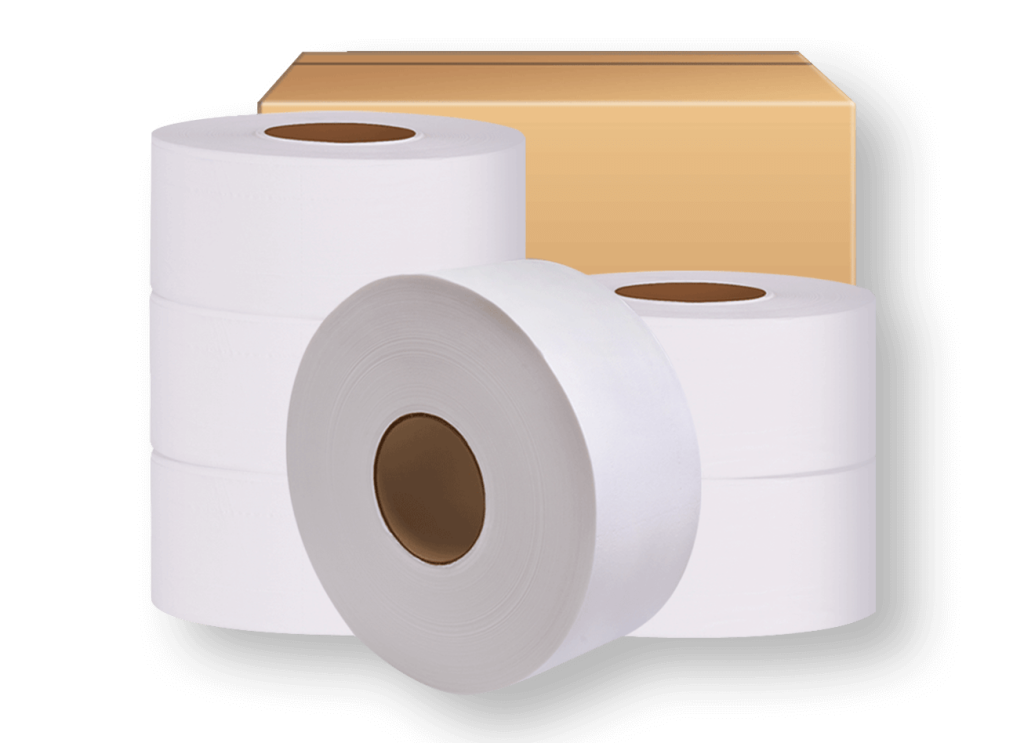
Mini jumbo toilet rolls and standard toilet rolls serve different operational requirements. Standard rolls may be suitable where restroom traffic is relatively low and conventional dispensers are already installed. Mini jumbo rolls, by contrast, are designed to provide greater paper capacity per roll and reduce the frequency of manual replacement, making them particularly relevant to commercial and public facilities. Donsea Paper’s mini jumbo toilet rolls, for example, are designed for commercial applications and can be customized by sheet size, sheet count, core, GSM, ply, and packaging.
The better choice, therefore, depends less on the name of the roll and more on how the restroom is used, how often it needs servicing, and what dispensing system is available.
What Is the Difference Between Mini Jumbo and Standard Toilet Rolls?
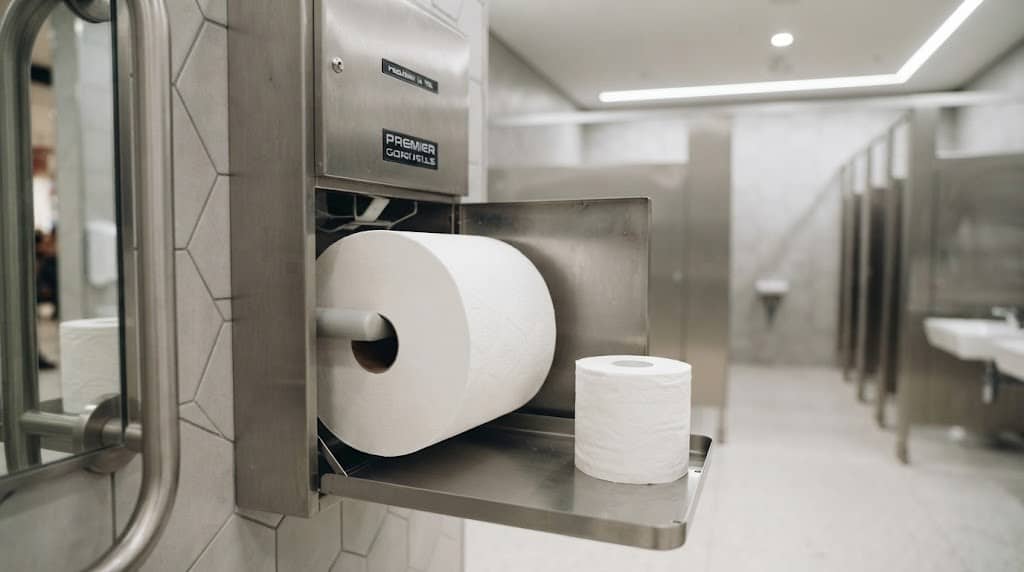
The most important difference is not simply the physical diameter of the roll. It is the amount of paper available before the dispenser needs to be refilled. A standard toilet roll is typically designed around conventional restroom or household-style dispensing systems. It is relatively easy to handle, store, and replace, but its lower paper capacity can result in more frequent refilling when usage increases. A mini jumbo toilet roll is designed around commercial dispensing. Its larger roll format provides more paper per refill and is intended to extend the operating period between replacements.
The practical differences can be summarized as follows:
| Factor | Mini Jumbo Toilet Roll | Standard Toilet Roll |
| Paper capacity | Higher | Lower |
| Refill frequency | Generally lower | Generally higher |
| Typical dispenser | Commercial dispenser | Standard dispenser |
| Maintenance requirement | Lower refill frequency | More frequent checking |
| Best application | Medium- and high-traffic facilities | Low-traffic facilities |
| Storage and handling | Larger individual rolls | Easier individual handling |
| Customization | Suitable for commercial specifications | Often based on standard formats |
The actual performance depends on roll length, sheet size, ply, GSM, and dispenser configuration, so buyers should avoid comparing roll formats based only on physical appearance. For example, Donsea Paper’s mini jumbo specification includes a 74 mm core, while sheet size and sheet count can be customized according to the application and dispenser requirements.
How Does Restroom Traffic Affect the Choice?
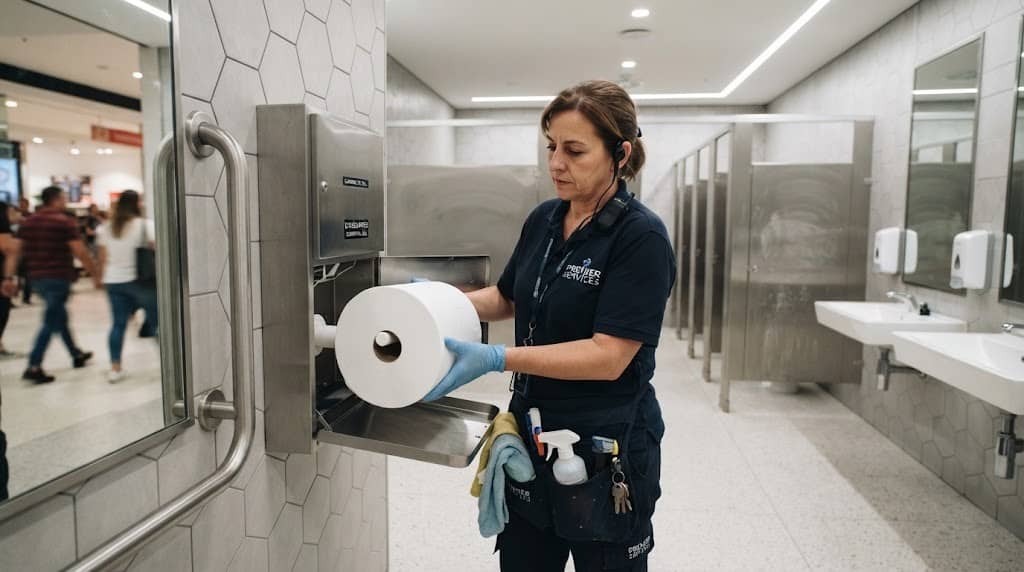
Restroom traffic is one of the most useful factors for deciding between mini jumbo and standard rolls. A facility with limited daily usage may not gain much from a high-capacity commercial roll. If the restroom is used by a small number of employees or customers, a standard roll can remain in service for a reasonable period. As traffic increases, however, the operational impact of frequent replacement becomes more significant.
1. Low-Traffic Facilities
Examples include:
- Small offices
- Boutique stores
- Small restaurants
- Private business facilities
- Low-occupancy commercial buildings
For these locations, standard toilet rolls may provide sufficient capacity without requiring a change in dispenser infrastructure.
2. Medium-Traffic Facilities
Examples include:
- Larger office buildings
- Schools
- Clinics
- Hotels
- Retail facilities
Here, mini jumbo rolls can become more attractive because longer intervals between refills can simplify restroom maintenance.
3. High-Traffic Facilities
Examples include:
- Shopping centers
- Transportation facilities
- Large factories
- Public buildings
- Entertainment venues
In these environments, the question is not simply how much a roll costs. The facility also needs to consider how often employees must inspect and refill dispensers.
This creates a basic operational relationship: Higher traffic → higher paper consumption → more frequent refilling → greater maintenance workload.
Mini jumbo rolls are designed to address this operational problem by increasing the amount of paper available between refills.
Which Roll Reduces Restroom Maintenance Work?
For facility managers, refill frequency can be more important than the purchase price of an individual roll. A restroom attendant or janitorial employee may need to:
- Inspect the dispenser.
- Identify low or empty rolls.
- Bring replacement stock.
- Open the dispenser.
- Replace the roll.
- Remove packaging or empty cores.
- Check the dispenser again before leaving.
When this process happens many times each day across multiple restrooms, the accumulated labor requirement can become significant. Standard rolls may require more frequent replacement because their capacity is relatively limited. This does not necessarily make them a poor choice; it simply means that the facility needs to account for a greater number of refill events. Mini jumbo rolls can reduce the number of these events because each roll contains more paper. Donsea Paper specifically positions its mini jumbo rolls for commercial and public restrooms where reducing refill frequency is an important operational benefit.
However, the benefit should be evaluated at the facility level, not simply per roll.
For example: 20 standard rolls replaced several times per day may require considerably more maintenance effort than a smaller number of higher-capacity rolls. This is why roll capacity should be considered together with restroom traffic and the number of dispensers being serviced.
Mini Jumbo vs Standard: Which Has the Lower Total Cost?
The lowest purchase price per roll does not necessarily represent the lowest operating cost. For commercial buyers, a more useful approach is to evaluate Total Cost of Ownership (TCO). A simplified calculation is:
Total Restroom Cost = Paper Cost + Labor Cost + Refill Cost + Inventory Cost + Waste Cost
1. Paper Cost
Instead of comparing only the price of one roll, buyers should consider:
- Cost per sheet
- Cost per meter
- Sheets per roll
- Roll length
- Ply
- GSM
- Expected consumption
A larger roll may have a higher unit price but provide substantially more usable paper.
2. Labor Cost
Frequent replacement requires employee time. For facilities with many restrooms, the labor associated with inspections and refilling can become an important part of operating expenses.
3. Inventory Cost
More frequent replacement can also affect stock planning. Facility managers need to keep enough rolls available to prevent empty dispensers during busy periods. Higher-capacity rolls can simplify inventory planning because fewer replacement units may be needed for the same operating period.
4. Waste and Packaging
Procurement teams can also consider:
- Packaging per usable meter
- Core waste
- Outer packaging
- Storage requirements
- Disposal requirements
Therefore, the right question is not: Which roll is cheaper? It is: Which roll provides the required paper capacity at the lowest practical operating cost?
This distinction is particularly important for multi-location businesses managing dozens or hundreds of restrooms.
How Important Is Dispenser Compatibility?
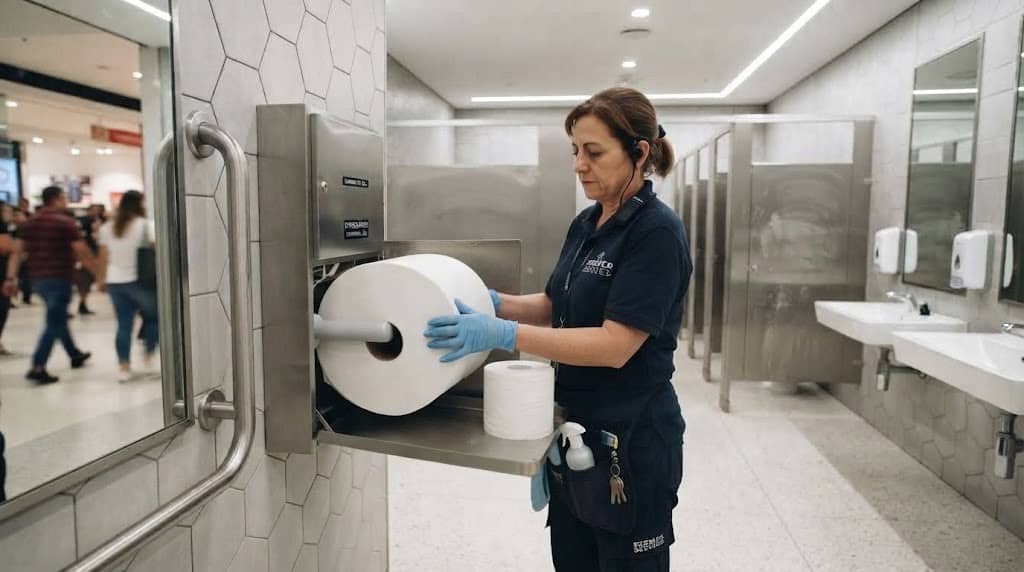
Before switching from standard toilet rolls to mini jumbo rolls, buyers should confirm dispenser compatibility. This is one of the most commonly overlooked factors in commercial tissue procurement.
Important specifications include:
1. Core Diameter
The core must match the dispenser spindle or mounting mechanism. For example, Donsea’s mini jumbo toilet rolls use a 74 mm core as a listed specification, although commercial buyers should always confirm the exact requirements of their dispenser before ordering.
2. Maximum Roll Diameter
A dispenser has a defined internal space. A roll that is too large may not rotate correctly or may not fit inside the housing.
3. Paper Width
The roll width should correspond to the dispenser’s dispensing path.
4. Roll Length
Two rolls with similar external dimensions can provide different operating times depending on sheet size and winding configuration.
5. Dispenser Mechanism
Buyers should also determine whether the dispenser uses:
- Single-roll dispensing
- Dual-roll dispensing
- Automatic roll transfer
- Manual tear-off
- Reserve-roll systems
This means that switching paper formats should be treated as a paper-and-dispenser system decision, rather than a paper-only decision.
Which Option Works Better for Different Commercial Facilities?
There is no universal answer for every commercial restroom. The following framework can help buyers make a practical decision:
| Facility Type | Suggested Format | Main Consideration |
| Small office | Standard roll | Limited consumption |
| Small restaurant | Standard roll | Moderate or intermittent traffic |
| Boutique hotel | Standard or mini jumbo | Depends on restroom traffic |
| Large office | Mini jumbo | Longer service intervals |
| School | Mini jumbo | Repeated daily usage |
| Shopping center | Mini jumbo | High user volume |
| Factory | Mini jumbo | Frequent employee use |
| Public facility | Mini jumbo | Maintenance efficiency |
The key point is that facility size alone does not determine the appropriate format. A small building with a highly concentrated restroom traffic pattern may consume more paper than a larger building with relatively few users.
Therefore, buyers should evaluate Daily users + consumption rate + number of restrooms + refill frequency + dispenser capacity rather than simply selecting a roll based on the type of building.
What Should Buyers Check Before Switching to Mini Jumbo Rolls?
A commercial buyer should evaluate several specifications before placing an order.
1. Daily Restroom Traffic
Estimate the number of users and identify peak periods.
2. Current Paper Consumption
Track how many standard rolls are consumed per restroom per day or week. This creates a useful baseline for calculating the potential benefit of a higher-capacity format.
3. Dispenser Compatibility
Check:
- Core diameter
- Maximum roll diameter
- Paper width
- Roll length
- Dispensing mechanism
4. Paper Construction
Consider:
- GSM
- Ply
- Sheet size
- Sheet count
- Strength
- Absorbency
- Dissolvability
5. Roll Capacity
Do not assume that a larger-looking roll automatically provides better value. Compare the actual usable paper quantity.
6. Packaging Requirements
For private-label or multi-location procurement, buyers may also need to define:
- Individual wrapping
- Shrink film
- Carton configuration
- Labeling
- Brand printing
7. Supply Consistency
For commercial operations, consistency between production batches matters. Variations in roll dimensions or specifications can create problems when products must work with fixed dispensers.
Donsea Paper supports customization of mini jumbo roll specifications, including sheet size, sheet count, core, GSM, ply, embossing, and packaging, making these parameters suitable for discussion during OEM or private-label procurement.
When Should Commercial Restrooms Choose Mini Jumbo Rolls?
The choice between mini jumbo and standard toilet rolls should ultimately be based on operational requirements rather than roll price alone.
Choose Mini Jumbo Toilet Rolls When:
- Restroom traffic is medium to high.
- Frequent refilling creates additional labor.
- Multiple restrooms need to be serviced regularly.
- Commercial dispensers are already installed or planned.
- Longer intervals between replacements are valuable.
- The facility needs more predictable paper inventory.
- Procurement teams want to evaluate cost based on actual paper usage rather than unit price.
Choose Standard Toilet Rolls When:
- Restroom traffic is relatively low.
- Existing standard dispensers are already installed.
- Consumption is predictable and limited.
- Compact roll handling is preferred.
- The cost of changing the dispenser system would outweigh the operational benefit.
For commercial facilities, mini jumbo toilet rolls are generally the stronger option when maintenance efficiency and refill capacity are priorities. Standard rolls remain practical where usage is low and conventional dispensing infrastructure already meets operational requirements. The most effective procurement decision is therefore not simply “mini jumbo vs standard.” It is a comparison of paper capacity, consumption, dispenser compatibility, maintenance frequency and total operating cost.
For tissue manufacturers and private-label buyers, these factors can also be translated into specific product requirements such as GSM, ply, sheet dimensions, sheet count, core diameter and packaging configuration. Donsea Paper offers customization across these specifications for mini jumbo toilet roll applications.
FAQs
Q1: Is a mini jumbo toilet roll more cost-effective than a standard toilet roll?
Yes, especially in medium- and high-traffic commercial restrooms. Although the unit price may be higher, mini jumbo rolls can reduce refill frequency, janitorial labor, inventory handling, and dispenser servicing, resulting in a lower total operating cost.
Q2: How do I know if a restroom should switch to mini jumbo toilet rolls?
Evaluate daily restroom traffic, current roll consumption, refill frequency, and dispenser capacity. If staff frequently need to replace standard rolls or dispensers become empty during peak periods, a mini jumbo format may provide better operational efficiency.
Q3: Can mini jumbo toilet rolls fit existing commercial dispensers?
Not necessarily. Buyers should verify the dispenser’s core diameter, maximum roll diameter, paper width, and dispensing mechanism before switching formats. Matching the roll specifications to the dispenser is essential for reliable operation.
Q4: Is a larger toilet roll always the better choice for commercial restrooms?
No. Mini jumbo rolls are generally advantageous for medium- and high-traffic facilities, but standard rolls can be more practical for low-traffic locations with existing conventional dispensers. The best choice depends on consumption, maintenance requirements, dispenser compatibility, and total cost of ownership.