LCA Comparison of Bamboo Toilet Paper and Recycled Paper
In 2026, the global tissue market will no longer be able to make marketing claims about switching to sustainable substrates, but will have to adhere to a strict Life Cycle Assessment (LCA). With manufacturing overheads shifting along with changing energy policies and carbon taxation, industrial buyers and individual consumers alike often ask: Why is bamboo toilet paper so expensive? This involves a technical assessment of the production variables, energy intensities, and chemical requirements. This report provides a data-driven comparison between bamboo toilet paper produced in specialized Asian facilities and recycled fiber paper manufactured within local US or European circular economies.
Fiber Morphological Characteristics and Land Use Efficiency
The biological classification of bamboo as a grass rather than a tree dictates its land use efficiency. Bamboo species used for industrial pulping, such as Neosinocalamus affinis, reach maturity for harvest within 3 to 5 years, whereas softwood species require 25 to 40 years. Data from 2025 forestry audits indicate that bamboo generates approximately 35% more oxygen and sequesters significantly more carbon per hectare than equivalent arboreal stands.
The bamboo long fiber morphology provides a good tensile strength from a manufacturing point of view. On the other hand, in each recycling loop, recycled fibers degrade mechanically and chemically. Paper processing reduces the bonding capacity and shortens the fibers. As a result, recycled tissue often requires the addition of virgin pulp or chemical fortifiers to maintain functional integrity. Bamboo toilet paper is structurally sound due to the natural integrity of virgin grass fibers, and does not require synthetic structural reinforcements.
The compliance landscape in 2026 is further defined by the EU Deforestation Regulation (EUDR). Bamboo, being a self-regenerating grass, simplifies the traceability requirements for manufacturers. It does not contribute to permanent deforestation, reducing the administrative and auditing costs associated with securing “deforestation-free” certifications compared to virgin wood pulp.
Life Cycle Assessment (LCA): Carbon Footprint Variables
1. Transportation vs. Production Energy
The criticism of products made from bamboo relates to the carbon emissions that occur due to the transportation of the product from an Asian port to the Western market. Nevertheless, according to LCA statistics, transport represents only 12% to 15% of the overall carbon emissions associated with a single tissue product. The biggest contributor to carbon emissions is pulping and drying, representing over 70%.
2. Regional Grid Decarbonization and the Energy Mix
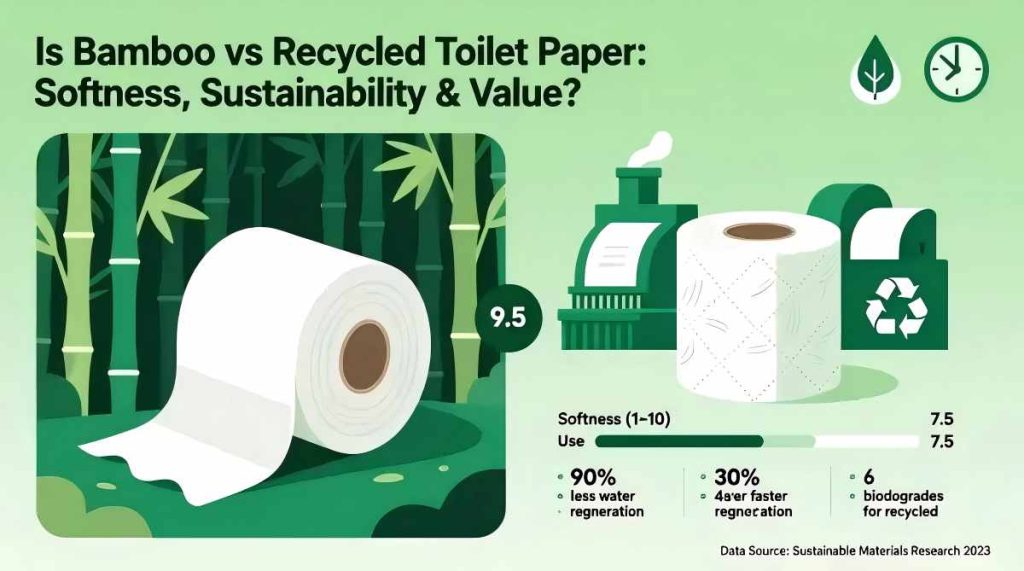
The environmental equality of the two types of toilet paper will depend on the local energy infrastructure. In 2026, most of the Asian bamboo mills will feature on-site biomass boilers, which will convert the lignin of the bamboo and its processing byproducts into steam and power. The result is a self-contained thermodynamic loop. While the European and American recycled paper mills will keep depending on energy grids that are predominantly based on natural gas or coal, the carbon footprint of one ton of recycled paper will be higher than that of bamboo toilet paper.
Chemical Processing and Toxicology: BPA and PFAS Risks
In the realm of hygiene in 2026, the concept of “toxic load” in substrates becomes prominent. Recycled paper comes from post-consumer substrates such as thermal receipts, magazines, and chemically treated office papers, all of which are notorious for their BPA and PFAS content.
- Recycled Fiber Processing: Needs extensive deinking, together with surfactants and bleach to remove the traces of ink and to get a standard level of whiteness. It is not easy to remove endocrine disruptors such as Bisphenol A during recycling.
- Bamboo Fiber Processing: As a virgin material, bamboo does not contain post-consumer contaminants. Leading manufacturers utilize Totally Chlorine-Free (TCF) bleaching processes. This eliminates the formation of dioxins and other chlorinated organic compounds.
| Technical Metric (2026) | Premium Bamboo Tissue | Post-Consumer Recycled Tissue |
| BPA/PFAS Residue | Non-detectable | Trace to moderate levels |
| Average Fiber Length | 1.5 – 2.5 mm | 0.5 – 1.0 mm |
| Bleaching Method | TCF (Totally Chlorine-Free) | PCF (Processed Chlorine-Free) |
| Tensile Index (MD) | 25 – 30 Nm/g | 12 – 18 Nm/g |
Analysis of Why Is Bamboo Toilet Paper So Expensive
The unit price of bamboo toilet paper is consistently higher than recycled or standard wood pulp options. This price disparity is the result of several fixed and variable costs:
- Economies of Scale: The wood pulp industry has a century’s worth of infrastructure built up. Bamboo pulping infrastructure is in an upscaling stage with higher capital expenditure (CapEx) per tonne.
- Specialized Processing: Bamboo contains more silica than wood and thus requires specialised equipment to protect machinery from abrasion during pulping.
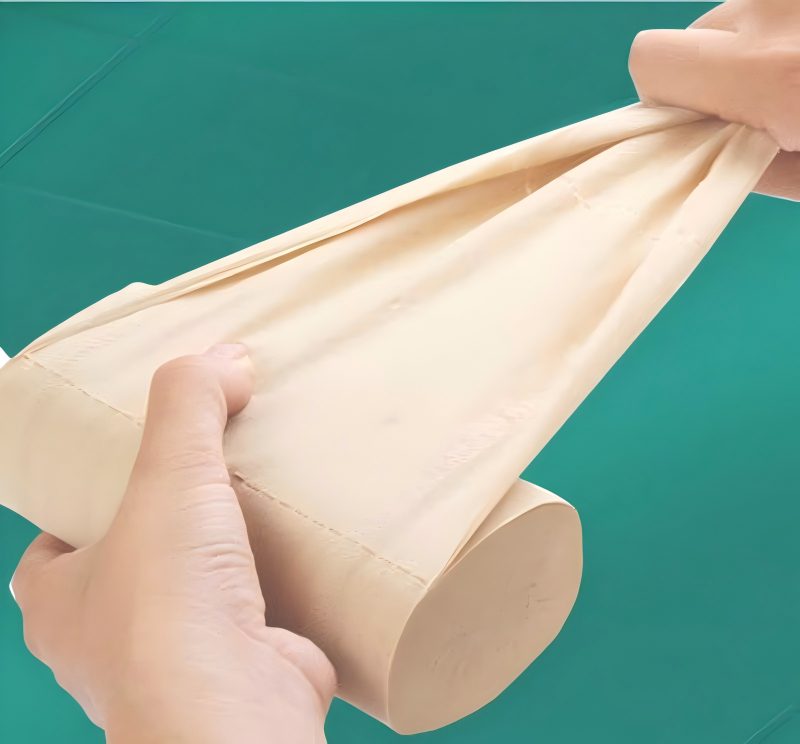
- Fiber Density: Bamboo fibre has high tensile strength, which facilitates the manufacturing of 3-ply or 4-ply tissue that does not tear in use.
To evaluate the actual cost to the consumer, the “cost per wipe” metric must be used. Owing to the absorbent capacity and strength properties of bamboo, tests conducted in laboratories reveal that users require 20%-25% fewer sheets per usage than those required from low-tensile recycled paper.
Considering the usage rate, the difference in price between bamboo and recycled paper reduces considerably, as the relatively high price is due to the relatively higher concentration of effective fibers per roll of paper
Industrial Application and Scenario Selection
The selection of a tissue substrate in 2026 should be based on specific operational requirements:
- Scenario A: High-Traffic Facilities. For environments where plumbing maintenance is a primary concern, recycled paper may be selected due to its rapid disintegration rates. However, this often results in higher volume consumption.
- Scenario B: Premium Hospitality and Healthcare. In sectors where skin sensitivity and environmental certifications are prioritized, bamboo toilet paper is the standard. Its hypoallergenic properties and TCF status meet the requirements of clinical and luxury environments.
Technical FAQ for 2026 Procurement
Q1: Does bamboo harvesting impact the habitat of endangered species?
A1: No. The industrial extraction of bamboo is done from “clumping” bamboo plants, including Dendrocalamus and Phyllostachys edulis (Mosso), which differ from the bamboo that is eaten by the giant pandas. Also, the plantations of these bamboos usually exist on land that cannot support primary forests.
Q2: Is bamboo paper compatible with septic systems?
A2: Yes. Technical specifications for bamboo tissue in 2026 ensure that the product meets the rapid-dissolve standards required for septic safety. The long fibers are processed to break down efficiently when saturated with water and subjected to mechanical agitation.
Q3: How does the 2026 carbon tax impact the price of bamboo tissue?
A3: With regard to the CBAM and other related schemes, taxes are levied according to the carbon contained in the product. The tax on bamboo is likely to be reduced as the bamboo production sites shift to 100 percent renewable energy.