Bamboo Toilet Paper in 2026: How to Made It Soft, Safe, and Skin-Friendly
For years, bamboo toilet paper carried a stubborn reputation: environmentally friendly, yes—but stiff, rough, and better in theory than in real life. Many consumers associated bamboo fiber toilet paper with a “sandpaper feel,” choosing traditional wood pulp alternatives whenever comfort mattered more than sustainability.
In 2026, that perception no longer holds. Thanks to major breakthroughs in fiber engineering, multi-layer structure design, and chemical-free processing, bamboo toilet paper has evolved into a genuinely soft, skin-friendly, and high-performance option. Today’s products compete directly with premium wood pulp paper—while offering superior safety and environmental benefits.
This article will explore why bamboo toilet paper becomes so soft, why it is increasingly favored by people with sensitive skin, and how modern design has addressed the long-standing concerns regarding flushing performance.
Why Did Bamboo Toilet Paper Feel Hard Before
To understand this transformation, start with the materials themselves. Bamboo fiber is naturally longer and stronger than traditional wood pulp fiber. This structure gives bamboo toilet paper its excellent tensile strength, which is why early bamboo products were so sturdy and did not tear easily.
However, strength came at a cost. Long fibers lack the natural loft and air retention found in wood pulp, resulting in a flatter, denser sheet. Early toilet paper manufacturers often adopted very few processing methods to maintain the “natural” image of bamboo, which unintentionally strengthened people’s stereotype that bamboo toilet paper was not soft enough.
By 2026, toilet paper manufacturers will no longer view the softness of bamboo as a marketing issue, but as a technical challenge.
How 2026 Bamboo Toilet Paper Became Soft
1. Air-Pocket Technology and Micro-Embossing
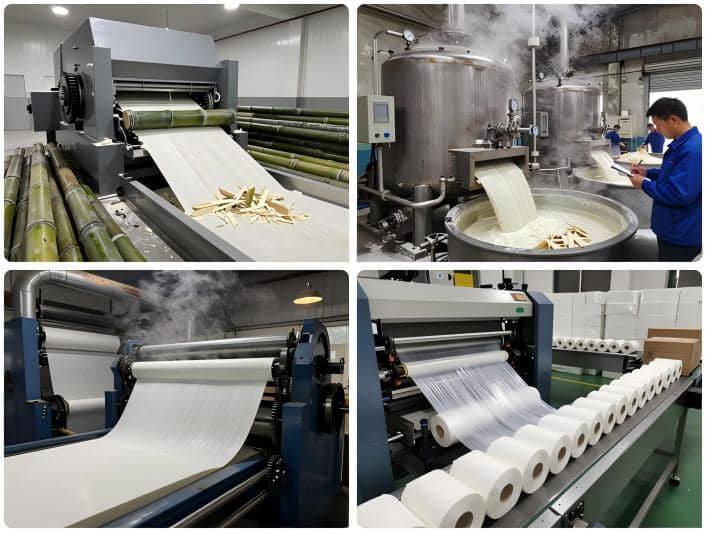
One of the most important innovations behind soft bamboo toilet paper is advanced air-pocket technology. Modern multi-layer bamboo-based toilet paper no longer relies solely on layering to achieve effects. Instead, manufacturers use micro-embossing technology to create tiny air pockets between sheets of paper.
These air pockets act like built-in cushions:
- Increased thickness without added weight
- Better rebound after pressure
- A noticeably softer, more elastic touch
The result is that this bamboo toilet paper has a touch that is more similar to high-quality wood pulp paper – while still retaining the durability of bamboo.
2. Mechanical Softening Without Chemicals
Another significant change is the widespread application of mechanical softening processes. Manufacturers will no longer use chemical softeners might irritate the skin, but scraping and crinkling technology with high precision.
This approach:
- Breaks fiber rigidity at a microscopic level
- Improves flexibility and surface smoothness
- Preserves a PFAS-free toilet paper profile
The mechanical softening treatment enables bamboo toilet paper to provide a comfortable experience while maintaining safety, making it highly suitable for daily use and for people with sensitive skin.
3. Blended Fiber Formulas: Bamboo + Sugarcane
An emerging trend in 2026 is bamboo sugarcane fiber toilet paper. The sugarcane fibers are naturally shorter and softer, complementing the toughness of bamboo.
Blended formulas:
- Improve initial softness and skin feel
- Retain bamboo’s tear resistance
- Reduce the need for heavy processing
This innovation reflects a broader trend of transformation, shifting from merely focusing on the purity of fibers to optimizing the material itself, especially in high-end products and those targeted at the household market.
Why Bamboo Toilet Paper Is Better for Sensitive Skin
1. PFAS-Free and TCF Processing
Safety has become a top priority for modern consumers. In 2026, shoppers are increasingly aware of PFAS (per- and polyfluoroalkyl substances)—often called “forever chemicals”—and their potential health risks.
Leading bamboo toilet paper brands address this concern by offering:
- PFAS-free toilet paper
- TCF bamboo toilet paper (Totally Chlorine Free)
- Unbleached bamboo toilet paper options
These features are especially important for people with eczema, dermatitis, or babies with delicate skin.
2. Bamboo Kun: Natural Antibacterial Protection
One of the significant advantages of bamboo is the bamboo kun – a naturally occurring antibacterial component that exists within bamboo fibers. Unlike synthetic antibacterial additives, bamboo ketal is a passive agent that does not disrupt the natural balance of the skin.
Benefits include:
- Natural odor control
- Reduced bacterial growth
- Enhanced suitability for feminine care and hygiene
This makes antibacterial bamboo toilet paper increasingly popular among health-conscious consumers.
3. Dermatologically Tested: From Claims to Proof
In 2026, “hypoallergenic” claims alone are no longer enough. Many premium brands now offer dermatologically tested toilet paper, verified through third-party skin testing.
This shift has enabled bamboo toilet paper to enter:
- Pharmacies and drugstores
- High-end baby care shops
- Sensitive skin and medical-grade hygiene categories
Trust is no longer built on marketing—it is built on data.
Flushability: Does Bamboo Toilet Paper Clog Toilets?
Because bamboo fibers are strong, many consumers worry about plumbing issues. In response, manufacturers now emphasize flushable bamboo toilet paper through transparent testing.
Modern products demonstrate:
- Rapid fiber dispersion in water
- Full breakdown within 30 seconds
- Compatibility with septic systems
Through toilet paper flushability tests, brands visually prove that strength does not mean poor dissolvability. Today’s bamboo toilet paper is both durable and septic-safe.
Bamboo vs Wood Pulp Toilet Paper in 2026
| Feature | Bamboo Toilet Paper | Wood Pulp Toilet Paper |
| Softness | High (air-pocket & mechanical softening) | High |
| Chemical Residue Risk | Very low (PFAS-free, TCF) | Moderate (varies by brand) |
| Sensitive Skin Suitability | Excellent | Good |
| Antibacterial Properties | Natural (bamboo kun) | Typically none |
| Environmental Impact | Rapidly renewable | Tree-dependent |
| Flushability | Fast dissolving, septic safe | Fast dissolving |
In 2026, bamboo toilet paper is no longer a compromise—it is a competitive upgrade.
Who Is Bamboo Toilet Paper For?
Bamboo toilet paper is perfect for anyone who values softness, safety, and sustainability.
- For sensitive and eczema prone skin: no perfluorinated compounds, chlorine-free bleaching or non-bleaching processes help reduce irritation, while mechanically softening fibers reduce friction on delicate skin.
- For infants and home users: Free of harsh chemicals, fragrances and brighteners – mild enough for infants and everyday home use.
- For women’s private care: The natural antibacterial bamboo fiber kun can effectively control odor and maintain skin balance, which is very suitable for menstrual, pregnancy and postpartum care.
- For clean label consumers: Engineering softness through fibers — not chemical softeners — is perfect for those who avoid unnecessary additives.
- For environmentally conscious consumers: Made from rapidly renewable bamboo, it has a lower environmental footprint without sacrificing softness or strength.
Frequently Asked Questions
Q1: Is bamboo toilet paper really soft in 2026?
Yes. Advances in air-pocket technology and mechanical softening have made modern bamboo toilet paper comparable to premium wood pulp options.
Q2: Is bamboo toilet paper safe for sensitive skin?
Absolutely. PFAS-free processing, bamboo kun antibacterial properties, and dermatological testing make it ideal for sensitive skin.
Q3: Does bamboo toilet paper dissolve in water?
Yes. High-quality bamboo toilet paper is fast-dissolving and septic safe.
Q4: Can bamboo toilet paper be used with septic systems?
Yes, most modern bamboo toilet paper is explicitly labeled septic safe.